

Add, Subtract, Divide, Multiply: MHSAA Not Alone
July 25, 2017
By Rob Kaminski
MHSAA benchmarks editor
This is the third part in a series on MHSAA tournament classification, past and present, that will be published over the next two weeks. This series originally ran in this spring's edition of MHSAA benchmarks.
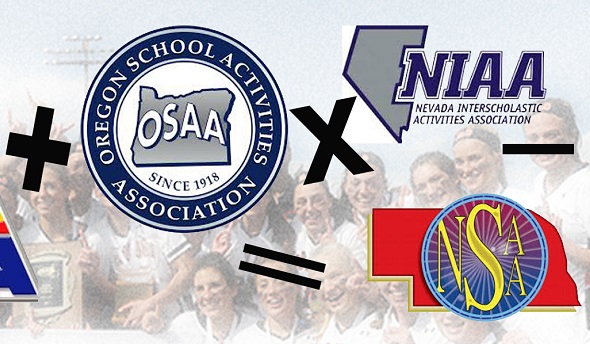
As the MHSAA faces its most recent classification task with 8-Player Football, and opinions continue to swirl about as to the method, timeframe, location and other procedures, a look around the country provides plenty of company among state association brethren factoring variables into their own equations.
In the Pacific Northwest, the Oregon School Activities Association Football Playoffs are under public scrutiny as leadership ponders a five or six classification format beginning with the 2018-19 school year.
The OSAA has crowned six champions on the gridiron since 2006-07. Many of the state’s smaller schools would like to keep it that way, while larger schools lean toward a five-classification system, citing larger leagues, ease of travel and credibility to state championships as the advantages.
Still others would prefer more than six classes, pointing to safety issues and the opportunity to increase participation numbers as positives.
Moving southeast of Oregon, the Nevada Interscholastic Activities Association recently voted to hold serve on a classification proposal that was volleyed to the membership.
However, changes still could be forthcoming by as early as the 2018-19 season which would add a fifth classification in more populated southern Nevada while allowing northern schools to participate in four classifications. Such divisions could mean no state championship for the fifth class in southern Nevada.
Because of that, the NIAA wants equal numbers of schools in each classification on both ends of the state. Complicating the issue is the fact that the 24 largest schools in the state, by enrollment, are all in Clark County in Southern Nevada.
Across Nevada’s border into Arizona, charter schools are asking the Arizona Interscholastic Association to reconsider classification that was voted upon and approved in September 2015. That agreement called for the largest 33 percent of charter schools by enrollment to be placed in the state’s largest school classification, 3A, the middle 33 percent into 2A, and the smallest 33 percent into 1A.
Less than two years later the charter schools have had a change of heart and have asked to be considered the same as other Arizona public schools and be placed appropriately by enrollment beginning with the 2018-19 school year.
The situation in Arizona further illustrates how the public/private debate that all state associations have faced throughout existence now has the added dynamic of rapidly growing charter schools in today’s educational system, along with virtual school enrollment.
In the nation’s heartland, Nebraska has retooled its football classifications by using enrollment of boys students only in its schools rather than total enrollment. The Nebraska School Activities Association football-playing schools will kick off the 2018 season using this alignment.
Nebraska has three classes of 11-player football, with the smallest class divided in two, Class C-1 and C-2. The state also will have 8-player football for boys enrollments under 47, and the NSAA will sponsor a new 6-player tournament in 2018 for schools with 27 or fewer boys.
“This is a good proposal because some schools have a sizable imbalance between the number of boys and girls, and there’s a large gap (in enrollment) between the largest and smallest schools in Classes A and B,” NSAA executive director Jim Tenopir said. “I think this addresses both of those concerns.”
Swimmers in Georgia, meanwhile, will feel like they are moving with the current, rather than upstream in 2017-18, as the Georgia High School Association recently doubled the number of team championship events from two to four.
Swim enthusiasts can also count on longer days at the finals, as the top 30 finishers from the prelims will advance to the finals instead of 20, and all championship events will have three heats versus two.
5 Ways Acupuncture Can Enhance Athletic Performance
May 9, 2023
In the ancient Chinese medicine of acupuncture, thin needles are gently inserted into specific areas of the body, stimulating blood flow to speed the recovery of certain ailments.
 It can be used as a treatment for everything from headaches and unbalanced hormones to joint pain and weakened immune systems. Acupuncture is also popular among athletes, as many of them incorporate it into their wellness regimens to stay in peak physical condition.
“Back in the day, athletes ate steak, smoked cigars and drank whiskey during the week and then played football on Sunday,” says Thomas Betts, a sports medicine acupuncturist with Henry Ford Health System. “But today, to improve their performance, athletes are attacking the body from every angle possible with diet, lifestyle and exercise. NBA players, for example, have talked about how acupuncture keeps them feeling their best.”
But you don’t have to be an NBA star to reap the benefits of acupuncture. Whether you’re a professional or student athlete, or you exercise and play sports for fun or to challenge yourself, here are ways acupuncture can boost your game:
- Acupuncture can help you recover more quickly from an injury. “If a muscle is torn, acupuncture won’t put it back together, but for sprains and strains, muscle soreness and tendonitis, acupuncture can decrease inflammation and speed the healing process,” says Betts.
- Acupuncture can reduce the need for “rest days.” If you just had an intense workout and your muscles are sore, getting acupuncture afterward can loosen the muscles and decrease soreness so you don’t have to take a day off to recuperate before training again.
- Acupuncture can improve flexibility, decrease muscle tension and increase muscle activation. “This is done with motor point acupuncture,” says Betts. “The motor point is where the brain attaches to the muscle via the motor nerve. By using needles to stimulate a motor point, it is like rebooting a phone or computer that isn’t working well: Motor point acupuncture is autoregulating, in that it can deactivate a tight muscle or reactivate an inhibited or weak muscle.”
- Acupuncture can provide immediate pain relief. “Some studies show that acupuncture can provide as much as, if not more pain relief than medication,” Betts says. “It differs for everyone, and it depends on what is being treated, but some people say they feel a difference right after a session, and others say they feel better about 20 to 30 minutes later.” Pain relief can last from a few hours to a few days.
- Acupuncture can help prevent injury. Because acupuncture can reactivate weak muscles and decrease muscle tension, it can also be used as a preventative measure against injury, Betts says. But you should always still stretch before and after exercising!
Learn more about acupuncture and other integrative medicine services at Henry Ford. To make an appointment, you can request one online or by calling 1-833-246-4347.
Thomas Betts, DOAM, RAc, is a certified sports acupuncturist with Henry Ford Health. He sees patients at the Henry Ford Center for Athletic Medicine in Detroit.