

Add, Subtract, Divide, Multiply: MHSAA Not Alone
July 25, 2017
By Rob Kaminski
MHSAA benchmarks editor
This is the third part in a series on MHSAA tournament classification, past and present, that will be published over the next two weeks. This series originally ran in this spring's edition of MHSAA benchmarks.
As the MHSAA faces its most recent classification task with 8-Player Football, and opinions continue to swirl about as to the method, timeframe, location and other procedures, a look around the country provides plenty of company among state association brethren factoring variables into their own equations.
In the Pacific Northwest, the Oregon School Activities Association Football Playoffs are under public scrutiny as leadership ponders a five or six classification format beginning with the 2018-19 school year.
The OSAA has crowned six champions on the gridiron since 2006-07. Many of the state’s smaller schools would like to keep it that way, while larger schools lean toward a five-classification system, citing larger leagues, ease of travel and credibility to state championships as the advantages.
Still others would prefer more than six classes, pointing to safety issues and the opportunity to increase participation numbers as positives.
Moving southeast of Oregon, the Nevada Interscholastic Activities Association recently voted to hold serve on a classification proposal that was volleyed to the membership.
However, changes still could be forthcoming by as early as the 2018-19 season which would add a fifth classification in more populated southern Nevada while allowing northern schools to participate in four classifications. Such divisions could mean no state championship for the fifth class in southern Nevada.
Because of that, the NIAA wants equal numbers of schools in each classification on both ends of the state. Complicating the issue is the fact that the 24 largest schools in the state, by enrollment, are all in Clark County in Southern Nevada.
Across Nevada’s border into Arizona, charter schools are asking the Arizona Interscholastic Association to reconsider classification that was voted upon and approved in September 2015. That agreement called for the largest 33 percent of charter schools by enrollment to be placed in the state’s largest school classification, 3A, the middle 33 percent into 2A, and the smallest 33 percent into 1A.
Less than two years later the charter schools have had a change of heart and have asked to be considered the same as other Arizona public schools and be placed appropriately by enrollment beginning with the 2018-19 school year.
The situation in Arizona further illustrates how the public/private debate that all state associations have faced throughout existence now has the added dynamic of rapidly growing charter schools in today’s educational system, along with virtual school enrollment.
In the nation’s heartland, Nebraska has retooled its football classifications by using enrollment of boys students only in its schools rather than total enrollment. The Nebraska School Activities Association football-playing schools will kick off the 2018 season using this alignment.
Nebraska has three classes of 11-player football, with the smallest class divided in two, Class C-1 and C-2. The state also will have 8-player football for boys enrollments under 47, and the NSAA will sponsor a new 6-player tournament in 2018 for schools with 27 or fewer boys.
“This is a good proposal because some schools have a sizable imbalance between the number of boys and girls, and there’s a large gap (in enrollment) between the largest and smallest schools in Classes A and B,” NSAA executive director Jim Tenopir said. “I think this addresses both of those concerns.”
Swimmers in Georgia, meanwhile, will feel like they are moving with the current, rather than upstream in 2017-18, as the Georgia High School Association recently doubled the number of team championship events from two to four.
Swim enthusiasts can also count on longer days at the finals, as the top 30 finishers from the prelims will advance to the finals instead of 20, and all championship events will have three heats versus two.
Brighton Names Baseball Field for Program Builder, Longtime Leader
By
Tim Robinson
Special for MHSAA.com
May 4, 2023
BRIGHTON — Mark Carrow didn’t know what to expect April 22 when he arrived at Brighton High School’s baseball field, where he was the guest of honor for a ceremony officially naming it Carrow Field.
 “I remember back in October, when they announced this would happen, I told my wife, Mary, that there will be probably 60-70 people here, because there are 18 players on each team and their parents,” he recalled. “We pulled up here and there were all these people, and these young men who look older now.”
Dozens of Brighton alumni, some of whom Carrow hadn’t seen since their high school days nearly a half-century ago, were in attendance for the ceremony held before a doubleheader with Ypsilanti Lincoln.
Carrow retired in 2006 after 34 seasons as Brighton’s baseball coach, recording 823 wins, now eighth on the state’s all-time list. He also was an assistant football coach and coached both boys and girls middle school basketball.
He came to Brighton a year after graduating from the University of Michigan, where he played baseball for the Wolverines, starring at third base.
“My dream was to coach baseball at Ann Arbor High,” Carrow said of his high school alma mater, now Ann Arbor Pioneer. “That was my dream.”
But he had applied to Brighton Area Schools as well, and after a year teaching in Grand Rapids, he and Mary both were offered teaching positions.
“Wouldn’t you know it? We were in school for two days and Ann Arbor calls me up,” Carrow said. “They had a phys ed job open. I’d have been the JV football coach, and I knew the baseball coach was on his way out. It was everything I wanted, and I went to (administrator) Bob Scranton and said, ‘Here’s what’s happening.’ He told me to think about it over the weekend and come back Monday.
“My wife and I talked it over, and we were so grateful to Brighton for giving us a chance to be near our hometown that we felt we owed them a year,” Carrow said. “In November, we bought a house that we lived in for 22 years.”
Brighton’s sports teams weren’t the dominant squads of today. The football team had had two winning seasons in 20 years, and the year Carrow arrived went 0-9.
“We played in six homecoming games, including our own,” he said. “Everyone wanted to play us.”
The baseball team wasn’t much better, having gone decades without a winning season.
But the Bulldogs were 12-12 that first spring under Carrow’s leadership, and never finished below .500 during the rest of his tenure.
 The Bulldogs joined the Southeastern Conference the next year and got off to a 7-0 start before losing at Lincoln.
“The kids were crying on the bus ride home,” Carrow said, “and I knew right then that Brighton had turned a corner, that it meant something to win and losing wasn’t acceptable anymore.”
Brighton took off, winning 20 games or more in all of his last 23 years as a coach, and a total of 13 league titles, 12 District titles, three Regional crowns and while making two trips to the Semifinals.
The talent was there, too, including 16 all-state players and two Mr. Baseball Award winners in Ron Hollis and Drew Henson.
Carrow earned national and Michigan Coach of the Year honors three times apiece and was inducted into the Michigan High School Baseball Coaches Hall of Fame in 1992.
The field was renamed in his honor after the Brighton school board changed its policy to allow the renaming of facilities to honor living persons less than two years ago.
But Carrow is quick to cite the reasons for his success.
“The players are the ones who made this possible,” he said. “I mean that from the bottom of my heart. I never threw a pitch or hit the baseball. I got 800 wins, but it was because of them.
Carrow has a photographic memory, which came in handy while chatting with former players.
“It was funny, because with each kid I remembered an incident about them,” he said. “Jeff Bogos, who I hadn’t seen since he graduated in 1979, came out and I said, ‘Do you remember when we were at Milan and your knee went out (of place) in the middle of the field?’ It happened twice. He said, ‘How do you remember that?’ And I said, ‘How could I not?’”
Carrow moved to Florida after his retirement, where he and his longtime assistant, George Reck, meet up a couple of times a week. He makes frequent trips north to watch U-M football and to visit his son, Chris, who lives in Chicago.
Baseball is firmly in his past.
“I think I’ve been to one high school game since I went down there,” Carrow said. “I hated the way the coach was coaching, and Mary did, too. She said, ‘We don’t have to watch any more high school baseball,’ and I said, ‘You’re right.’”
When he retired, Carrow said he would likely be forgotten in a few years.
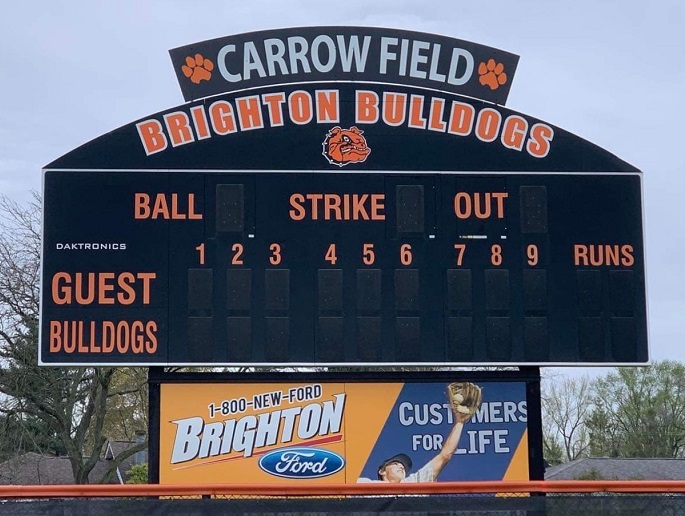
Seventeen years later, his legacy is assured and his memory will be invoked any time one looks at the scoreboard in left-center field that has a “Carrow Field” sign on top of it.
Not bad for a coach who was in the right place at the right time.
“My dream was fulfilled, and rightly so,” Carrow said. “And, believe me, I made the right decision. I couldn't have had better kids to teach or lived in a better community. It couldn't have worked out any better.”
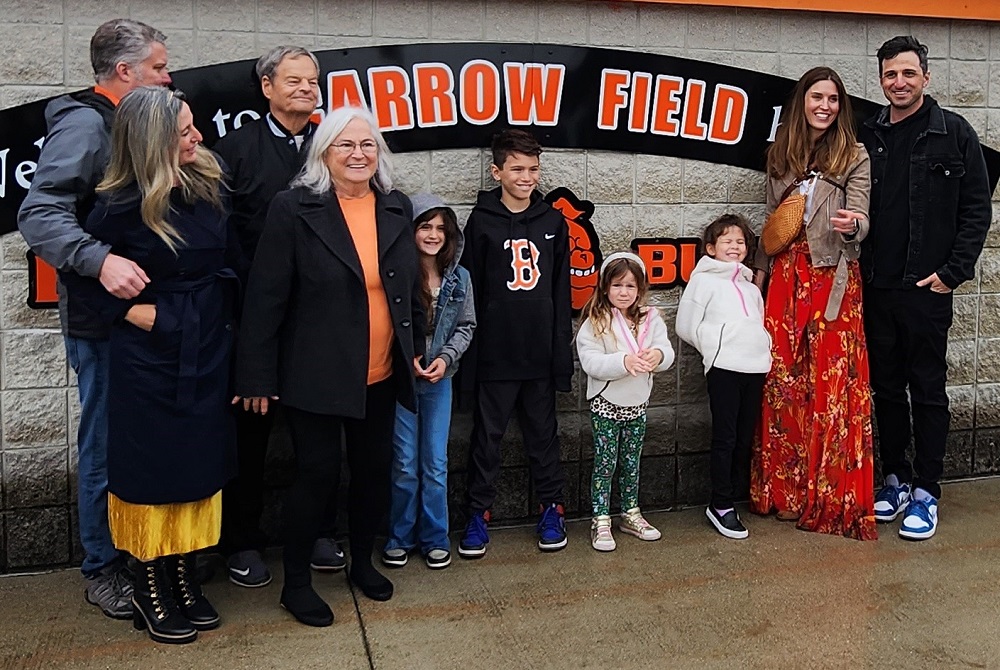
PHOTOS (Top) The Carrow family stands together in front of the welcome sign to Carrow Field – including daughter Tiffany (front left), Mark and Mary (second from left, front and back) and son Chris (far right). (Middle) The Carrow name stands tall atop the scoreboard at the field named for the longtime coach. (Family photo by Daniel Collins.)