

Add, Subtract, Divide, Multiply: MHSAA Not Alone
July 25, 2017
By Rob Kaminski
MHSAA benchmarks editor
This is the third part in a series on MHSAA tournament classification, past and present, that will be published over the next two weeks. This series originally ran in this spring's edition of MHSAA benchmarks.
As the MHSAA faces its most recent classification task with 8-Player Football, and opinions continue to swirl about as to the method, timeframe, location and other procedures, a look around the country provides plenty of company among state association brethren factoring variables into their own equations.
In the Pacific Northwest, the Oregon School Activities Association Football Playoffs are under public scrutiny as leadership ponders a five or six classification format beginning with the 2018-19 school year.
The OSAA has crowned six champions on the gridiron since 2006-07. Many of the state’s smaller schools would like to keep it that way, while larger schools lean toward a five-classification system, citing larger leagues, ease of travel and credibility to state championships as the advantages.
Still others would prefer more than six classes, pointing to safety issues and the opportunity to increase participation numbers as positives.
Moving southeast of Oregon, the Nevada Interscholastic Activities Association recently voted to hold serve on a classification proposal that was volleyed to the membership.
However, changes still could be forthcoming by as early as the 2018-19 season which would add a fifth classification in more populated southern Nevada while allowing northern schools to participate in four classifications. Such divisions could mean no state championship for the fifth class in southern Nevada.
Because of that, the NIAA wants equal numbers of schools in each classification on both ends of the state. Complicating the issue is the fact that the 24 largest schools in the state, by enrollment, are all in Clark County in Southern Nevada.
Across Nevada’s border into Arizona, charter schools are asking the Arizona Interscholastic Association to reconsider classification that was voted upon and approved in September 2015. That agreement called for the largest 33 percent of charter schools by enrollment to be placed in the state’s largest school classification, 3A, the middle 33 percent into 2A, and the smallest 33 percent into 1A.
Less than two years later the charter schools have had a change of heart and have asked to be considered the same as other Arizona public schools and be placed appropriately by enrollment beginning with the 2018-19 school year.
The situation in Arizona further illustrates how the public/private debate that all state associations have faced throughout existence now has the added dynamic of rapidly growing charter schools in today’s educational system, along with virtual school enrollment.
In the nation’s heartland, Nebraska has retooled its football classifications by using enrollment of boys students only in its schools rather than total enrollment. The Nebraska School Activities Association football-playing schools will kick off the 2018 season using this alignment.
Nebraska has three classes of 11-player football, with the smallest class divided in two, Class C-1 and C-2. The state also will have 8-player football for boys enrollments under 47, and the NSAA will sponsor a new 6-player tournament in 2018 for schools with 27 or fewer boys.
“This is a good proposal because some schools have a sizable imbalance between the number of boys and girls, and there’s a large gap (in enrollment) between the largest and smallest schools in Classes A and B,” NSAA executive director Jim Tenopir said. “I think this addresses both of those concerns.”
Swimmers in Georgia, meanwhile, will feel like they are moving with the current, rather than upstream in 2017-18, as the Georgia High School Association recently doubled the number of team championship events from two to four.
Swim enthusiasts can also count on longer days at the finals, as the top 30 finishers from the prelims will advance to the finals instead of 20, and all championship events will have three heats versus two.
Team of the Month: Croswell-Lexington Competitive Cheer
By
Geoff Kimmerly
MHSAA.com senior editor
April 14, 2023
The Croswell-Lexington competitive cheer team had finished fourth, fifth and fourth, respectively over the last three Division 3 Finals as this season began in November with more high expectations – but also the annual challenge of believing those could be attained.
 Competing in the same Blue Water Area Conference as Richmond, the Pioneers are more familiar than most with the program that entered the season coming off a fourth-straight Division 3 title. And as a regular at Finals weekend, Cros-Lex also is plenty aware of the power of Pontiac Notre Dame Prep, the only other team besides Richmond to win a Division 3 championship between 2012-22.
But during the Pioneers’ first competition this winter, coach Katie Tomlinson knew this could be the team to rise above that history and make some of its own.
Cros-Lex finished fifth of 18 at the Jan. 6 Richmond Invitational, but second in Division 3 to only the host Blue Devils, and with scores including a D3-best 309.30 in Round 3.
“For our first competition, (we had) some of our best scores we’ve ever received – and typically our first competition is really tough for us. So that was kind of a turning point,” Tomlinson said. “Just the confidence they had that first night, competing for the first time, it was just a shift.”
That shift provided early momentum as Cros-Lex made one of the most impressive championship moves in any winter sport this season.
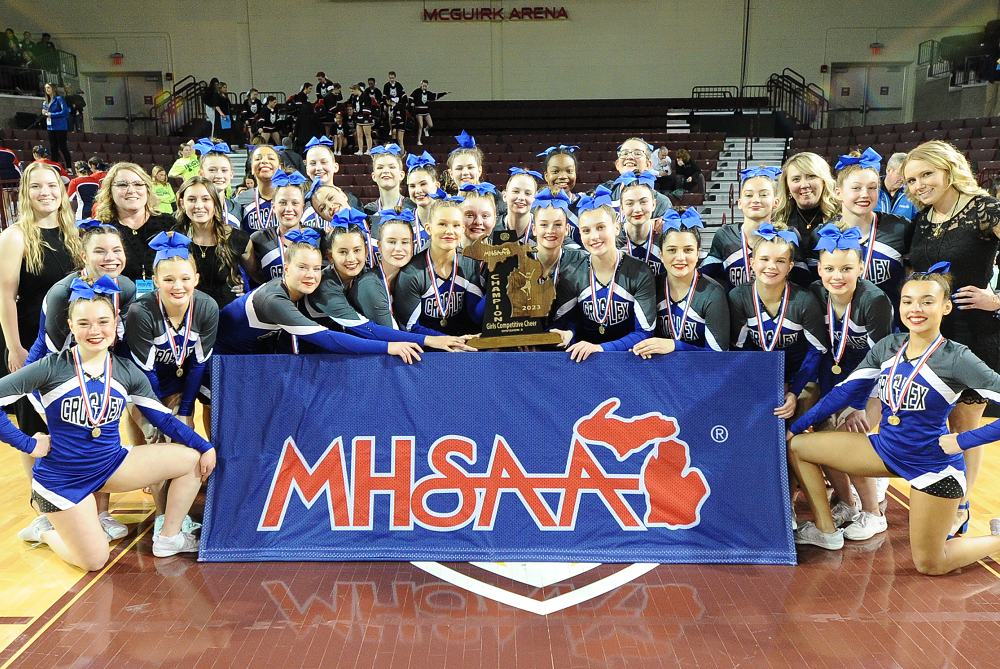
The Pioneers are the MHSAA/Applebee’s “Team of the Month” for March after finishing their season as MHSAA Finals champions in the sport for the first time, overcoming a 1.24-point deficit to Richmond after Round 2 to win the Division 3 title at Central Michigan University’s McGuirk Arena.
Croswell-Lexington finished with three-round score of 776.72, seven-tenths of a point better than runner-up Notre Dame Prep and with nearly two points more than the Blue Devils. The Pioneers launched into the lead with a 314.50 in Round 3, the second-best score for that round in the competition.
“I think that it was such a shock for them in the moment and so exciting and rewarding,” Tomlinson recalled this week, “but it definitely was the work put in, just like every other team, and believing in themselves and just going out there and doing what we always do and what we’d worked hard for and what we’d put in that time and effort for – and just watching it pay off. It was kind of a mix of just really believing in ourselves – it’s been a challenge for a few years now building up that confidence to know that they are a team that’s worthy of a state championship and then proving that. They earned it.”
And it was truly a team effort. Cros-Lex had 28 athletes, and only one of the other 31 teams across four divisions at the Finals – Division 1 Grandville with 30 – had more on the roster. Of those 28, 22 competed in at least one round at CMU. Juniors Alexis Bales, Cora Katulski, Shelby Oliver and Makayla Rice and sophomore Carly Old competed in all three rounds, while seniors Noelle Golda, Santanna Horning and Emma Six and sophomores Larkin Krohn, Niah Krohn, Kaleigh Kelch and Addyson Sharpe competed in two rounds. Seniors Cassidy Seaman, Deborahann White, Maria Tabernero and Alleyna Martinez; junior Grace Hodges, sophomores Emma Yearkey, Madison Greenaway, Maggie Wallace and Addison Gardner; and freshman Chelsea Miller also took the mat.
Oliver, Katulski, Rice, Bales, Old and Kelch made the all-state first team. Wallace, Hodges and Sharpe made the second team, and Six, Horning and Golda earned honorable mentions.
Cros-Lex had finished second to Richmond in the BWAC and second to Notre Dame Prep at their District before finishing third to both at the Regional. The Pioneers had never finished higher than fourth at a Final.
“We are up against (Richmond) quite a bit and I’m super close with Kelli (Blue Devils coach Kelli Matthes) … and honestly, we enjoy going to the competitions that have those teams that have won on that stage,” said Tomlinson, who has been part of the Pioneers cheer program since seventh grade beginning as an athlete and including the last eight seasons as head coach. “It sure pushes us further to be better and keep improving instead of staying satisfactory.
“It does make it hard when you’re up against such powers for years where they take it every single year. It makes the girls second-guess themselves and their capabilities, so that was a big thing that we started back in June for sideline and tried since to implement every day – the confidence and the belief in ourselves that even though they’re great, we are too.”
Past Teams of the Month, 2022-23
February: Hart girls & boys basketball - Report
January: Taylor Trillium Academy girls bowling - Report
December: Byron Center hockey - Report
November: Martin football - Report
October: Gladwin volleyball - Report
September: Negaunee girls tennis - Report