


Add, Subtract, Divide, Multiply: MHSAA Not Alone
July 25, 2017
By Rob Kaminski
MHSAA benchmarks editor
This is the third part in a series on MHSAA tournament classification, past and present, that will be published over the next two weeks. This series originally ran in this spring's edition of MHSAA benchmarks.
As the MHSAA faces its most recent classification task with 8-Player Football, and opinions continue to swirl about as to the method, timeframe, location and other procedures, a look around the country provides plenty of company among state association brethren factoring variables into their own equations.
In the Pacific Northwest, the Oregon School Activities Association Football Playoffs are under public scrutiny as leadership ponders a five or six classification format beginning with the 2018-19 school year.
The OSAA has crowned six champions on the gridiron since 2006-07. Many of the state’s smaller schools would like to keep it that way, while larger schools lean toward a five-classification system, citing larger leagues, ease of travel and credibility to state championships as the advantages.
Still others would prefer more than six classes, pointing to safety issues and the opportunity to increase participation numbers as positives.
Moving southeast of Oregon, the Nevada Interscholastic Activities Association recently voted to hold serve on a classification proposal that was volleyed to the membership.
However, changes still could be forthcoming by as early as the 2018-19 season which would add a fifth classification in more populated southern Nevada while allowing northern schools to participate in four classifications. Such divisions could mean no state championship for the fifth class in southern Nevada.
Because of that, the NIAA wants equal numbers of schools in each classification on both ends of the state. Complicating the issue is the fact that the 24 largest schools in the state, by enrollment, are all in Clark County in Southern Nevada.
Across Nevada’s border into Arizona, charter schools are asking the Arizona Interscholastic Association to reconsider classification that was voted upon and approved in September 2015. That agreement called for the largest 33 percent of charter schools by enrollment to be placed in the state’s largest school classification, 3A, the middle 33 percent into 2A, and the smallest 33 percent into 1A.
Less than two years later the charter schools have had a change of heart and have asked to be considered the same as other Arizona public schools and be placed appropriately by enrollment beginning with the 2018-19 school year.
The situation in Arizona further illustrates how the public/private debate that all state associations have faced throughout existence now has the added dynamic of rapidly growing charter schools in today’s educational system, along with virtual school enrollment.
In the nation’s heartland, Nebraska has retooled its football classifications by using enrollment of boys students only in its schools rather than total enrollment. The Nebraska School Activities Association football-playing schools will kick off the 2018 season using this alignment.
Nebraska has three classes of 11-player football, with the smallest class divided in two, Class C-1 and C-2. The state also will have 8-player football for boys enrollments under 47, and the NSAA will sponsor a new 6-player tournament in 2018 for schools with 27 or fewer boys.
“This is a good proposal because some schools have a sizable imbalance between the number of boys and girls, and there’s a large gap (in enrollment) between the largest and smallest schools in Classes A and B,” NSAA executive director Jim Tenopir said. “I think this addresses both of those concerns.”
Swimmers in Georgia, meanwhile, will feel like they are moving with the current, rather than upstream in 2017-18, as the Georgia High School Association recently doubled the number of team championship events from two to four.
Swim enthusiasts can also count on longer days at the finals, as the top 30 finishers from the prelims will advance to the finals instead of 20, and all championship events will have three heats versus two.
'Ultimate Competitor' Collins Catalyzing Blissfield's Championship Pursuit
By
Doug Donnelly
Special for MHSAA.com
March 7, 2023
BLISSFIELD – Avery Collins has played with a broken nose, ankle sprain and a sore back.
 Earlier this season, the Blissfield junior was in the emergency room one night and on the basketball floor the next day.
“She texted me first thing in the morning and said, ‘I’m ready to play Coach,’” said Royals head coach Ryan Gilbert. “I said, ‘No, you’re not.’ She was cleared to play, so she played. It’s hard to tell her no.”
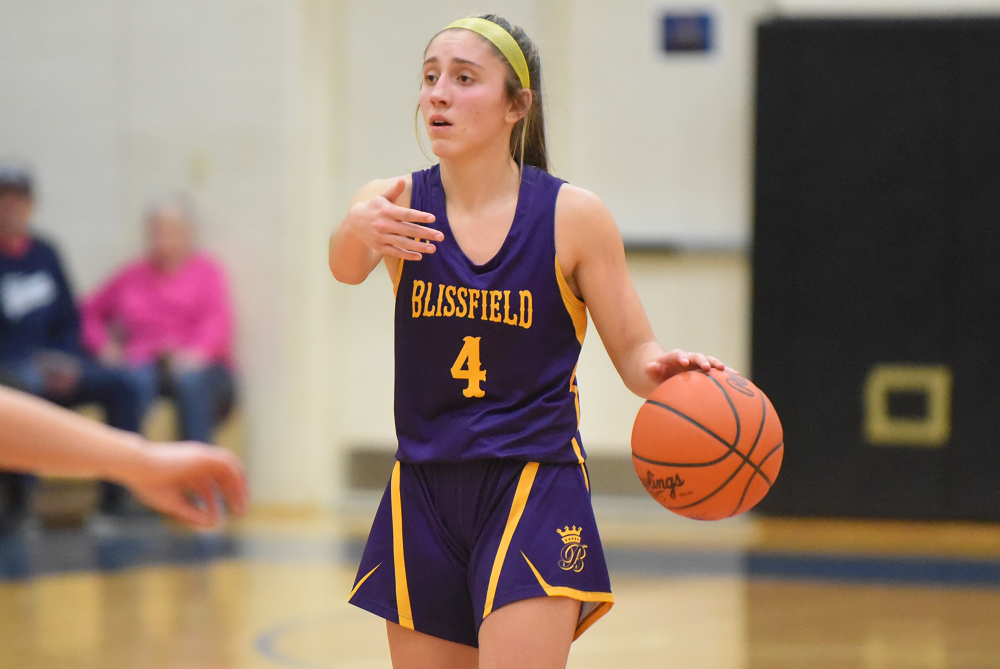
Collins is the catalyst behind Blissfield’s 23-1 record heading into tonight’s Division 3 Regional Semifinal against Hanover-Horton at Concord. Already a three-year starter, Collins is a ballhawk on defense, expert dribbler on offense and a competitor all the way.
“I’m constantly talking basketball with people, either my dad, my coach, or even family friends,” Collins said. “I want to make this season so memorable and with the team we have, I knew it was possible.”
When it comes to intensity, Collins has an extra gear. Opposing coaches quickly recognize that.
“Avery is hands down the best player on the court night-in and night-out,” said Onsted head coach Brandon Arnold. “She’s tough. She does so many things for them.”
Blissfield started the season 7-0 before being tripped up by Grand Blanc in the Motor City Roundball Classic. The Royals haven’t lost since, running off 16 straight wins, including in the District championship game Saturday.
Defense has been the key.
Opponents are averaging just 26.5 points a game against the Royals. Seven opponents have scored 21 or fewer points.
Offensively, Blissfield averages four 3-pointers a game, shoots 60 percent from the free throw line and has four players with at least 150 points on the season.
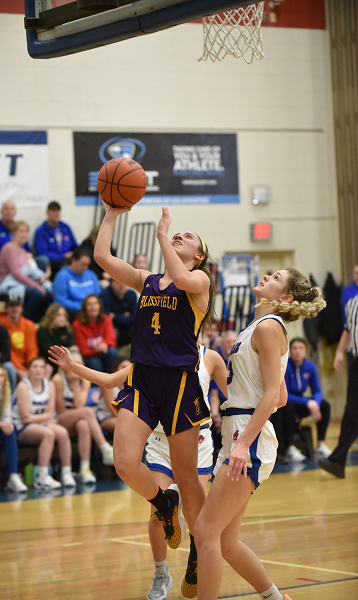
Collins averages 11.0 points, 3.0 rebounds, 4.5 assists and 4.0 steals a game. She’s sat out several fourth quarters this season as the Royals have had big leads. In the District Semifinal against Erie Mason, she didn’t see the court in the second half.
 Gilbert said she sits out more fourth quarters than she would like, but she also knows it makes the team stronger the more experience others get.
“What you wouldn't know if you don't come watch her play is how her energy transfers to the rest of the team and the crowd,” Gilbert said. “Her grit and determination rubs off on everyone around her. I can’t tell you how many times the opponent turns it over because of her defensive pressure. She has pieces around her. She doesn't have to score 20 a game for this team to be successful. She could, but she doesn't have to.”
If the game is close, the ball is in her hands. She shoots 70 percent from the free throw line and has become quite adept at dribbling away from opponents so they can’t foul her with the clock winding down.
“She has the ability to change a game without scoring,” Gilbert said.
Collins missed her AAU season this past summer due to a collarbone injury sustained during soccer season. She missed the early part of soccer with a broken nose that happened in basketball, although she never missed time on the court for it.
The downtime, she said, helped keep her motivated when she was able to get a ball in her hands again.
“I was extra ready to get back,” she said. “We all knew what this team could have in store this season, and that made me want to get better even more.”
Collins put in a lot of work to get ready for this season. Her shooting has improved. She’s made 22 triples, but the bulk of her points come on steals and layups.
“Before the season, my dad and I were doing a strength and conditioning workout almost every night, then after the workout, I’d go shoot at least 500 shots in the gym,” she said. “My dad has pushed me to be the best me that I can be. I’m always looking to put the work in to be better, because not only does it make me better, but it also helps my team as well.”
The Royals have just two seniors, 6-footers Julia White (10.0 points and 10.0 rebounds a game) and Sarah Bettis, a Division 1 volleyball signee with the University of Akron. June Miller leads the team in 3-pointers with 32, and Abrie Louden has been steady all season at both ends of the floor. Freshman Leigh Wyman and sophomore Peyton Tennant have come off the bench all season, ready to provide a spark, especially on defense. The combination has the Royals tied for the lead in Division 3 with 23 wins and ranked No. 3 in the final Associated Press poll.
“Coming into this season, we knew we’d have a real shot at getting the league title,” Collins said. “I believe we will carry this energy as far as we get because of what our possible outcomes are in the state tournament.”
The Royals play well together. They average about 19 field goals made a game – and 14 assists.
Gilbert, in his 15th season as Blissfield coach, calls Collins the ultimate competitor.
“She has a fiery chip on her shoulder,” he said. “She plays her best during the biggest of games. There is an edge about her that few have. She's just wired differently.”
 Doug Donnelly has served as a sports and news reporter and city editor over 25 years, writing for the Daily Chief-Union in Upper Sandusky, Ohio from 1992-1995, the Monroe Evening News from 1995-2012 and the Adrian Daily Telegram since 2013. He's also written a book on high school basketball in Monroe County and compiles record books for various schools in southeast Michigan. E-mail him at [email protected] with story ideas for Jackson, Washtenaw, Hillsdale, Lenawee and Monroe counties.
PHOTOS (Top) Blissfield’s Avery Collins directs her team’s offense this season against Adrian Lenawee Christian. (Middle) Collins gets to the basket; she’s averaging 11 points per game. (Photos by Deloris Clark-Osborne.)