


Add, Subtract, Divide, Multiply: MHSAA Not Alone
July 25, 2017
By Rob Kaminski
MHSAA benchmarks editor
This is the third part in a series on MHSAA tournament classification, past and present, that will be published over the next two weeks. This series originally ran in this spring's edition of MHSAA benchmarks.
As the MHSAA faces its most recent classification task with 8-Player Football, and opinions continue to swirl about as to the method, timeframe, location and other procedures, a look around the country provides plenty of company among state association brethren factoring variables into their own equations.
In the Pacific Northwest, the Oregon School Activities Association Football Playoffs are under public scrutiny as leadership ponders a five or six classification format beginning with the 2018-19 school year.
The OSAA has crowned six champions on the gridiron since 2006-07. Many of the state’s smaller schools would like to keep it that way, while larger schools lean toward a five-classification system, citing larger leagues, ease of travel and credibility to state championships as the advantages.
Still others would prefer more than six classes, pointing to safety issues and the opportunity to increase participation numbers as positives.
Moving southeast of Oregon, the Nevada Interscholastic Activities Association recently voted to hold serve on a classification proposal that was volleyed to the membership.
However, changes still could be forthcoming by as early as the 2018-19 season which would add a fifth classification in more populated southern Nevada while allowing northern schools to participate in four classifications. Such divisions could mean no state championship for the fifth class in southern Nevada.
Because of that, the NIAA wants equal numbers of schools in each classification on both ends of the state. Complicating the issue is the fact that the 24 largest schools in the state, by enrollment, are all in Clark County in Southern Nevada.
Across Nevada’s border into Arizona, charter schools are asking the Arizona Interscholastic Association to reconsider classification that was voted upon and approved in September 2015. That agreement called for the largest 33 percent of charter schools by enrollment to be placed in the state’s largest school classification, 3A, the middle 33 percent into 2A, and the smallest 33 percent into 1A.
Less than two years later the charter schools have had a change of heart and have asked to be considered the same as other Arizona public schools and be placed appropriately by enrollment beginning with the 2018-19 school year.
The situation in Arizona further illustrates how the public/private debate that all state associations have faced throughout existence now has the added dynamic of rapidly growing charter schools in today’s educational system, along with virtual school enrollment.
In the nation’s heartland, Nebraska has retooled its football classifications by using enrollment of boys students only in its schools rather than total enrollment. The Nebraska School Activities Association football-playing schools will kick off the 2018 season using this alignment.
Nebraska has three classes of 11-player football, with the smallest class divided in two, Class C-1 and C-2. The state also will have 8-player football for boys enrollments under 47, and the NSAA will sponsor a new 6-player tournament in 2018 for schools with 27 or fewer boys.
“This is a good proposal because some schools have a sizable imbalance between the number of boys and girls, and there’s a large gap (in enrollment) between the largest and smallest schools in Classes A and B,” NSAA executive director Jim Tenopir said. “I think this addresses both of those concerns.”
Swimmers in Georgia, meanwhile, will feel like they are moving with the current, rather than upstream in 2017-18, as the Georgia High School Association recently doubled the number of team championship events from two to four.
Swim enthusiasts can also count on longer days at the finals, as the top 30 finishers from the prelims will advance to the finals instead of 20, and all championship events will have three heats versus two.
Team of the Month: Taylor Trillium Academy Girls Bowling
By
Geoff Kimmerly
MHSAA.com senior editor
February 16, 2023
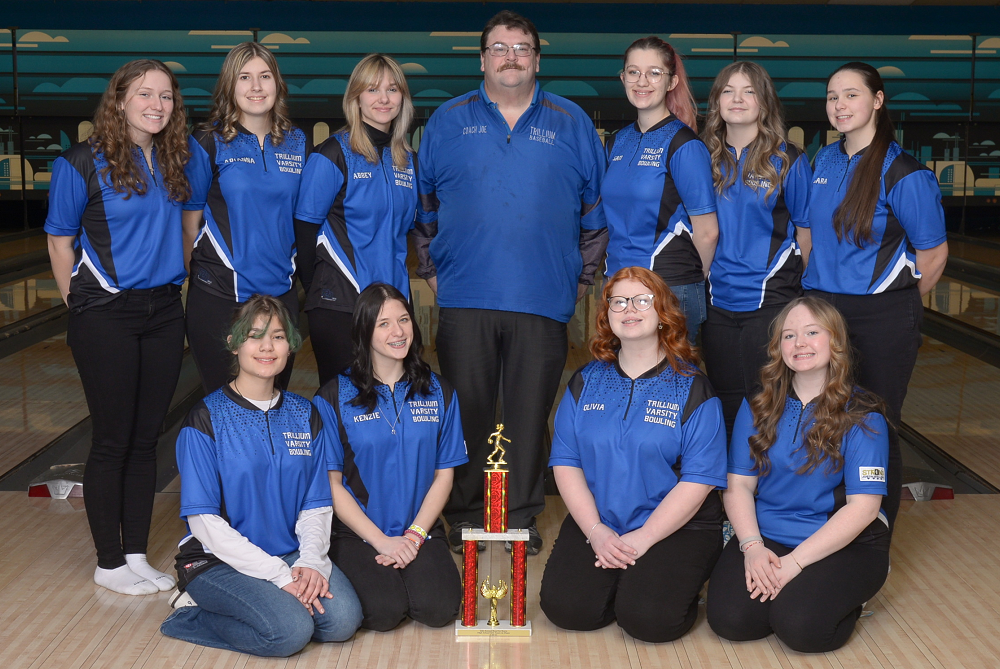
Coach Joseph Slaven started Taylor Trillium Academy’s bowling program seven years ago in part because his children hoped to represent their school on the lanes, plus he’s a bowler, and as a longtime coach in various sports he is glad to pass on what he knows. It’s become an opportunity for them and their classmates to compete, but also to learn a lifelong sport and add to their already well-rounded résumés as they prepare for life after high school.
 It’s become quite a history-making endeavor as well – and his Wildcats girls team is in the midst of a multi-season surge that may be just the start.
Taylor Trillium’s girls bowling team – the MHSAA/Applebee’s “Team of the Month” for January – finished an undefeated run through the Independent Bowling League on Wednesday, and will enter its Feb. 24 Team Regional seeking to make the Division 4 Finals for the second-straight season after the Wildcats made their championship debut as a full team a year ago.
Trillium will enter postseason competition having also prepped against several much larger opponents, with January also highlighted by a championship at Trenton’s 16th Annual Bowl for Burns tournament on Jan. 28. The Wildcats defeated Division 1 Taylor in the final of that all-Baker event, and Trillium this season also has finished second at the Detroit Mercy Tournament, fourth at the Livonia Clarenceville Tournament and fifth at the Dearborn Divine Child Tournament – all won by Division 1 teams.
“Everybody is improving just by leaps and bounds. In one year, it’s just amazing to see how they’ve grown as people … it’s a lot of fun, and we’re really enjoying it,” Slaven said. “The biggest key is they are very coachable. To be able to teach them and explain at the same time, the combination of those two is very welcoming as a coach – and that’s what I’m working with.”
Bowling got its start at the school in 2016-17 when Slaven’s son Connor was a sophomore. Students had shown interest in the past, and Joseph Slaven gave it life by taking on building the program – which began with six girls and two boys at the first tryout. As a junior a year later, Connor became the school’s first athlete in any sport to reach the MHSAA Finals, in Division 4 singles, and he qualified for singles competition again as a senior – this time as he and his dad were joined by the rest of the Wildcats as boys bowling became the first team in school history to qualify for a Finals as well. Additionally that season, Kalyn Browne became the school’s first female athlete to reach a Finals in any sport.
Joseph Slaven switched to coaching the girls team in 2020-21 with his daughter Abbey a freshman (trading places with current boys coach Jason Caperton). She reached the Division 4 Singles Final as a freshman and again last season, advancing to the match play as a sophomore. She also was joined in last year’s singles championship competition by then-senior teammate Haylee Irvin-Byford – and by all of the Wildcats the day before as they reached the Team Final for the first time.
That momentum has continued rolling this winter.
Joseph Slaven has 11 bowlers total on the girls team this season, and most are multi-sport athletes also competing in volleyball, golf, cross country and softball. Together, they all carry grade-point averages of 3.0 or higher, with the team average pushing toward 3.7, on top of National Honor Society activities and service hours that go along with it.
“They make it fun, and everyone is really inviting – the girls are rooting for each other, watching each other grow,” Slaven said. “But at the same time, it’s competitive.”
Slaven tells them to “practice how you play,” and he makes all of it count. He tracks every game including from practices in his bowlers’ averages, and on match days the current top five for the season make the starting lineup.
Those five heading into Wednesday were Abbey Slaven (176 average), Emily Yagley (157), Sara Brunell (143), Alivia Schmer (132) and Arianna Lask (131), followed by Mackenzie Peplinski and Sara Boiler as the lineup that will go on to next weekend’s Regional.
“For a lot of them, I can see (Abbey’s) set the bar for them. But she’s also straddling the bar, reaching back down to tell them, ‘You can do this too,’” Joseph Slaven said. “It’s almost like having an extra coach sometimes. It’s not like the coach, but having a buddy telling you (ways to improve). … She’s competitive, but super supportive of her teammates.”
Samantha Keilman, Noelia Guerrido, Cheyanne Miller, and Dria Keilman round out the squad, and all 11 have enjoyed highlight moments this season including three-game series where all three were above their single-game averages. Those top seven all have put together high series above 500, led heading into Wednesday by Slaven’s best of 733, Yagley’s of 652 and Brunell’s of 604.
They’ll take to the lanes next for the Feb. 24-25 Division 4 Regional at Ten Pin Bowling Alley in Tecumseh. Once again, the top three teams from Friday and top 10 singles from Saturday will advance to the Division 4 Finals, this season March 3-4 at M-66 Bowl in Battle Creek.
Past Teams of the Month, 2022-23
December: Byron Center hockey - Report
November: Martin football - Report
October: Gladwin volleyball - Report
September: Negaunee girls tennis - Report
(PHOTO courtesy of the Taylor Trillium Academy girls bowling program.)