


Add, Subtract, Divide, Multiply: MHSAA Not Alone
July 25, 2017
By Rob Kaminski
MHSAA benchmarks editor
This is the third part in a series on MHSAA tournament classification, past and present, that will be published over the next two weeks. This series originally ran in this spring's edition of MHSAA benchmarks.
As the MHSAA faces its most recent classification task with 8-Player Football, and opinions continue to swirl about as to the method, timeframe, location and other procedures, a look around the country provides plenty of company among state association brethren factoring variables into their own equations.
In the Pacific Northwest, the Oregon School Activities Association Football Playoffs are under public scrutiny as leadership ponders a five or six classification format beginning with the 2018-19 school year.
The OSAA has crowned six champions on the gridiron since 2006-07. Many of the state’s smaller schools would like to keep it that way, while larger schools lean toward a five-classification system, citing larger leagues, ease of travel and credibility to state championships as the advantages.
Still others would prefer more than six classes, pointing to safety issues and the opportunity to increase participation numbers as positives.
Moving southeast of Oregon, the Nevada Interscholastic Activities Association recently voted to hold serve on a classification proposal that was volleyed to the membership.
However, changes still could be forthcoming by as early as the 2018-19 season which would add a fifth classification in more populated southern Nevada while allowing northern schools to participate in four classifications. Such divisions could mean no state championship for the fifth class in southern Nevada.
Because of that, the NIAA wants equal numbers of schools in each classification on both ends of the state. Complicating the issue is the fact that the 24 largest schools in the state, by enrollment, are all in Clark County in Southern Nevada.
Across Nevada’s border into Arizona, charter schools are asking the Arizona Interscholastic Association to reconsider classification that was voted upon and approved in September 2015. That agreement called for the largest 33 percent of charter schools by enrollment to be placed in the state’s largest school classification, 3A, the middle 33 percent into 2A, and the smallest 33 percent into 1A.
Less than two years later the charter schools have had a change of heart and have asked to be considered the same as other Arizona public schools and be placed appropriately by enrollment beginning with the 2018-19 school year.
The situation in Arizona further illustrates how the public/private debate that all state associations have faced throughout existence now has the added dynamic of rapidly growing charter schools in today’s educational system, along with virtual school enrollment.
In the nation’s heartland, Nebraska has retooled its football classifications by using enrollment of boys students only in its schools rather than total enrollment. The Nebraska School Activities Association football-playing schools will kick off the 2018 season using this alignment.
Nebraska has three classes of 11-player football, with the smallest class divided in two, Class C-1 and C-2. The state also will have 8-player football for boys enrollments under 47, and the NSAA will sponsor a new 6-player tournament in 2018 for schools with 27 or fewer boys.
“This is a good proposal because some schools have a sizable imbalance between the number of boys and girls, and there’s a large gap (in enrollment) between the largest and smallest schools in Classes A and B,” NSAA executive director Jim Tenopir said. “I think this addresses both of those concerns.”
Swimmers in Georgia, meanwhile, will feel like they are moving with the current, rather than upstream in 2017-18, as the Georgia High School Association recently doubled the number of team championship events from two to four.
Swim enthusiasts can also count on longer days at the finals, as the top 30 finishers from the prelims will advance to the finals instead of 20, and all championship events will have three heats versus two.
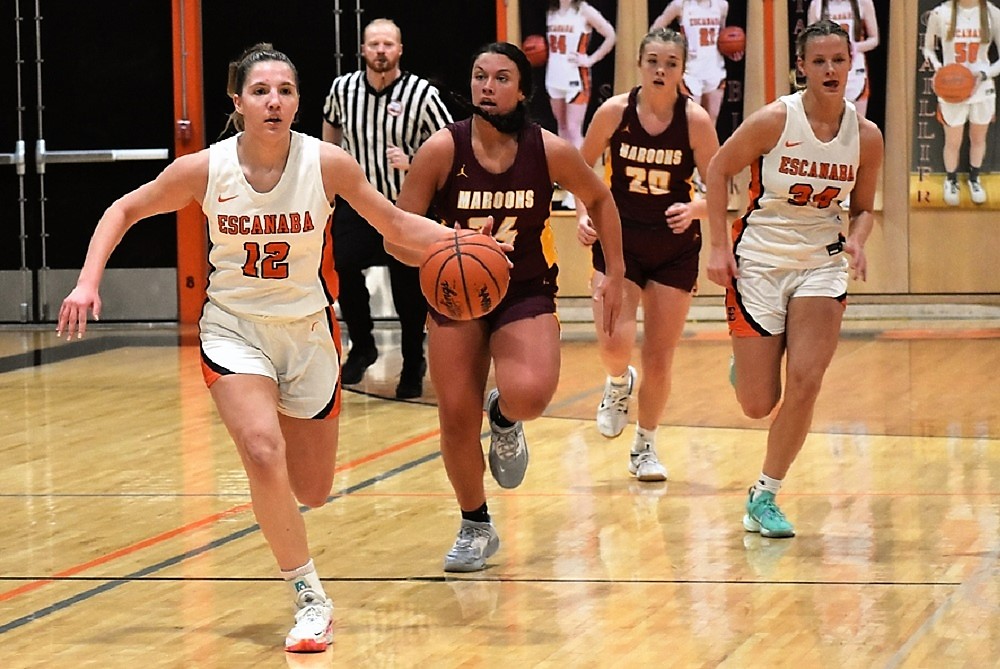
Summer Strides, Preseason Confidence Showing in Escanaba's Excellent Start
By
John Vrancic
Special for MHSAA.com
January 27, 2023
ESCANABA — So far, so good for the Escanaba girls basketball team. The Eskymos are 13-0 after rolling to a 65-36 triumph at Bark River-Harris last Friday, with three more wins already than all of last season.
 Coach Tracy Hudson said everything started in a cornfield in Carney during the summer.
“We lost to Ewen-Trout Creek, West Iron County and Bark River-Harris in summer tournaments,” he added. “We were taking a step back and a step forward. We kind of found ourselves in a small gym at Carney-Nadeau. We had to go through some growing pains, but played real well at Michigan Tech and Marquette. We came out of the summer feeling we could be all right.”
They’ve been outstanding.
Coming off a 10-10 finish last season, Escanaba has won nine of its games by double digits under Hudson, who took over the girls program this season after leading the varsity boys from 1997-2022.
The Eskymos improved to 5-0 in the Great Northern Conference with a 62-46 triumph over Menominee on Jan. 16 and have a two-game lead in the league standings with three GNC games to play.
“It feels great to be where we are,” said senior forward Mari Bink, who averages 15.1 points a game. “We were confident coming into the season, but you never know what can happen. We enjoy playing together, and we’re having fun. It’s crazy, but we get excited.”
Hudson is happy with all the success as well but knows the Eskymos will be tested in the days to come. They visit Calumet (10-2) tonight and Houghton (12-1) on Feb. 3.
“The teams in the Keweenaw are very good,” he said. “We’re going to have to bring our A game. Our team motto is ‘All In.’ Coach (Lisa) Maki and the girls came up with it. We have to bring it every day. I think we still have a lot of room for growth.”
Still, Escanaba will enter those games having handed the lone loss to another of the elite teams from the Keweenaw. Sophomore center Grayson LaMarche scored the game-winner on a layup in the final 12 seconds of a 50-49 win over Hancock (11-1) on Jan. 13.
 “They definitely have some good teams in the Copper Country,” said senior point guard Carney Salo, who was forced out of that game after hitting her head on the floor late in the third quarter. “I had a rough couple days, but it felt good playing in the Menominee game (three days later).
“I didn’t have any hesitation. We were able to take away (Menominee’s) passing lanes. Defense is the one thing you can control.”
Escanaba is giving up just under 46 points per game against a schedule that’s included wins over four teams with at least 10 wins and eight teams .500 or better. Rival Marquette would be a ninth over .500 if not for a sweep by the Eskymos.
Salo, who didn’t play last season due to an ACL injury, is averaging 7.3 points, 3.5 assists and 2.4 steals per game.
“A personal highlight is just getting a chance to play after missing last year,” she said. “I think that makes me more motivated, although you always want to give it your all.”
Junior forward Keira Maki, a 49-percent field goal shooter, scored 24 points and LaMarche added 13 at BR-H.
“That has become a good rivalry,” said Maki. “They’re quick, and they put a lot of pressure on you. They don’t give up. They’re definitely well coached.”
Maki is averaging 17.8 points, 9.9 rebounds, 1.9 blocked shots, four steals and 2.8 assists per game. She went down with an ankle injury during a 49-33 triumph at Alpena on Dec. 13 but returned in time to help the Eskymos post a 74-44 triumph at Gladstone two weeks later.
“Gladstone definitely has a good freshman (Lillie Johnson), but we put it all together and got the ball moving a lot,” said Maki. “They had a few other players we also had to stop. I felt I wasn’t as well prepared as I could have been if I hadn’t gotten injured at Alpena.”
The Eskymos opened this season with a 65-50 triumph at Marquette, then defeated Gaylord St. Mary (60-45) and the host Ramblers (50-42) in the McBain Invitational.
“We felt we needed to get a win at Marquette,” said Hudson. “Gaylord St. Mary and McBain were polar opposites and got on a little bit of a roll after that. The game with Sault Ste. Marie (a 62-57 victory) was a very big game here. That was similar to Hancock. We couldn’t relax for a moment.
“We’ve separated from the rest of the GNC teams a little and found a way to win the close games. We’re excited about where we’re at. It’s like whipped cream right now, but we’ve told the girls to keep the eye of the tiger and keep improving.”
Junior guard Saylor Henderson has provided timely shooting from outside, hitting 37 percent of her shots from 3-point range and 44 percent inside the arc. She’s averaging 7.2 points.
“The 3-point shot is a big part of our game, and Saylor is a green-light shooter for us,” said Hudson. “Because we play uptempo, we get good looks in transition. We’re also a good free throw shooting team (averaging 67 percent).”
Hudson said he also appreciates the help from the assistant coaches.
“Coach Maki has done a real good job,” he added. “She understands the girls, and our younger coaches (C.J. Barron and Darren Landis) absorb everything like a sponge.”
 John Vrancic has covered high school sports in the Upper Peninsula since joining the Escanaba Daily Press staff in 1985. He is known most prominently across the peninsula for his extensive coverage of cross country and track & field that frequently appears in newspapers from the Wisconsin border to Lake Huron. He received the James Trethewey Award for Distinguished Service in 2015 from the Upper Peninsula Sportswriters and Sportscasters Association.
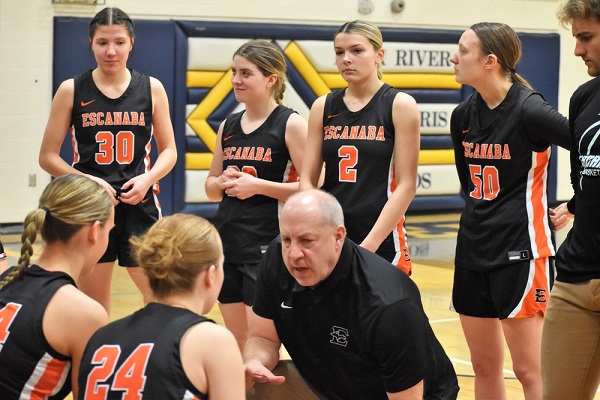
PHOTOS (Top) Escanaba's Keira Maki (12) leads a break against Menominee during a Jan. 16 victory. (Middle) Eskymos coach Tracy Hudson talks things over with his team during last Friday's win over Bark River-Harris. (Photos courtesy of RRNSports.com.)