


Add, Subtract, Divide, Multiply: MHSAA Not Alone
July 25, 2017
By Rob Kaminski
MHSAA benchmarks editor
This is the third part in a series on MHSAA tournament classification, past and present, that will be published over the next two weeks. This series originally ran in this spring's edition of MHSAA benchmarks.
As the MHSAA faces its most recent classification task with 8-Player Football, and opinions continue to swirl about as to the method, timeframe, location and other procedures, a look around the country provides plenty of company among state association brethren factoring variables into their own equations.
In the Pacific Northwest, the Oregon School Activities Association Football Playoffs are under public scrutiny as leadership ponders a five or six classification format beginning with the 2018-19 school year.
The OSAA has crowned six champions on the gridiron since 2006-07. Many of the state’s smaller schools would like to keep it that way, while larger schools lean toward a five-classification system, citing larger leagues, ease of travel and credibility to state championships as the advantages.
Still others would prefer more than six classes, pointing to safety issues and the opportunity to increase participation numbers as positives.
Moving southeast of Oregon, the Nevada Interscholastic Activities Association recently voted to hold serve on a classification proposal that was volleyed to the membership.
However, changes still could be forthcoming by as early as the 2018-19 season which would add a fifth classification in more populated southern Nevada while allowing northern schools to participate in four classifications. Such divisions could mean no state championship for the fifth class in southern Nevada.
Because of that, the NIAA wants equal numbers of schools in each classification on both ends of the state. Complicating the issue is the fact that the 24 largest schools in the state, by enrollment, are all in Clark County in Southern Nevada.
Across Nevada’s border into Arizona, charter schools are asking the Arizona Interscholastic Association to reconsider classification that was voted upon and approved in September 2015. That agreement called for the largest 33 percent of charter schools by enrollment to be placed in the state’s largest school classification, 3A, the middle 33 percent into 2A, and the smallest 33 percent into 1A.
Less than two years later the charter schools have had a change of heart and have asked to be considered the same as other Arizona public schools and be placed appropriately by enrollment beginning with the 2018-19 school year.
The situation in Arizona further illustrates how the public/private debate that all state associations have faced throughout existence now has the added dynamic of rapidly growing charter schools in today’s educational system, along with virtual school enrollment.
In the nation’s heartland, Nebraska has retooled its football classifications by using enrollment of boys students only in its schools rather than total enrollment. The Nebraska School Activities Association football-playing schools will kick off the 2018 season using this alignment.
Nebraska has three classes of 11-player football, with the smallest class divided in two, Class C-1 and C-2. The state also will have 8-player football for boys enrollments under 47, and the NSAA will sponsor a new 6-player tournament in 2018 for schools with 27 or fewer boys.
“This is a good proposal because some schools have a sizable imbalance between the number of boys and girls, and there’s a large gap (in enrollment) between the largest and smallest schools in Classes A and B,” NSAA executive director Jim Tenopir said. “I think this addresses both of those concerns.”
Swimmers in Georgia, meanwhile, will feel like they are moving with the current, rather than upstream in 2017-18, as the Georgia High School Association recently doubled the number of team championship events from two to four.
Swim enthusiasts can also count on longer days at the finals, as the top 30 finishers from the prelims will advance to the finals instead of 20, and all championship events will have three heats versus two.
Local Dominance Achieved Again, Dow Sets Sights on Statewide Success
By
Paul Costanzo
Special for MHSAA.com
January 25, 2023
Less than 24 hours after its 2021-22 season ended, the Midland Dow boys swimming & diving team had established its goal for the next year.
 Get back to the MHSAA Lower Peninsula Division 2 Finals, and put Dow back among the best swim teams in the state.
“Even at the state meet last year, we were like, ‘Where are we going to be at when we come back here?’” Dow coach Claire Fries said. “It was the day after the state meet last year, we were already in that mode for next year. The boys have worked hard to meet that goal.”
While the Finals are still more than a month away – March 10 and 11 at the Holland Aquatic Center – Dow has already punched several tickets back to the championship meet.
All three Dow relays have met the Finals-qualifying mark, and at least one Dow swimmer has hit the mark in all but one individual event. In some events, multiple Chargers have qualified.
That’s a far cry from a year ago, when nearly all of Dow’s qualifying times were met in the final meets of the season.
“We’ve had our mindset on it all year,” said Dow senior Thomas Bacigalupo. “We’ve been working on it, practicing in the morning three times a week. On a big piece of paper in our office here, it says, ‘We’re going back,’ and we’re going to succeed. We have a saying that when we can see our goals, we have a higher chance of achieving them.”
Bacigalupo is one of six returning Finals qualifiers for Dow, joining his twin brother Tyler, senior Harrison Schuster, juniors Noah Buist and Nathan Velez, and sophomore Eli Soderberg.
That core made it easy to see why the Chargers were excited well before a single qualifying time had been accomplished.
 “From last year’s team, we had almost everybody come back, and our team is full of depth this year with the freshman class we brought in,” Soderberg said. “We still have all that talent and all that speed. Those expectations, last year, were for all of us just to get to the state meet and qualify top 16 and all of that. Now, this year, we can actually make a run for stuff.”
Qualifying as many swimmers for the Finals as early as they have is a good sign for the Chargers. So is winning their 20th-straight Tri-Cities championship, which they accomplished this past weekend at Saginaw Valley State.
It’s a streak that predates the birth of any current Dow swimmer, and very nearly their coach.
“I think our goal is to keep that streak going as long as we can,” Tyler Bacigalupo said. “It shows the work ethic of all the guys in the past. But we also try to think of it like every regular meet, and just go out there and do our thing.”
For Fries, who is in her fourth year with the program and third as head coach, the Tri-Cities meet is about more than just continuing the streak.
“It’s more about a celebration of our community here,” she said. “What I stress to the boys is that this is really about representing Dow and the Tri-City community, and being able to compete and race with these kids that you’re with all year round. That’s more of what I put the focus on.”
With their local dominance established again, the Chargers continue to look to establish themselves on a bigger stage, and from what Fries has seen from her swimmers this season, it’s something she thinks they’re capable of accomplishing.
“We have nine seniors on our team, and they definitely are motivated,” she said. “They wanted to show that Dow is a good swim program, and one that should be respected anywhere in the state. Our boys are really motivated to compete with anybody in the state. That drive for competition has really fueled our team and made our team really close.”
Dow has twice been Finals runner-up, in 2006 and 2008 both in LP Division 2. The Chargers felt they had a chance to win it all in 2020, but that meet never happened as it was canceled because of the pandemic.
Rather than say “what if?” regarding their freshman year, the seniors are looking forward.
“We want to be top five and really put Midland Dow back on the map,” Tyler Bacigalupo said. “That (2020) was our best chance of being on top in states, but we want to put Dow back on the map again. Our tennis team and our hockey team have done it, now we just want to bring some attention to us.”
 Paul Costanzo served as a sportswriter at The Port Huron Times Herald from 2006-15, including three years as lead sportswriter, and prior to that as sports editor at the Hillsdale Daily News from 2005-06. He can be reached at [email protected] with story ideas for Genesee, Lapeer, St. Clair, Sanilac, Huron, Tuscola, Saginaw, Bay, Arenac, Midland and Gladwin counties.
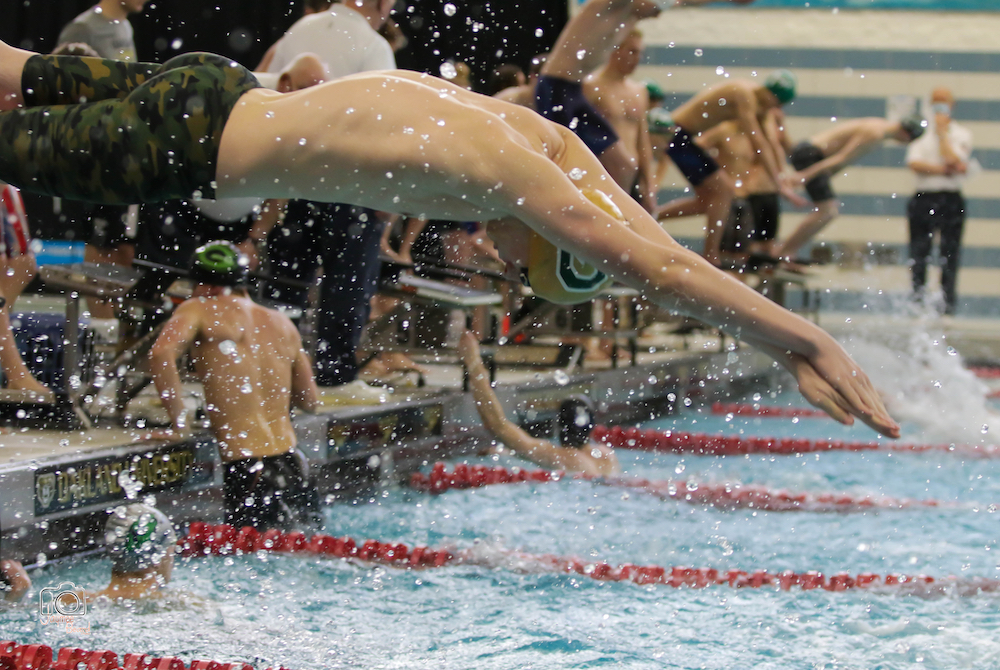
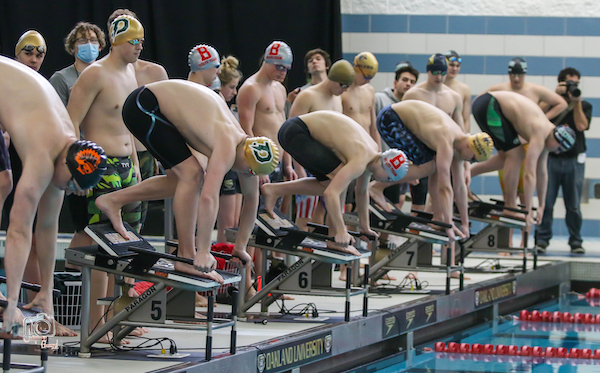
PHOTOS (Top) Midland Dow’s Noah Buist launches into a race during last season’s LPD2 Finals. (Middle) Thomas Bacigalupo, second from left on starting block, prepares to lead off the B heat of the 400 freestyle relay. (Photos by High School Sports Scene.)