


Add, Subtract, Divide, Multiply: MHSAA Not Alone
July 25, 2017
By Rob Kaminski
MHSAA benchmarks editor
This is the third part in a series on MHSAA tournament classification, past and present, that will be published over the next two weeks. This series originally ran in this spring's edition of MHSAA benchmarks.
As the MHSAA faces its most recent classification task with 8-Player Football, and opinions continue to swirl about as to the method, timeframe, location and other procedures, a look around the country provides plenty of company among state association brethren factoring variables into their own equations.
In the Pacific Northwest, the Oregon School Activities Association Football Playoffs are under public scrutiny as leadership ponders a five or six classification format beginning with the 2018-19 school year.
The OSAA has crowned six champions on the gridiron since 2006-07. Many of the state’s smaller schools would like to keep it that way, while larger schools lean toward a five-classification system, citing larger leagues, ease of travel and credibility to state championships as the advantages.
Still others would prefer more than six classes, pointing to safety issues and the opportunity to increase participation numbers as positives.
Moving southeast of Oregon, the Nevada Interscholastic Activities Association recently voted to hold serve on a classification proposal that was volleyed to the membership.
However, changes still could be forthcoming by as early as the 2018-19 season which would add a fifth classification in more populated southern Nevada while allowing northern schools to participate in four classifications. Such divisions could mean no state championship for the fifth class in southern Nevada.
Because of that, the NIAA wants equal numbers of schools in each classification on both ends of the state. Complicating the issue is the fact that the 24 largest schools in the state, by enrollment, are all in Clark County in Southern Nevada.
Across Nevada’s border into Arizona, charter schools are asking the Arizona Interscholastic Association to reconsider classification that was voted upon and approved in September 2015. That agreement called for the largest 33 percent of charter schools by enrollment to be placed in the state’s largest school classification, 3A, the middle 33 percent into 2A, and the smallest 33 percent into 1A.
Less than two years later the charter schools have had a change of heart and have asked to be considered the same as other Arizona public schools and be placed appropriately by enrollment beginning with the 2018-19 school year.
The situation in Arizona further illustrates how the public/private debate that all state associations have faced throughout existence now has the added dynamic of rapidly growing charter schools in today’s educational system, along with virtual school enrollment.
In the nation’s heartland, Nebraska has retooled its football classifications by using enrollment of boys students only in its schools rather than total enrollment. The Nebraska School Activities Association football-playing schools will kick off the 2018 season using this alignment.
Nebraska has three classes of 11-player football, with the smallest class divided in two, Class C-1 and C-2. The state also will have 8-player football for boys enrollments under 47, and the NSAA will sponsor a new 6-player tournament in 2018 for schools with 27 or fewer boys.
“This is a good proposal because some schools have a sizable imbalance between the number of boys and girls, and there’s a large gap (in enrollment) between the largest and smallest schools in Classes A and B,” NSAA executive director Jim Tenopir said. “I think this addresses both of those concerns.”
Swimmers in Georgia, meanwhile, will feel like they are moving with the current, rather than upstream in 2017-18, as the Georgia High School Association recently doubled the number of team championship events from two to four.
Swim enthusiasts can also count on longer days at the finals, as the top 30 finishers from the prelims will advance to the finals instead of 20, and all championship events will have three heats versus two.
'Invaluable' Hancock Nearing Half-Century of Service to Cheboygan Athletics
By
Tom Spencer
Special for MHSAA.com
December 2, 2022
When Cheboygan hosts Ogemaw Heights next week to kick off a new boys basketball season, those attending will see something special.
 And really, for Cheboygan and its opponents, it’s nothing new. It’s been going on for five decades.
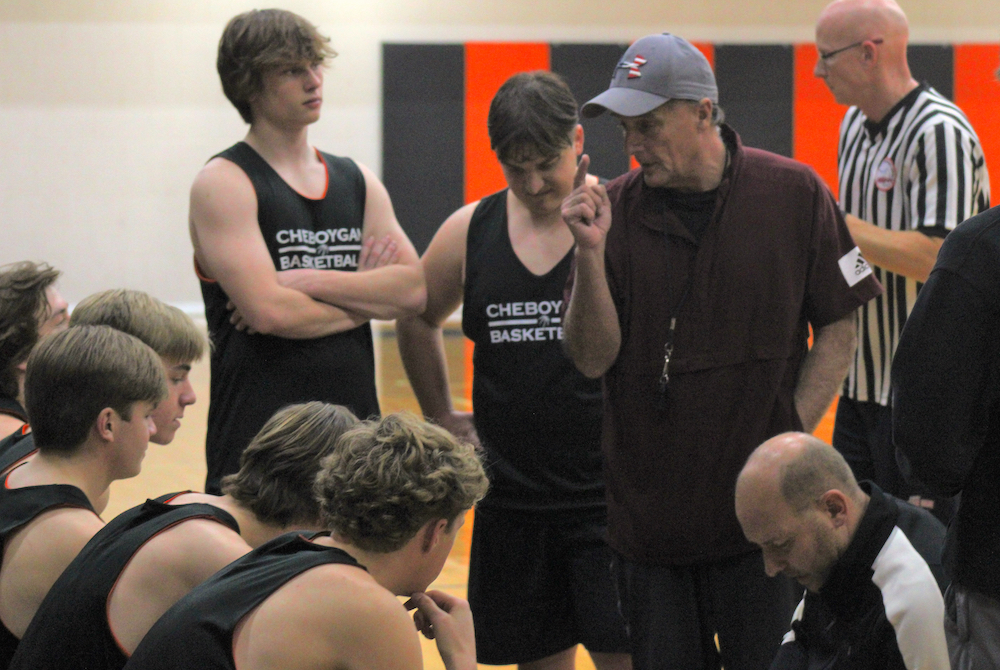
The special part? Scott Hancock, junior varsity coach and assistant varsity coach, is starting his 47th year coaching at the school. Forty-five of those years have been in the same role he has this season.
“It really just means I’m getting old, but I feel very fortunate to be able to do something that I love for this long,” Hancock, himself a Cheboygan product of 1976, reflected on his tenure. “To be honest, I never really thought about how long I would do it. It’s just something I love doing, so I never really put a number on how long I would do it.”
As the campaign starts, though, he has thoughts of coaching high school basketball for six and possibly seven decades before he hangs it up. He has coached his sons — Nick, who owns the Cheboygan career steals record; and Brian, the leader in career made 3-pointers — and now he’s looking forward to the possibility of coaching his two grandchildren, Landon Gahn and Lincoln Hancock.
“Well, all I can say is I have a grandson that is 3 years old, and I would love to hang around coaching until he graduates,” Hancock said of how long he thinks he’ll stay in coaching. “I have loved every year.
“I have coached with a lot of great coaches who are all great friends to this day.”
Included among those coaches are his two sons, who served as assistants for Cheboygan, and Jason Friday, the current varsity coach who also played for Hancock during the early 1990s – a time when Hancock briefly stepped in to fill a varsity coaching vacancy after the sudden departure of the previous head coach.
Friday, who also serves as the school’s athletic director, is not at all surprised his former coach is still in the game. It became a factor in Friday’s decision to take over the boys program three years ago.
“If you're a boy who grew up in Cheboygan, there's a good chance that Scott coached you in something,” Friday said. “He has a grandson who is in eighth grade, and he wants to coach him.
“So yes, I knew he was going to be around for several more years.”
And next week, Friday will be thrilled to have Hancock alongside him on the court as Cheboygan opens up with the Falcons.
“Today, I don't look at Scott as one of my former varsity coaches — he's a friend,” Friday said. “We're friends more than anything, and that makes coaching even more fun for me.
“Most importantly, having someone on the bench that you can trust is invaluable.”
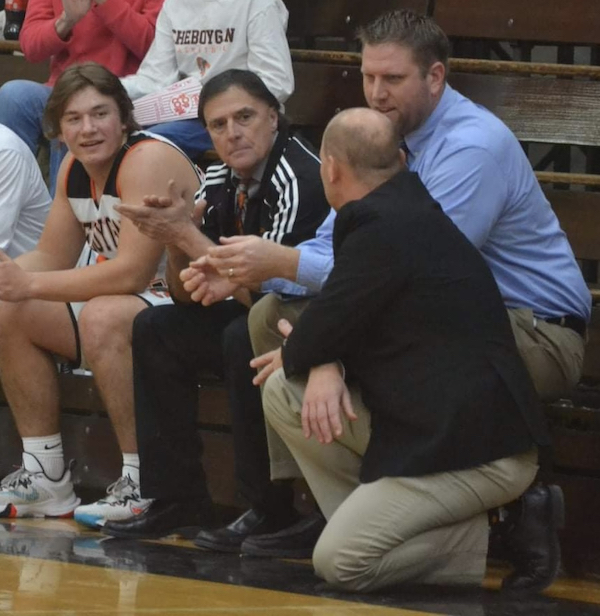 Hancock, who was helping with the boys program when Friday was coaching the Cheboygan girls team, began expecting to coach with his former player some time ago.
“I was very fortunate to have both my sons be assistant coaches for our varsity program,” said Hancock, who also has served decades coaching baseball and keeping stats for the football program. “But as far as being head coach, I always thought Jason would take over at some time.
“It’s awesome to have a former player running our program, but it is no surprise,” he continued. “Jason has always been a student of the game and is very detailed, and what he does, our program is in great hands.”
The mutual trust the coaches share has really benefited the Cheboygan student-athletes.
“I think it is important to have a JV coach who the head coach can trust that he has bought in to all of the beliefs of the head coach’s program,” Hancock noted. “Being loyal to your varsity coach and doing what’s best for your program is the most important aspect of JV coaching.
“And, getting kids to buy in to what it takes to play the game the right way.”
That’s one of the strengths Hancock brings to the basketball program, Friday singled out.
“Coach Hancock does a tremendous job teaching the fundamentals, but also does a great job communicating with the boys, making each one feel valued, even those who don't play as much,” Friday said. “He's at every practice.
“If there's an emergency and I need to step out for a minute and put my AD hat on, he can run practice and we don't miss a beat,” Friday continued. “He has a tremendous knowledge of the game and is a coach anyone would love on their bench.”
Hancock, who assists another former player, Kevin Baller, coaching the baseball team, has no thoughts of getting back into a varsity coaching position.
“I have no plans to coach at the varsity level, and the reason is because I have the best of both worlds by coaching JV,” said Hancock, who sees the 3-point shot as the biggest change in the game during his tenure. “Every coach that I have worked for lets me be involved with the varsity, so really I get to be involved in both.”
Friday recalls wishing as a player that Hancock had stayed at the helm when he took over temporarily. But, he loves having him coach with him today.
“After our junior season, we were told he was going back to JV,” Friday said. “We tried to convince him to stay for one more year, but he wanted to go back.
“There's no way I could be varsity basketball coach and athletic director without having a JV coach like Scotty.”
Off the court successes in life are just as importance as athletic endeavors, Hancock indicated. In fact, those give him the most pride.
“Probably helping kids with off-the-court issues makes me feel better than anything,” he said. “Also hearing from the kids that I’ve coached after they graduate and how much they enjoyed their JV year.”
There aren’t many – if any – parent, player or community member names on a complaint list from Hancock’s first five decades, and there’s not likely to be any more in however many years are ahead.
“When you’ve coached in the same small town for nearly 50 years, you’d expect to have a few people upset with you, but not Scotty,” said Friday. “You can’t find a person who says something bad about him.
“He’s extremely well-respected,” he continued. “You absorb his passion and love of the game just by being around him, and all of Cheboygan should be thankful (for) how much he's done for our community.”
 Tom Spencer is a longtime MHSAA-registered basketball and soccer official, and former softball and baseball official, and he also has coached in the northern Lower Peninsula area. He previously has written for the Saginaw News, Bay County Sports Page and Midland Daily News. He can be reached at [email protected] with story ideas for Manistee, Wexford, Missaukee, Roscommon, Ogemaw, Iosco, Alcona, Oscoda, Crawford, Kalkaska, Grand Traverse, Benzie, Leelanau, Antrim, Otsego, Montmorency, Alpena, Presque Isle, Cheboygan, Charlevoix and Emmet counties.
PHOTOS (Top) Cheboygan assistant boys basketball coach Scott Hancock offers some pointers during a scrimmage last week. (Middle) Hancock, second from left, confers last season with assistant Matt Mylnarchek, head coach Jason Friday and player Dylan Balazovic. (Photos courtesy of Jared Greenleaf/Cheboygan Daily Tribune.)