


Add, Subtract, Divide, Multiply: MHSAA Not Alone
July 25, 2017
By Rob Kaminski
MHSAA benchmarks editor
This is the third part in a series on MHSAA tournament classification, past and present, that will be published over the next two weeks. This series originally ran in this spring's edition of MHSAA benchmarks.
As the MHSAA faces its most recent classification task with 8-Player Football, and opinions continue to swirl about as to the method, timeframe, location and other procedures, a look around the country provides plenty of company among state association brethren factoring variables into their own equations.
In the Pacific Northwest, the Oregon School Activities Association Football Playoffs are under public scrutiny as leadership ponders a five or six classification format beginning with the 2018-19 school year.
The OSAA has crowned six champions on the gridiron since 2006-07. Many of the state’s smaller schools would like to keep it that way, while larger schools lean toward a five-classification system, citing larger leagues, ease of travel and credibility to state championships as the advantages.
Still others would prefer more than six classes, pointing to safety issues and the opportunity to increase participation numbers as positives.
Moving southeast of Oregon, the Nevada Interscholastic Activities Association recently voted to hold serve on a classification proposal that was volleyed to the membership.
However, changes still could be forthcoming by as early as the 2018-19 season which would add a fifth classification in more populated southern Nevada while allowing northern schools to participate in four classifications. Such divisions could mean no state championship for the fifth class in southern Nevada.
Because of that, the NIAA wants equal numbers of schools in each classification on both ends of the state. Complicating the issue is the fact that the 24 largest schools in the state, by enrollment, are all in Clark County in Southern Nevada.
Across Nevada’s border into Arizona, charter schools are asking the Arizona Interscholastic Association to reconsider classification that was voted upon and approved in September 2015. That agreement called for the largest 33 percent of charter schools by enrollment to be placed in the state’s largest school classification, 3A, the middle 33 percent into 2A, and the smallest 33 percent into 1A.
Less than two years later the charter schools have had a change of heart and have asked to be considered the same as other Arizona public schools and be placed appropriately by enrollment beginning with the 2018-19 school year.
The situation in Arizona further illustrates how the public/private debate that all state associations have faced throughout existence now has the added dynamic of rapidly growing charter schools in today’s educational system, along with virtual school enrollment.
In the nation’s heartland, Nebraska has retooled its football classifications by using enrollment of boys students only in its schools rather than total enrollment. The Nebraska School Activities Association football-playing schools will kick off the 2018 season using this alignment.
Nebraska has three classes of 11-player football, with the smallest class divided in two, Class C-1 and C-2. The state also will have 8-player football for boys enrollments under 47, and the NSAA will sponsor a new 6-player tournament in 2018 for schools with 27 or fewer boys.
“This is a good proposal because some schools have a sizable imbalance between the number of boys and girls, and there’s a large gap (in enrollment) between the largest and smallest schools in Classes A and B,” NSAA executive director Jim Tenopir said. “I think this addresses both of those concerns.”
Swimmers in Georgia, meanwhile, will feel like they are moving with the current, rather than upstream in 2017-18, as the Georgia High School Association recently doubled the number of team championship events from two to four.
Swim enthusiasts can also count on longer days at the finals, as the top 30 finishers from the prelims will advance to the finals instead of 20, and all championship events will have three heats versus two.
COMMENTARY: Public Act 184 a Real Loser for School Sports in Michigan
By
Mark Uyl
MHSAA Executive Director
October 20, 2022
There is a crisis in Michigan schools today that centers on one problem:
Not having enough people.
In discussions with school district personnel, we are being told there has never been a more difficult time for finding people than today. All of us are searching high and low to find coaches for athletic teams, and officials, referees and umpires to administer those games in an orderly and safe way. Dig a little deeper, and school districts are desperate to find those willing to serve as substitute teachers and bus drivers.
Because of this current reality, we continue to be dumbfounded over the approval of Public Act 184 this past summer. This created a new set of retirement rules stipulating that a retiring teacher or administrator cannot be rehired to serve as a coach until after a nine-month waiting period. Even more frustrating: Individuals who had served as high school coaches for many years, who retired from the classroom last June but had planned to keep coaching for a few more seasons, are being told they cannot do so. Those coaches are sidelined, and for no sensible reason.
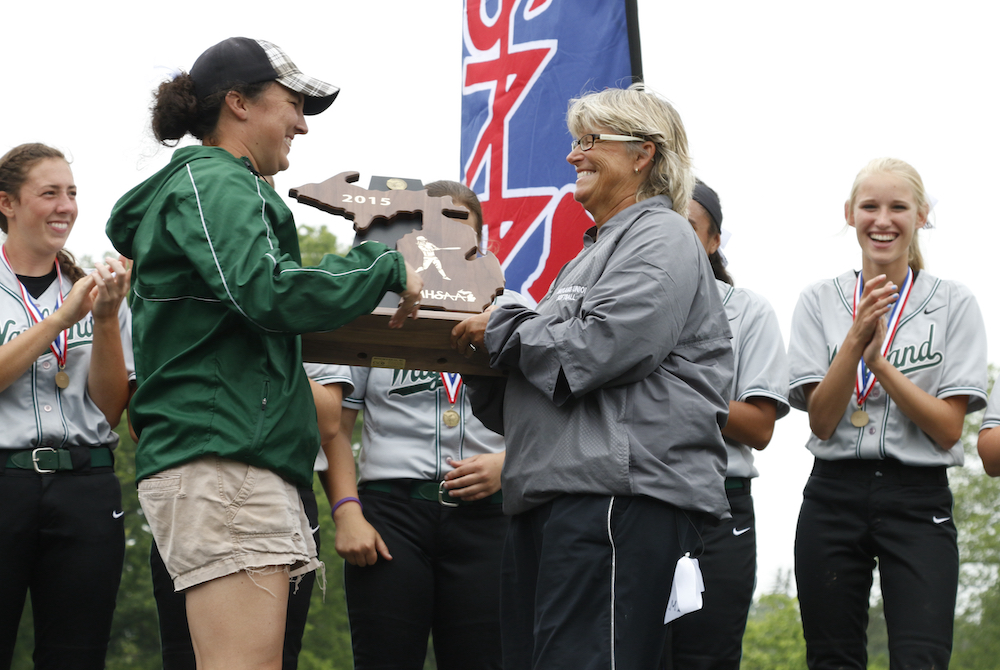
Cheri Ritz has been the varsity softball coach at Wayland High School since 1995. Cheri has won numerous championships, and has been a model coach and great leader of students throughout her career. Cheri retired as a teacher in June and planned to keep coaching the softball team for a few more years, making a small fraction of what her classroom salary was before retirement. Under the “old” retirement law, Cheri could have retired in June and been detached from the district for 30 days, and then returned and worked for the district in any capacity as long as she was making less than 30 percent of her compensation at the time of her retirement. Under PA 184, this scenario can no longer happen.
In the state of Michigan, we have hundreds of recently-retired school people who want to continue to be some of our best coaches, making pennies on the hour for their time. Now they simply aren’t allowed to do so because of a law that had no intention of impacting coaches and school sports. Cheri is just one example. The same issue has found several more longtime, successful coaches including Northville’s golf coach Chris Cronin and cross country & track field’s Steve Porter at Milan High School.
For the past few months, the MHSAA has met with the Office of Retirement Services, representatives from the Governor’s office and even the bill sponsor of PA 184. Every single conversation revealed the fact that coaches were not even part of the discussion when this new retirement law was passed. In other words, recent retirees continuing to coach were not the issue, but yet this new law now treats coaches as some sort of enemy with zero phase-in period, modification or even the ability to seek a waiver of this new law which became effective immediately on July 25, 2022. We have tried to work within the system to seek some commonsense approaches and solutions to this problem, but to no avail as of yet.
We need your help. We need you to contact the Governor’s office and your State Representative and State Senator’s offices. Let them know PA 184 needs to be fixed now. We need to find a way to let these individuals continue to coach and lead our student-athletes. Let them know our kids cannot play their games without individuals who want to coach, and let them know our kids will miss out on learning valuable life lessons if these coaches are not allowed to continue.
And let them know that PA 184 could not have been passed at a worse time given our most valuable resource – people – is at an all-time low.
PHOTO: Wayland softball coach Cheri Ritz, front right, accepts the Division 2 championship trophy in 2015.