


Add, Subtract, Divide, Multiply: MHSAA Not Alone
July 25, 2017
By Rob Kaminski
MHSAA benchmarks editor
This is the third part in a series on MHSAA tournament classification, past and present, that will be published over the next two weeks. This series originally ran in this spring's edition of MHSAA benchmarks.
As the MHSAA faces its most recent classification task with 8-Player Football, and opinions continue to swirl about as to the method, timeframe, location and other procedures, a look around the country provides plenty of company among state association brethren factoring variables into their own equations.
In the Pacific Northwest, the Oregon School Activities Association Football Playoffs are under public scrutiny as leadership ponders a five or six classification format beginning with the 2018-19 school year.
The OSAA has crowned six champions on the gridiron since 2006-07. Many of the state’s smaller schools would like to keep it that way, while larger schools lean toward a five-classification system, citing larger leagues, ease of travel and credibility to state championships as the advantages.
Still others would prefer more than six classes, pointing to safety issues and the opportunity to increase participation numbers as positives.
Moving southeast of Oregon, the Nevada Interscholastic Activities Association recently voted to hold serve on a classification proposal that was volleyed to the membership.
However, changes still could be forthcoming by as early as the 2018-19 season which would add a fifth classification in more populated southern Nevada while allowing northern schools to participate in four classifications. Such divisions could mean no state championship for the fifth class in southern Nevada.
Because of that, the NIAA wants equal numbers of schools in each classification on both ends of the state. Complicating the issue is the fact that the 24 largest schools in the state, by enrollment, are all in Clark County in Southern Nevada.
Across Nevada’s border into Arizona, charter schools are asking the Arizona Interscholastic Association to reconsider classification that was voted upon and approved in September 2015. That agreement called for the largest 33 percent of charter schools by enrollment to be placed in the state’s largest school classification, 3A, the middle 33 percent into 2A, and the smallest 33 percent into 1A.
Less than two years later the charter schools have had a change of heart and have asked to be considered the same as other Arizona public schools and be placed appropriately by enrollment beginning with the 2018-19 school year.
The situation in Arizona further illustrates how the public/private debate that all state associations have faced throughout existence now has the added dynamic of rapidly growing charter schools in today’s educational system, along with virtual school enrollment.
In the nation’s heartland, Nebraska has retooled its football classifications by using enrollment of boys students only in its schools rather than total enrollment. The Nebraska School Activities Association football-playing schools will kick off the 2018 season using this alignment.
Nebraska has three classes of 11-player football, with the smallest class divided in two, Class C-1 and C-2. The state also will have 8-player football for boys enrollments under 47, and the NSAA will sponsor a new 6-player tournament in 2018 for schools with 27 or fewer boys.
“This is a good proposal because some schools have a sizable imbalance between the number of boys and girls, and there’s a large gap (in enrollment) between the largest and smallest schools in Classes A and B,” NSAA executive director Jim Tenopir said. “I think this addresses both of those concerns.”
Swimmers in Georgia, meanwhile, will feel like they are moving with the current, rather than upstream in 2017-18, as the Georgia High School Association recently doubled the number of team championship events from two to four.
Swim enthusiasts can also count on longer days at the finals, as the top 30 finishers from the prelims will advance to the finals instead of 20, and all championship events will have three heats versus two.

Britton Deerfield Boys Following Bigger Numbers to Championship Results
By
Doug Donnelly
Special for MHSAA.com
May 6, 2026
Each week during boys track & field season, Dustin Longnecker gathers his Britton Deerfield team in his classroom. They call it the “War Room.”
 Longnecker and his Patriots stand in front of the white board and go through the upcoming track meet or invitational event-by-event, figuring out where they can score the most points. The fact that BD is even focused on dual meets is a complete change of thinking for Longnecker.
“I’m so blessed,” he said. “I could go on and on about this group. I’ve never had numbers like this. My first year I had eight kids on the boys and girls team combined.
“One year I had this phenomenal sprinter, a high jumper with turf toe and some throwers. I’ve never cared about dual meets because we just couldn’t compete.”
As Longnecker says, this is “the good old days” for BD.
The Patriots finished the Tri-County Conference with a winning record at 3-2-1 and head into Friday’s league meet with a good shot at third place. They won a home invitational Friday against some established programs from the Lenawee County Athletic Association and Cascades Conference.
“Before the season Erik (Johnson) asked me what kind of trophy to get for the Bob Beckey Invite. I said I didn’t care because we’d never sniff that,” said Longnecker, referring to a conversation with his athletic director. “Turns out, we won. It was so great for the kids. We score up to eight places and had all sorts of kids contribute. That was the great thing about it. It is more special when everyone contributes.”
The Beckey Invite was named after longtime coach Bob Beckey, who died in 2016.
Ottawa Lake Whiteford coach Jay Yockey coached at BD previously and was elated to hear BD took home the trophy.
“Bob was also a great guy and coach, and he loved track, but he loved our athletes more,” Yockey said. “So, to see BD win an invite that is named after him is incredible. Bob had a saying that he used often when he was happy. He would say, ‘I’m tickled pink.’ Now he probably would be embarrassed to have an invite named after him, but to know the school he last coached at won that invite, I would have to imagine that he would say that he was ‘tickled pink.’”
Longnecker has had to utilize various strategies over the years as a track coach due to BD’s low numbers. For example, he’s seldom been in favor of pushing kids to run in four events in one day. He’s also never concerned himself with winning dual meets.
“We have a winning record in the TCC for the first time in my career,” he said. “I never thought I’d say that. We just don’t win dual meets. We haven’t had the numbers. This year, the kids have been all about it. We have a really strong freshman and junior class. The great thing about it is that it is really from top to bottom. The kids are still getting better.”
 Typically, Longnecker is focused on getting kids to qualify for the MHSAA Finals and run record times at BD.
This year he can do both.
“I was a two-miler in high school,” he said. “I’ve never had a kid who would run it here. This year, I have Donovan McCarthy who runs it. He doesn’t like it, but he likes scoring points.”
McCarthy finished third in the 3,200 at the Beckey Invitational in a great finish.
“He fought a kid from Hudson the whole way,” Longnecker said. “Performances like that is why I love this group.”
The Patriots 400 relay is knocking on the door of a Finals-qualifying time. Freshman Elijah Fortune is a talented athlete who vomited twice and took a nap in the parking lot before returning to the track and helping his team win that race.
BD could get multiple distance runners to the Finals, and all four throwers have had an impact this season, especially senior Andrew Bunker.
“He’ll have both records before the season is over,” Longnecker predicted about Bunker.
Bunker has been an amazing story in his own right. He weighed less than 200 pounds when the Britton Deerfield 8-player football season ended in 2024. He’s now up to 275 and will play college football. He’s become a fitness guru, counting every calorie and working out daily with a stringent routine.
“I try to stay clean,” he said. “I track my protein, carbs and fat. I try to eat as clean as I can. You can’t always eat clean 24/7. I’m in high school. I just do the best I can – a lot of chicken, eggs and rice. I think in that first year we went through dozens and dozens of eggs. (My brother and I would) come home and just devour eggs after the gym – eggs, rice and chicken. You just have to eat what you can.”
Longnecker said Bunker has turned into a great team leader for track, too.
“He’s such a cerebral kid. It’s rare to be around a kid who is that committed to anything,” the coach said.
For Britton Deerfield, which has a high school enrollment of 125, the track numbers might stay high for the next few years. Longnecker credits the middle school coaches with helping kids get interested – and stay interested – in track & field.
“We have a good nucleus right now,” he said. “I think next year we’re going to be just as solid.”
 Doug Donnelly has served as a news and sports reporter at the Adrian Daily Telegram and the Monroe News for 30 years, including 10 years as city editor in Monroe. He's written a book on high school basketball in Monroe County and compiles record books for various schools in southeast Michigan. He is now publisher and editor of The Blissfield Advance, a weekly newspaper. E-mail him at [email protected] with story ideas for Jackson, Washtenaw, Hillsdale, Lenawee and Monroe counties.
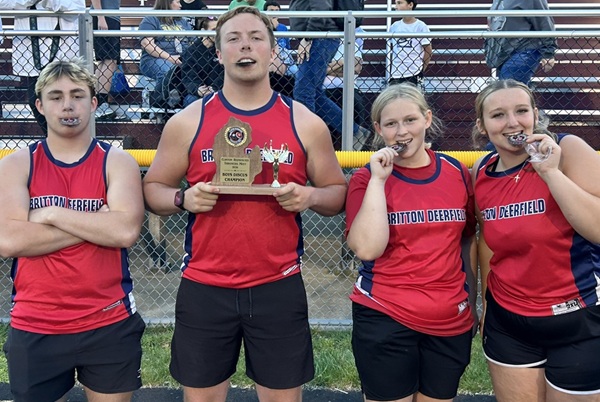
PHOTOS (Top) The Britton Deerfield boys track & field team gathers around coach Dustin Longnecker after winning its Bob Beckey Invitational. (Middle) Patriots throwers (from left) Drew Bunker, Zach Gonzalez, Kurina Dotson and McKenna Allshouse show off their trophy and medals won at the Clinton Throwers Meet. (Photos courtesy of the Britton Deerfield athletic department.)