


Add, Subtract, Divide, Multiply: MHSAA Not Alone
July 25, 2017
By Rob Kaminski
MHSAA benchmarks editor
This is the third part in a series on MHSAA tournament classification, past and present, that will be published over the next two weeks. This series originally ran in this spring's edition of MHSAA benchmarks.
As the MHSAA faces its most recent classification task with 8-Player Football, and opinions continue to swirl about as to the method, timeframe, location and other procedures, a look around the country provides plenty of company among state association brethren factoring variables into their own equations.
In the Pacific Northwest, the Oregon School Activities Association Football Playoffs are under public scrutiny as leadership ponders a five or six classification format beginning with the 2018-19 school year.
The OSAA has crowned six champions on the gridiron since 2006-07. Many of the state’s smaller schools would like to keep it that way, while larger schools lean toward a five-classification system, citing larger leagues, ease of travel and credibility to state championships as the advantages.
Still others would prefer more than six classes, pointing to safety issues and the opportunity to increase participation numbers as positives.
Moving southeast of Oregon, the Nevada Interscholastic Activities Association recently voted to hold serve on a classification proposal that was volleyed to the membership.
However, changes still could be forthcoming by as early as the 2018-19 season which would add a fifth classification in more populated southern Nevada while allowing northern schools to participate in four classifications. Such divisions could mean no state championship for the fifth class in southern Nevada.
Because of that, the NIAA wants equal numbers of schools in each classification on both ends of the state. Complicating the issue is the fact that the 24 largest schools in the state, by enrollment, are all in Clark County in Southern Nevada.
Across Nevada’s border into Arizona, charter schools are asking the Arizona Interscholastic Association to reconsider classification that was voted upon and approved in September 2015. That agreement called for the largest 33 percent of charter schools by enrollment to be placed in the state’s largest school classification, 3A, the middle 33 percent into 2A, and the smallest 33 percent into 1A.
Less than two years later the charter schools have had a change of heart and have asked to be considered the same as other Arizona public schools and be placed appropriately by enrollment beginning with the 2018-19 school year.
The situation in Arizona further illustrates how the public/private debate that all state associations have faced throughout existence now has the added dynamic of rapidly growing charter schools in today’s educational system, along with virtual school enrollment.
In the nation’s heartland, Nebraska has retooled its football classifications by using enrollment of boys students only in its schools rather than total enrollment. The Nebraska School Activities Association football-playing schools will kick off the 2018 season using this alignment.
Nebraska has three classes of 11-player football, with the smallest class divided in two, Class C-1 and C-2. The state also will have 8-player football for boys enrollments under 47, and the NSAA will sponsor a new 6-player tournament in 2018 for schools with 27 or fewer boys.
“This is a good proposal because some schools have a sizable imbalance between the number of boys and girls, and there’s a large gap (in enrollment) between the largest and smallest schools in Classes A and B,” NSAA executive director Jim Tenopir said. “I think this addresses both of those concerns.”
Swimmers in Georgia, meanwhile, will feel like they are moving with the current, rather than upstream in 2017-18, as the Georgia High School Association recently doubled the number of team championship events from two to four.
Swim enthusiasts can also count on longer days at the finals, as the top 30 finishers from the prelims will advance to the finals instead of 20, and all championship events will have three heats versus two.
MHSAA Women In Sports Leadership Conference to Celebrate Multiple Milestones
By
Geoff Kimmerly
MHSAA.com senior editor
September 14, 2022
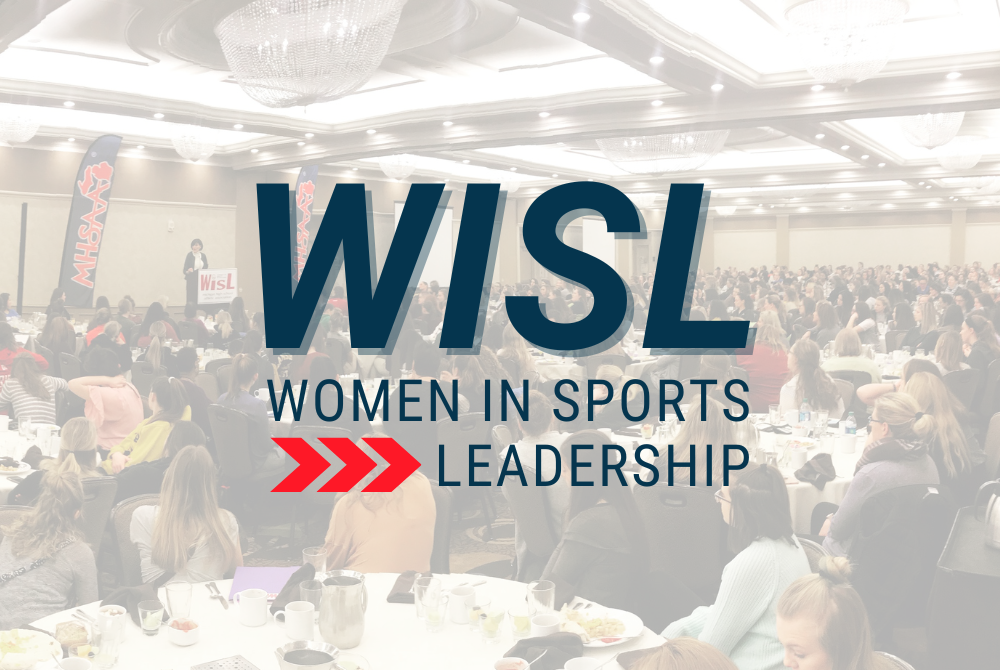
A pair of milestones will be celebrated by the Michigan High School Athletic Association during this year’s Women In Sports Leadership Conference, to be presented Sunday, Oct. 9, and Monday, Oct. 10 at Crowne Plaza Lansing West for 600 participants, most of them high school female student-athletes from across the state.
A theme of “Power of the Past – Force of the Future” will recall opportunities created during the 50 years since the enactment of Title IX in 1972. This also will be the 25th WISL Conference, which remains the first, largest and longest-running program of its type in the country.
This year’s edition again will feature three keynote speakers and a variety of workshops. The opening address will be delivered by Ashley Baker, who serves as the chief diversity, equity and inclusion (DEI) officer at Michigan State University. Baker, originally from Pontiac, earned bachelor and master’s degrees from Bowling Green State University and a doctorate in sport management and policy from the University of Georgia. She came to MSU in December 2020 from Xavier University (Louisiana) where she most recently had served as assistant vice president for student affairs and chief inclusion officer/deputy Title IX coordinator.
First-year Spartans softball coach Sharonda McDonald-Kelley will speak during the Oct. 9 evening general session. She coached Campbell University (N.C.) to back-to-back NCAA Tournament appearances and was a four-time all-Big 12 selection as a player at Texas A&M, appearing in the College World Series before playing professionally for seven years. McDonald-Kelley was named Big South Conference Coach of the Year in 2021, and previously also coached professionally and as associate head coach at Texas Tech University after serving as an assistant for multiple prestigious college programs.
University of Michigan women’s basketball coach Kim Barnes-Arico will speak during the morning session Oct. 10. She led the Wolverines last season to their first NCAA Tournament Elite Eight and is nearing 500 career victories, having won a U-M program-record 218 during her 10 seasons. She’s a two-time Big Ten Conference Coach of Year and was a semifinalist this past season for the Werner Ladder Naismith Coach of the Year honor. Michigan is her fifth college coaching stop; she came to Ann Arbor after 10 seasons at St. John’s. She played basketball one season at Stony Brook University (N.Y.) and then her final three including two as captain at Montclair State University (N.J.).
Workshops offered during the WISL Conference include topics on coaching, teaching and learning leadership; sports nutrition and performance, and injury prevention; and empowerment and goal-setting. Presenters are accomplished in their fields and represent a wide range of backgrounds in sport.
A complete itinerary is available on the MHSAA Website.
The Oct. 9 evening general session also will include recognition for the 2022 Women In Sports Leadership Award winner – recently-retired Livonia Stevenson athletic director Lori Hyman. A basketball standout at MSU during the second half of the 1970s, Hyman went on to coach college basketball for 17 years and then serve as a highly-regarded athletic director for 27 years including the last 22 at her alma mater Stevenson.
Follow the #WISL hashtag on Twitter and Instagram to learn more about the conference’s activities.