


Add, Subtract, Divide, Multiply: MHSAA Not Alone
July 25, 2017
By Rob Kaminski
MHSAA benchmarks editor
This is the third part in a series on MHSAA tournament classification, past and present, that will be published over the next two weeks. This series originally ran in this spring's edition of MHSAA benchmarks.
As the MHSAA faces its most recent classification task with 8-Player Football, and opinions continue to swirl about as to the method, timeframe, location and other procedures, a look around the country provides plenty of company among state association brethren factoring variables into their own equations.
In the Pacific Northwest, the Oregon School Activities Association Football Playoffs are under public scrutiny as leadership ponders a five or six classification format beginning with the 2018-19 school year.
The OSAA has crowned six champions on the gridiron since 2006-07. Many of the state’s smaller schools would like to keep it that way, while larger schools lean toward a five-classification system, citing larger leagues, ease of travel and credibility to state championships as the advantages.
Still others would prefer more than six classes, pointing to safety issues and the opportunity to increase participation numbers as positives.
Moving southeast of Oregon, the Nevada Interscholastic Activities Association recently voted to hold serve on a classification proposal that was volleyed to the membership.
However, changes still could be forthcoming by as early as the 2018-19 season which would add a fifth classification in more populated southern Nevada while allowing northern schools to participate in four classifications. Such divisions could mean no state championship for the fifth class in southern Nevada.
Because of that, the NIAA wants equal numbers of schools in each classification on both ends of the state. Complicating the issue is the fact that the 24 largest schools in the state, by enrollment, are all in Clark County in Southern Nevada.
Across Nevada’s border into Arizona, charter schools are asking the Arizona Interscholastic Association to reconsider classification that was voted upon and approved in September 2015. That agreement called for the largest 33 percent of charter schools by enrollment to be placed in the state’s largest school classification, 3A, the middle 33 percent into 2A, and the smallest 33 percent into 1A.
Less than two years later the charter schools have had a change of heart and have asked to be considered the same as other Arizona public schools and be placed appropriately by enrollment beginning with the 2018-19 school year.
The situation in Arizona further illustrates how the public/private debate that all state associations have faced throughout existence now has the added dynamic of rapidly growing charter schools in today’s educational system, along with virtual school enrollment.
In the nation’s heartland, Nebraska has retooled its football classifications by using enrollment of boys students only in its schools rather than total enrollment. The Nebraska School Activities Association football-playing schools will kick off the 2018 season using this alignment.
Nebraska has three classes of 11-player football, with the smallest class divided in two, Class C-1 and C-2. The state also will have 8-player football for boys enrollments under 47, and the NSAA will sponsor a new 6-player tournament in 2018 for schools with 27 or fewer boys.
“This is a good proposal because some schools have a sizable imbalance between the number of boys and girls, and there’s a large gap (in enrollment) between the largest and smallest schools in Classes A and B,” NSAA executive director Jim Tenopir said. “I think this addresses both of those concerns.”
Swimmers in Georgia, meanwhile, will feel like they are moving with the current, rather than upstream in 2017-18, as the Georgia High School Association recently doubled the number of team championship events from two to four.
Swim enthusiasts can also count on longer days at the finals, as the top 30 finishers from the prelims will advance to the finals instead of 20, and all championship events will have three heats versus two.
Riverview Gabriel Richard, Beal City Make Right Plays When Needed Most
By
Keith Dunlap
Special for MHSAA.com
June 16, 2022
EAST LANSING – Up until there were two outs in the top of the seventh inning of its Division 4 Semifinal on Thursday, Riverview Gabriel Richard was winning with an unusual formula.
At that point, the Pioneers had three more errors (5) than hits (2), but still found themselves up a run as they looked for some insurance.
After the first two batters made outs, the Pioneers found insurance, and then some.
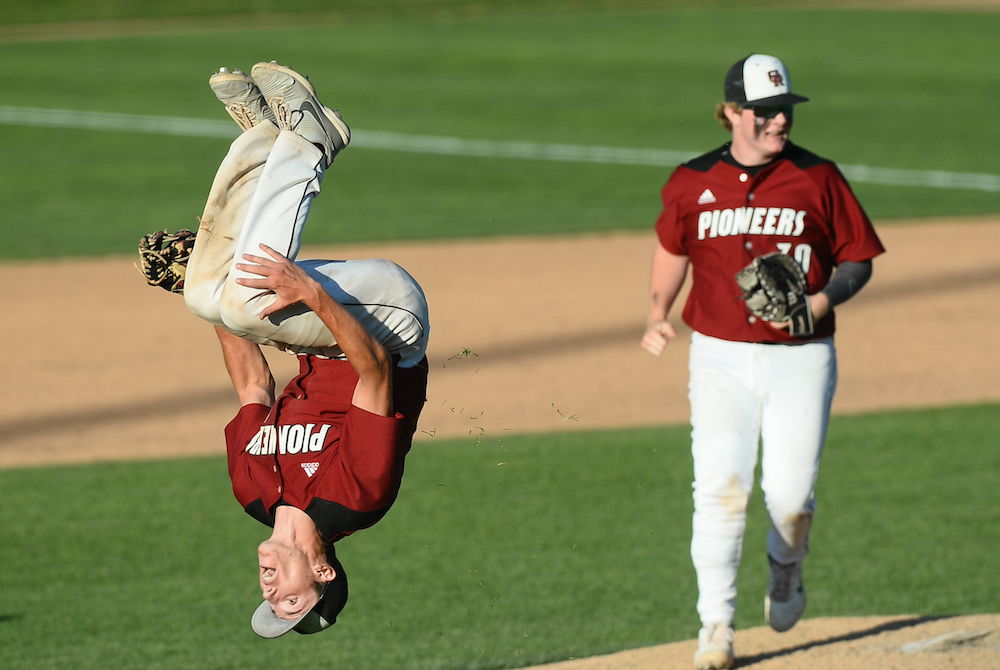
With a lengthy two-out rally, Gabriel Richard tacked on six runs en route to a 10-3 win over Rudyard.
The Pioneers (16-12) are headed back to Finals day with an opportunity to add to their Division 3 title in 2018.
“It definitely wasn’t the way we drew it up,” Gabriel Richard coach Mike Magier said. “We actually have been playing pretty clean. I don’t know if was nerves or what, but we just didn’t play a very good game today. We finally did wake up and hit some balls there in the seventh inning.”
Gabriel Richard was cruising along with a 4-0 lead and two outs in the sixth, but Rudyard got on the board when senior Austin Warner singled and then scored on a two-out throwing error.
The rally continued and the Bulldogs pulled to within 4-3 on another two-out error and an RBI single by sophomore Eli Sprague.
But Gabriel Richard got the runs back in the seventh.
With the bases loaded and two outs, Gabriel Richard took a 5-3 lead on a wild pitch, and then senior Ashton Nowak delivered a two-run single to make it 7-3.
“It felt really good,” Nowak said. “Especially since I haven’t been really doing well at the plate the last couple of games. I’ve been getting on base, but not a lot of big hits. That was really nice.”
Senior Brenden Hills followed Nowak with an RBI single, a Rudyard error made it 9-3, and then another wild pitch scored a run to make it 10-3.
Senior Connor Silka didn’t allow an earned run in six innings of work on the mound, then Nowak pitched a scoreless seventh to finish the game for Gabriel Richard.
Rudyard had troubles in the field as well, committing four errors, allowing four unearned runs and throwing eight wild pitches.
Gabriel Richard opened the scoring in the first inning, taking a 1-0 lead on an RBI groundout by Hills that scored Nowak, who was hit by a pitch to start the inning, took second on a throwing error and went to third on a wild pitch.
The score remained that way until the fifth inning when Gabriel Richard loaded the bases with nobody out and took a 2-0 lead on a sacrifice fly by senior Bryan Tuttle.
The Pioneers took a 3-0 lead on a two-out error. Gabriel Richard added another run in the sixth inning on another two-out error by the Bulldogs that made it 4-0.
Rudyard, which was making its first Semifinal appearance, finished 28-7-1.
Beal City 14, Whitmore Lake 4 (6 innings)
No. 1-ranked Beal City certainly didn’t play its cleanest game of the year, but ultimately did what it had to in advancing to its seventh championship game.
The Aggies overcame three errors and six walks allowed during the first three innings by banging out 17 hits.
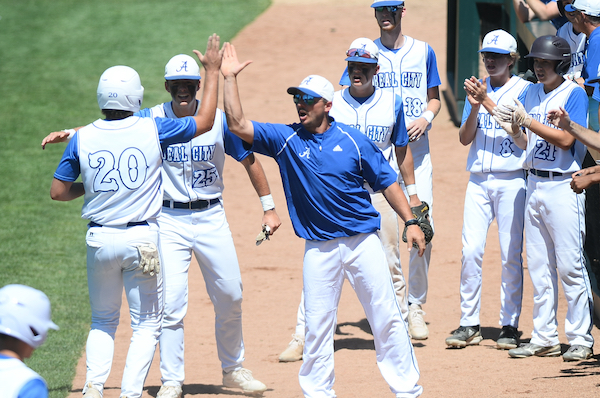 Beal City (30-2) employed a bunt game that was largely responsible for five Whitmore Lake errors and other defensive lapses.
“I told my kids that back in 2018 when we won it, we could bunt, but you guys can’t bunt,” said Beal City coach Steve Pickens, referring to Division 4 championship team in 2018. “We have worked on bunting all year. The best practice we had all year was (Wednesday), and I said that we were going to be able to win bunting. We bunted.”
Whitmore Lake took a 2-0 lead in the top of the first inning, loading the bases on a single by Zane Gregg, double by Alex Di Dio and walk before plating its runs on a double-play groundout and wild pitch.
Beal City answered in the bottom of the first, cutting its deficit to 2-1 on an RBI double by senior Hunter Miles. The Aggies then scored three runs in the second inning to take a 4-2 lead, mainly using their bunt game including a pair of bunt singles.
Whitmore Lake answered in the third inning, taking advantage of three walks, two errors and a misplay in the outfield to score two runs and tie the game at 4-4. But in the fifth inning, Beal City took a 5-4 lead on an RBI bunt single by Konnor Wilson.
The Aggies made it 8-4 scoring three runs in the fourth inning on another bunt single by Wilson, an RBI sacrifice fly by Wade Wilson and an RBI triple by sophomore Jack Fussman. They scored three more in the fifth inning, thanks in large part to RBI singles by Miles and Josh Wilson, to go up 11-4.
Beal City then finished out the game by scoring three runs in the sixth inning to evoke the 10-run differential rule.
Miles and senior Kaiden Andrews each had three RBI for Beal City.
Di Dio had three hits for Whitmore Lake (22-10), which had advanced to the Semifinals for the first time.
“We just didn’t take care of the little things today,” Whitmore Lake coach Hank Dreffs said. “Couldn’t be prouder of this team. Program history by making it all the way to East Lansing. Hats off to Beal City. They got their small-ball game going against us, and let the ball fly.”
PHOTOS (Top) Riverview Gabriel Richard celebrates Thursday’s Semifinal win with a backflip. (Middle) Beal City congratulates Wade Wilson (20) after he crosses the plate during the second inning.