


Add, Subtract, Divide, Multiply: MHSAA Not Alone
July 25, 2017
By Rob Kaminski
MHSAA benchmarks editor
This is the third part in a series on MHSAA tournament classification, past and present, that will be published over the next two weeks. This series originally ran in this spring's edition of MHSAA benchmarks.
As the MHSAA faces its most recent classification task with 8-Player Football, and opinions continue to swirl about as to the method, timeframe, location and other procedures, a look around the country provides plenty of company among state association brethren factoring variables into their own equations.
In the Pacific Northwest, the Oregon School Activities Association Football Playoffs are under public scrutiny as leadership ponders a five or six classification format beginning with the 2018-19 school year.
The OSAA has crowned six champions on the gridiron since 2006-07. Many of the state’s smaller schools would like to keep it that way, while larger schools lean toward a five-classification system, citing larger leagues, ease of travel and credibility to state championships as the advantages.
Still others would prefer more than six classes, pointing to safety issues and the opportunity to increase participation numbers as positives.
Moving southeast of Oregon, the Nevada Interscholastic Activities Association recently voted to hold serve on a classification proposal that was volleyed to the membership.
However, changes still could be forthcoming by as early as the 2018-19 season which would add a fifth classification in more populated southern Nevada while allowing northern schools to participate in four classifications. Such divisions could mean no state championship for the fifth class in southern Nevada.
Because of that, the NIAA wants equal numbers of schools in each classification on both ends of the state. Complicating the issue is the fact that the 24 largest schools in the state, by enrollment, are all in Clark County in Southern Nevada.
Across Nevada’s border into Arizona, charter schools are asking the Arizona Interscholastic Association to reconsider classification that was voted upon and approved in September 2015. That agreement called for the largest 33 percent of charter schools by enrollment to be placed in the state’s largest school classification, 3A, the middle 33 percent into 2A, and the smallest 33 percent into 1A.
Less than two years later the charter schools have had a change of heart and have asked to be considered the same as other Arizona public schools and be placed appropriately by enrollment beginning with the 2018-19 school year.
The situation in Arizona further illustrates how the public/private debate that all state associations have faced throughout existence now has the added dynamic of rapidly growing charter schools in today’s educational system, along with virtual school enrollment.
In the nation’s heartland, Nebraska has retooled its football classifications by using enrollment of boys students only in its schools rather than total enrollment. The Nebraska School Activities Association football-playing schools will kick off the 2018 season using this alignment.
Nebraska has three classes of 11-player football, with the smallest class divided in two, Class C-1 and C-2. The state also will have 8-player football for boys enrollments under 47, and the NSAA will sponsor a new 6-player tournament in 2018 for schools with 27 or fewer boys.
“This is a good proposal because some schools have a sizable imbalance between the number of boys and girls, and there’s a large gap (in enrollment) between the largest and smallest schools in Classes A and B,” NSAA executive director Jim Tenopir said. “I think this addresses both of those concerns.”
Swimmers in Georgia, meanwhile, will feel like they are moving with the current, rather than upstream in 2017-18, as the Georgia High School Association recently doubled the number of team championship events from two to four.
Swim enthusiasts can also count on longer days at the finals, as the top 30 finishers from the prelims will advance to the finals instead of 20, and all championship events will have three heats versus two.
Spring Lake Ace with Basketball Name Showing Off Buckets of Golf Game
By
Tom Kendra
Special for MHSAA.com
June 7, 2022
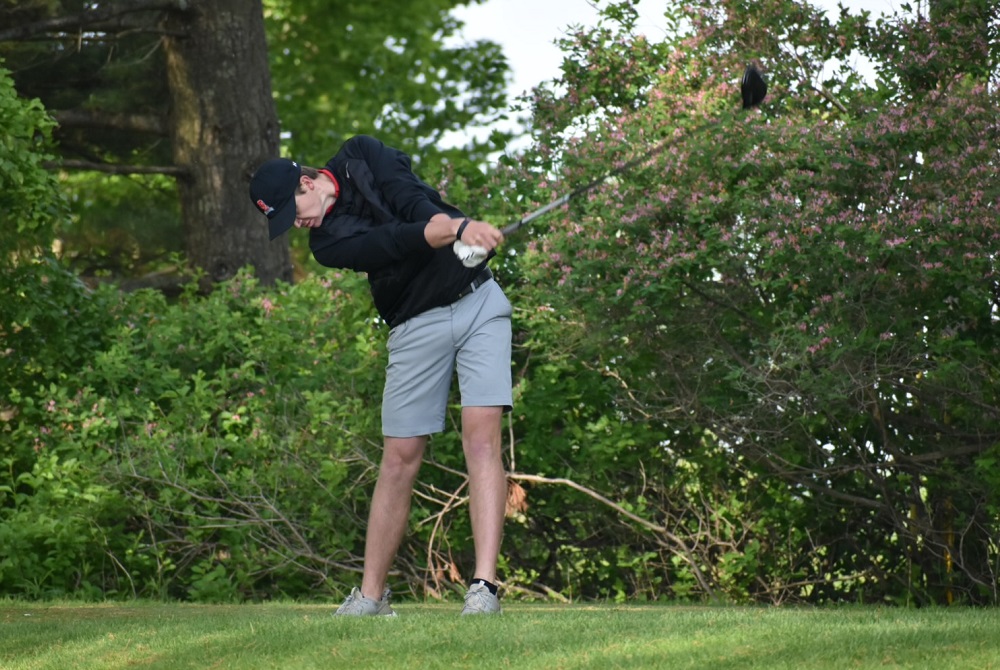
His last name may be associated with basketball, but Spring Lake senior Evan McDermott is making a name for himself on the golf course.
 McDermott’s uncle, Greg, is the longtime men’s basketball coach at Creighton University (Neb.). Greg’s son and Evan’s cousin, Doug, was a three-time, All-American basketball player for his father at Creighton, who recently completed his eighth season in the NBA, currently with the San Antonio Spurs.
Evan McDermott is putting his 6-foot-4 frame and athletic ability to use on the golf course, where the slim bomber has emerged as one of the state’s best players.
“For a long time, I thought I was going to be a basketball player, because that’s obviously big in our family,” said Evan, a 3.9-GPA student who did play basketball for the Lakers. “But then I fell in love with golf.”
McDermott captured the medalist honor with a 3-under par 69 at last week’s Lower Peninsula Division 2 Regional at Lincoln Hills in Ludington, helping the Lakers to the team championship.
He and his teammates are putting in the work and hoping for a similar result at this weekend’s Division 2 Final at The Meadows at Grand Valley State University in nearby Allendale.
McDermott can’t think of a better place to conclude his high school career because, outside of the course he grew up playing (Terra Verde in Nunica) and the Lakers’ home course (Spring Lake Country Club), it’s the golf course that he has played the most.
It also helps that one of his biggest mentors in the sport during his high school career happens to be GVSU men’s golf coach Gary Bissell, who is Director of Instruction at The Meadows.
And, finally, he and his teammates have good memories from their last tournament at the links-style course. Spring Lake won the Gull Lake Invitational at The Meadows on May 19, a tournament which featured 11 of the state’s top 16 teams in Division 2, and McDermott placed second overall with a 71.
 First-year Spring Lake coach Dan Start thinks the combination of a familiar course and an experienced team – with a leader like McDermott – could help the Lakers improve on last year’s eighth-place Finals finish.
“We have played three competitive rounds at The Meadows already this year, so that’s a big plus,” said Start. “All of our guys have the ability to score well, but I like what I saw at Regionals. We had struggles early, but the guys battled and battled and got themselves back on track.”
Max Brown has emerged as a solid No. 2 man for the Lakers, coming up big at Regionals with a 75. Senior cousins Dylan Lisman and RJ Lisman hold down the third and fourth positions, while junior Conrad Bush and senior Braiden McClain have battled for the fifth playing spot.
But without question, McDermott is the leader of the Lakers.
McDermott uses his long, flexible frame to crank drives approaching 300 yards – regularly giving him an edge over his competition. He considers ball-striking his biggest strength, and in recent weeks he’s been heating up on and around the greens.
“I really played well at Regionals. I played the last 11 holes four-under in some big winds,” said McDermott, 18, who has an older sister, Mia, who attends Notre Dame. “I’m just going to try and keep that going at state and not over-complicate things. If it isn’t broke, don’t fix it.”
McDermott, a four-year varsity golfer for SL, first made a name for himself by making a run to the finals at the 2020 Michigan Junior State Amateur at TPC Michigan in Dearborn, the summer before his junior year. He then placed third at last year’s LP Division 2 Final, shooting a 68 in his final round.
This spring, he has picked up where he left off as the steady leader of the Lakers. McDermott powered his team to the Ottawa-Kent Conference Blue title, with the highlight a sizzling 31 at SLCC in a conference jamboree.
“Evan has amazing physical skills, but he also has the mental toughness – he’s steady Eddie,” explained Start. “You combine that with his work ethic, and the sky’s the limit. He could be a professional golfer.”
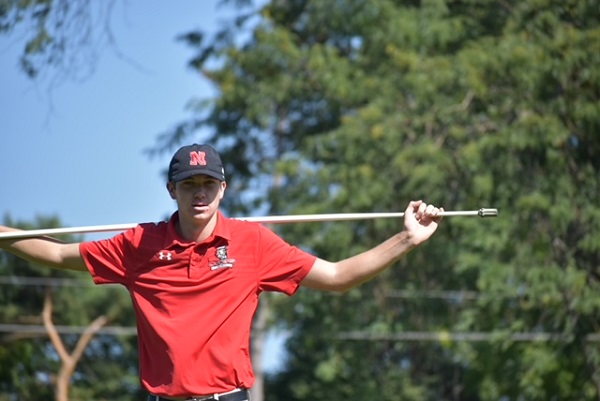
He will take the first step in that direction in August, when he leaves West Michigan to play golf and study mechanical engineering at the University of Nebraska.
McDermott has roots in the Heartland as his father, Marty, grew up in Cascade, Iowa, and later was the head men’s basketball coach at Lake Superior State (where he met his wife and Evan’s mother, Rachel) and the University of Dubuque. He has served as the athletic director at Muskegon Community College for the past 15 years.
Evan McDermott said he was “blown away” by his visit to Lincoln, Neb., in the fall, especially attending the Cornhuskers’ night football game against Michigan.
“It was an incredible atmosphere, and it just felt like home,” McDermott explained. “With my dad’s family from down there, I’ve spent a fair amount of time there growing up. I’m used to the cornfields and the wind and the heat.”
 Tom Kendra worked 23 years at The Muskegon Chronicle, including five as assistant sports editor and the final six as sports editor through 2011. E-mail him at [email protected] with story ideas for Muskegon, Oceana, Mason, Lake, Oceola, Mecosta and Newaygo counties.
PHOTOS (Top) Spring Lake’s Evan McDermott unloads on a drive. (Middle) McDermott will continue his academic and golf careers at University of Nebraska. (Photos courtesy of the Spring Lake boys golf program.)