


Add, Subtract, Divide, Multiply: MHSAA Not Alone
July 25, 2017
By Rob Kaminski
MHSAA benchmarks editor
This is the third part in a series on MHSAA tournament classification, past and present, that will be published over the next two weeks. This series originally ran in this spring's edition of MHSAA benchmarks.
As the MHSAA faces its most recent classification task with 8-Player Football, and opinions continue to swirl about as to the method, timeframe, location and other procedures, a look around the country provides plenty of company among state association brethren factoring variables into their own equations.
In the Pacific Northwest, the Oregon School Activities Association Football Playoffs are under public scrutiny as leadership ponders a five or six classification format beginning with the 2018-19 school year.
The OSAA has crowned six champions on the gridiron since 2006-07. Many of the state’s smaller schools would like to keep it that way, while larger schools lean toward a five-classification system, citing larger leagues, ease of travel and credibility to state championships as the advantages.
Still others would prefer more than six classes, pointing to safety issues and the opportunity to increase participation numbers as positives.
Moving southeast of Oregon, the Nevada Interscholastic Activities Association recently voted to hold serve on a classification proposal that was volleyed to the membership.
However, changes still could be forthcoming by as early as the 2018-19 season which would add a fifth classification in more populated southern Nevada while allowing northern schools to participate in four classifications. Such divisions could mean no state championship for the fifth class in southern Nevada.
Because of that, the NIAA wants equal numbers of schools in each classification on both ends of the state. Complicating the issue is the fact that the 24 largest schools in the state, by enrollment, are all in Clark County in Southern Nevada.
Across Nevada’s border into Arizona, charter schools are asking the Arizona Interscholastic Association to reconsider classification that was voted upon and approved in September 2015. That agreement called for the largest 33 percent of charter schools by enrollment to be placed in the state’s largest school classification, 3A, the middle 33 percent into 2A, and the smallest 33 percent into 1A.
Less than two years later the charter schools have had a change of heart and have asked to be considered the same as other Arizona public schools and be placed appropriately by enrollment beginning with the 2018-19 school year.
The situation in Arizona further illustrates how the public/private debate that all state associations have faced throughout existence now has the added dynamic of rapidly growing charter schools in today’s educational system, along with virtual school enrollment.
In the nation’s heartland, Nebraska has retooled its football classifications by using enrollment of boys students only in its schools rather than total enrollment. The Nebraska School Activities Association football-playing schools will kick off the 2018 season using this alignment.
Nebraska has three classes of 11-player football, with the smallest class divided in two, Class C-1 and C-2. The state also will have 8-player football for boys enrollments under 47, and the NSAA will sponsor a new 6-player tournament in 2018 for schools with 27 or fewer boys.
“This is a good proposal because some schools have a sizable imbalance between the number of boys and girls, and there’s a large gap (in enrollment) between the largest and smallest schools in Classes A and B,” NSAA executive director Jim Tenopir said. “I think this addresses both of those concerns.”
Swimmers in Georgia, meanwhile, will feel like they are moving with the current, rather than upstream in 2017-18, as the Georgia High School Association recently doubled the number of team championship events from two to four.
Swim enthusiasts can also count on longer days at the finals, as the top 30 finishers from the prelims will advance to the finals instead of 20, and all championship events will have three heats versus two.
Hailey Helps Carry Berrien Springs Once More, This Time to 1st Track Title
By
Steve Vedder
Special for MHSAA.com
June 4, 2022
ADA – Don't ask Jamal Hailey to explain winning two MHSAA Finals titles without relying on his best effort.
Don't get Hailey wrong. The Berrien Springs senior is thrilled with not only winning Saturday's 100 and 200-meter dashes, but also helping his somewhat undermanned team to the Lower Peninsula Division 2 Finals championship at Forest Hills Eastern.
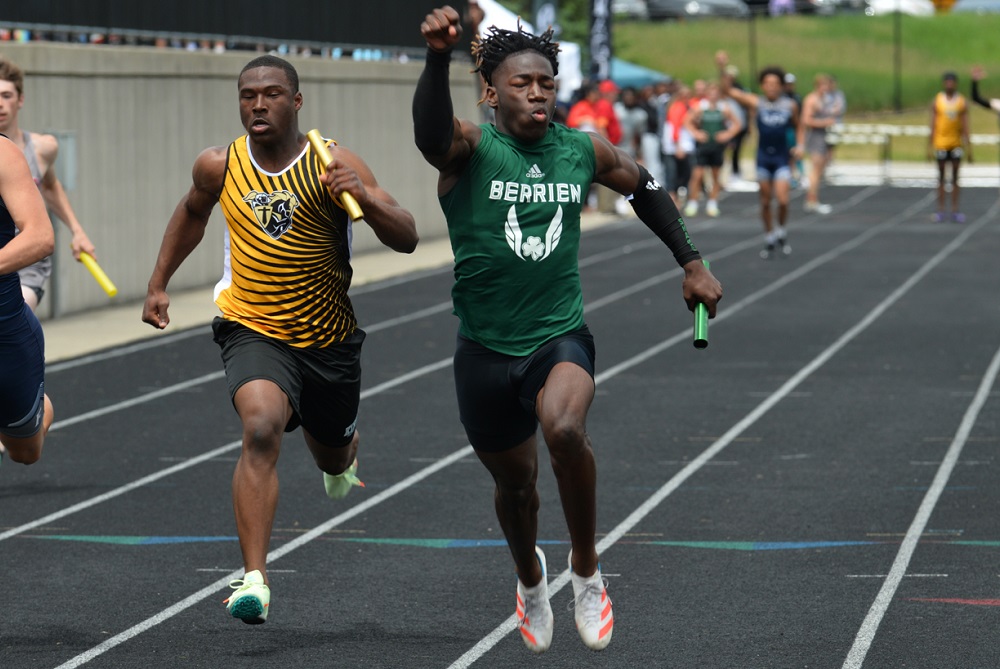
Hailey won the 100 with a time of 10.77, a fraction better than runner-up Ian Thompson (10.78) of Wayland. Hailey also took the 200 (22.11) over second-place Julian Bailey of Dearborn (22.25). Neither winning time was a personal best for Hailey, but he'll gladly take both his individual efforts, which resulted in 20 points. And with his inclusion on the winning 400 relay, the Western Michigan-bound Hailey was part of 30 of the team's 41 points – and nearly equaled the 33 points totaled by runner-up Forest Hills Eastern.
"I can't explain it," Hailey said. "It's preparation, being fortunate and knowing what I came here to do. I came here to win."
What is explainable is Hailey's value to a team which brought just 10 participants to the meet. Most track coaches are more comfortable with 15-20 potential point scorers, Berrien Springs coach Jon Rodriguez said. Hailey is also a standout football player who rushed for more than 2,000 yards and 33 touchdowns last fall.
The team championship was Berrien Springs' first in the sport, to go with runner-up finishes in 1953 and 2018.
"We had an idea we could win because Jamal is so special. He scores a lot of points for us," said Rodriguez, who finished up his 10th year as coach. "If we were healthy, we thought we had a chance to win. It all comes down to who can be best on that day. We were the best today."
Berrien Springs senior James York contributed a key first place in the long jump (22-10).
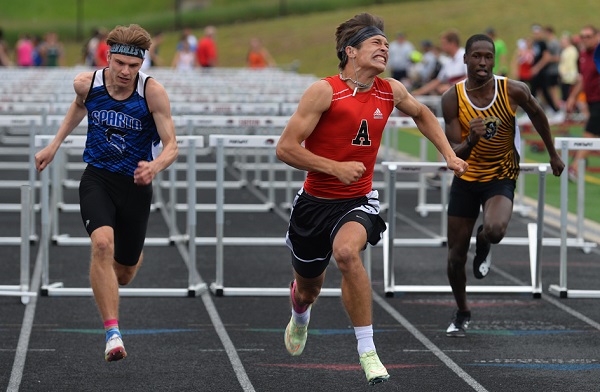 Three other Finals titles were grabbed by longtime friends Patrick Adams of Allendale and Sparta's Lance Riddle. The two seniors have competed back and forth against each other for at least the last six years and culminated in Riddle winning the 300 hurdles (39.28) and Adams capturing the 110 hurdles (14.73). Riddle was third to Adams in the 110 and Adams was only three tenths of a second behind in finishing second to Riddle in the 300.
Adams was the 2021 champ in the 110.
"I ran faster this year," said Adams, who will attend Cornerstone University next season. "But it was definitely more competitive. It's definitely tougher trying to win back-to-back. Me and Lance have been going at it since middle school, so I know him.
"I started kinda slow, but I just trusted my training and ran. The pressure got to me a little, so I just tried harder. Honestly, you just want to get to the finals; nothing is guaranteed in the hurdles. Getting to the final is what counts."
Spring Lake's Ian Hill won the 1,600 (4:16.99) after finishing third a year ago as a junior. Hill said there was one simple explanation for jumping two spots.
"Confidence," he said. "Last year I didn't really give myself a chance. I had a lot of confidence this year even though there are a lot of good runners here. But I was confident in my ability. I have all the respect for the other runners, but I have confidence.”
Even having to bounce back from the flu bug at midseason failed to dent Hill's' confidence. He also helped the 1,600 relay to a first place (3:23.78).
"I knew this would be close, but I thought I had as much a shot as anyone else," said Hill, who will attend Michigan next season. "I'm really happy to win this."
Other champs in the running events were senior Caleb Jarema of Pinckney, who won the 3,200 (9:17.36), and Stuart Gould of Howard City Tri County in the 400 (49.18). Aiden Sullivan of Forest Hills Eastern won the 800 (1:56.40). Whitehall won the 800 relay (1:29.73), while Holland Christian took first in the 3,200 (7:54.35)
Heading the field event winners was Alex Mansfield of Monroe Jefferson, who won the shot put (57-6). The Oakland University-bound Mansfield, who was also runner-up in the discus, said the title came despite some technique difficulties.
"I couldn't get the ball to throw; it kept slipping out of my fingers," he said. "But I got the job done; you still have to perform."
Edwardsburg senior Luke Stowasser successfully repeated in the high jump (6-8). He also won the long jump a year ago, but finished runner-up this time to Berrien Springs’ York.
"It was definitely a lot tougher, but I was more confident this year, which only pushed me to be better," Stowasser said.
Landon Cosby of Charlotte won the pole vault (15-9), while Dalton DeBeau of Frankenmuth took first in the discus (175-7).
Chelsea junior Jacob Nelson competed in one of the first-time adaptive events, in the 100 (33.19).
PHOTOS (Top) Berrien Springs’ Jamal Hailey (in green) crosses the finish first in the 400 relay Saturday, just ahead of Detroit Martin Luther King’s Terrence Brown to his right. (Middle) From left, Sparta’s Lance Riddle, Allendale’s Patrick Adams and King’s Teon Parks stride toward the finish of the 110 hurdles. (Click for more from Dave McCauley/Run Michigan.)