


Add, Subtract, Divide, Multiply: MHSAA Not Alone
July 25, 2017
By Rob Kaminski
MHSAA benchmarks editor
This is the third part in a series on MHSAA tournament classification, past and present, that will be published over the next two weeks. This series originally ran in this spring's edition of MHSAA benchmarks.
As the MHSAA faces its most recent classification task with 8-Player Football, and opinions continue to swirl about as to the method, timeframe, location and other procedures, a look around the country provides plenty of company among state association brethren factoring variables into their own equations.
In the Pacific Northwest, the Oregon School Activities Association Football Playoffs are under public scrutiny as leadership ponders a five or six classification format beginning with the 2018-19 school year.
The OSAA has crowned six champions on the gridiron since 2006-07. Many of the state’s smaller schools would like to keep it that way, while larger schools lean toward a five-classification system, citing larger leagues, ease of travel and credibility to state championships as the advantages.
Still others would prefer more than six classes, pointing to safety issues and the opportunity to increase participation numbers as positives.
Moving southeast of Oregon, the Nevada Interscholastic Activities Association recently voted to hold serve on a classification proposal that was volleyed to the membership.
However, changes still could be forthcoming by as early as the 2018-19 season which would add a fifth classification in more populated southern Nevada while allowing northern schools to participate in four classifications. Such divisions could mean no state championship for the fifth class in southern Nevada.
Because of that, the NIAA wants equal numbers of schools in each classification on both ends of the state. Complicating the issue is the fact that the 24 largest schools in the state, by enrollment, are all in Clark County in Southern Nevada.
Across Nevada’s border into Arizona, charter schools are asking the Arizona Interscholastic Association to reconsider classification that was voted upon and approved in September 2015. That agreement called for the largest 33 percent of charter schools by enrollment to be placed in the state’s largest school classification, 3A, the middle 33 percent into 2A, and the smallest 33 percent into 1A.
Less than two years later the charter schools have had a change of heart and have asked to be considered the same as other Arizona public schools and be placed appropriately by enrollment beginning with the 2018-19 school year.
The situation in Arizona further illustrates how the public/private debate that all state associations have faced throughout existence now has the added dynamic of rapidly growing charter schools in today’s educational system, along with virtual school enrollment.
In the nation’s heartland, Nebraska has retooled its football classifications by using enrollment of boys students only in its schools rather than total enrollment. The Nebraska School Activities Association football-playing schools will kick off the 2018 season using this alignment.
Nebraska has three classes of 11-player football, with the smallest class divided in two, Class C-1 and C-2. The state also will have 8-player football for boys enrollments under 47, and the NSAA will sponsor a new 6-player tournament in 2018 for schools with 27 or fewer boys.
“This is a good proposal because some schools have a sizable imbalance between the number of boys and girls, and there’s a large gap (in enrollment) between the largest and smallest schools in Classes A and B,” NSAA executive director Jim Tenopir said. “I think this addresses both of those concerns.”
Swimmers in Georgia, meanwhile, will feel like they are moving with the current, rather than upstream in 2017-18, as the Georgia High School Association recently doubled the number of team championship events from two to four.
Swim enthusiasts can also count on longer days at the finals, as the top 30 finishers from the prelims will advance to the finals instead of 20, and all championship events will have three heats versus two.

Renaissance Follows Record-Setting Jackson to 1st Division 1 Finals Win
By
Paul Costanzo
Special for MHSAA.com
June 4, 2022
ROCKFORD – Before she even ran a race Saturday, Kaila Jackson had already established herself as one of the best sprinters in MHSAA history.
But in her final meet, she gave everyone at the Lower Peninsula Division 1 Track & Field Finals one final show.
The Detroit Renaissance senior won four Finals titles Saturday, repeating the feat she had accomplished in 2021, and led the Phoenix to their first Division 1 team title.
“The question was asked early in the season if I thought Kaila was one of the all-time great sprinters,” Renaissance co-coach Calvin Johnson said. “She solidified her legacy today. She solidified her legacy. With her going down to Georgia now to be a Bulldog, there’s nothing I can say but they’re getting a great athlete – a great student-athlete. It’s unfortunate they don’t have an MVP trophy, because she should get it, hands down.”
Jackson was responsible for 40 of Renaissance’s 80 points on the day. Three-time reigning champion Oak Park was second with 60. Ann Arbor Huron (55), Holland West Ottawa (47) and Ann Arbor Pioneer (38) rounded out the top five.
It was the first Finals title for Renaissance since 2007, when it finished a run of 10 Division 2/Class B titles over 11 seasons. The Phoenix were runners-up to Oak Park both of the past two seasons.
“It’s well overdue,” Renaissance co-coach Darnell Hall said. “It’s a good honor to finally get that monkey off our back. Especially with a good group of girls, the elite kids we have, this was the last thing they needed to solidify their legacy in the state of Michigan, was that Michigan state title.”
Jackson won the 100 meters and 200 meters and was part of the winning 400 and 800 relay teams. Olivia Jenkins, Madison Sheard and Jayla Graham joined Jackson on the 400 relay, while Jenkins, Chloe Vines and Jayla Dace joined her on the 800 relay.
Jackson’s winning 200-meter time of 23.51 seconds broke the all-Finals record of 23.74 run by Shayla Mahan of Detroit Mumford in 2006.
 “It feels amazing to break a state record,” Jackson said. “I knew it was going to come, but I’m happy it came now. I worked very hard for this. I just feel so accomplished.”
She won the 100 in 11.64, and the relays came in at 47.01 and 1:38.09, respectively.
“I really work hard for this,” Jackson said. “Everything paid off, all the hard practices, the crying, smiling, it’s paid off. I’ve worked very hard.”
The Phoenix also got a Finals title from Leeah Burr, who won the 400 in 55.05.
Oak Park had three champions on the day, led by Morgan Roundtree’s record-breaking performance in the 300 hurdles. Roundtree’s time of 42.38 broke the LP Division 1 Finals record of 42.64 set by Wyandotte Roosevelt’s Kyana Evans in 2017. Ann Arbor Huron’s Mya Georgiadis was second in the race at 42.52, also breaking the record.
Nonah Waldron won the 100 hurdles for Oak Park in 13.9 seconds, while Drelin Mapp won the long jump with a distance of 18 feet, 2.25 inches.
Two others joined Jackson in winning multiple individual titles on the day.
Allen Park’s Abigail Russell won the discus and the shot put. Her throw of 144-4 in the discus won by nearly seven feet, while her throw of 41-8.25 in the shot put won by eight inches.
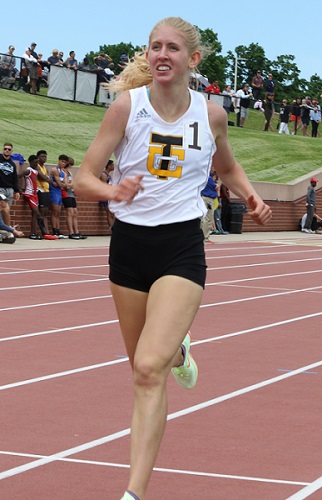
Traverse City Central’s Julia Flynn pulled off the 1,600/800 double, and even came back and placed fifth in the 3,200.
She won the 1,600 in 4:39.75, and the 800 in 2:08. In the 800, she took control of the race about 250 meters in, and never relinquished her lead.
“I wanted to go out in my first lap, not crazy, crazy, crazy fast,” Flynn said. “I let myself ease into the competition a little bit, had girls in front of me. Then, I had the fear of getting boxed in, so then I just peaced out. I was trying to use my competition, I wanted to stay with them a little longer than I did, but I started to get in that inner lane, and I was like, ‘I don’t want to misstep and get DQ’d.”
Dexter’s Sophia Mettes repeated as champion in the pole vault, clearing 13 feet to hold off a tough field.
“Coming into this I was a little nervous, because I knew I had really good competition,” Mettes said. “Natalie Blake (Holland West Ottawa), I’m competing with her next year (at Michigan State), so I’m super excited. She’s been looking so strong. Brooke Bowers (Grand Rapids Forest Hills Central), she’s been looking great, too. I knew I had a lot to look up to, and I was feeling a little tired coming in, but it was a great competition. I just got nervous throughout the whole thing, but my adrenaline kept me going.”
Holland West Ottawa’s Arianne Olson, who was runner-up to Flynn in the 1,600, won the 3,200 by more than 10 seconds, finishing in 10:23.43.
Ann Arbor Pioneer won the 3,200 relay in 8:55.58 with the team of Sylvia Sanok Dufallo, Emily Cooper, Cookie Baugh and Sarah Forsyth.
Ann Arbor Huron won the 1,600 relay in 3:52.81 with the team of Mackenzie Robinson, Jada Wilson, Christabelle Obi and Georgiadis.
Pioneer’s Gabriella Newman won the high jump with a jump of 5-8.
PHOTOS (Top) Detroit Renaissance's Kaila Jackson, front, powers to a win during Saturday's Lower Peninsula Division 1 Finals. (Middle) Traverse City Central's Julia Flynn turns into the straightaway during one of her races. (Click for more from John Brabbs/Run Michigan.)