


Add, Subtract, Divide, Multiply: MHSAA Not Alone
July 25, 2017
By Rob Kaminski
MHSAA benchmarks editor
This is the third part in a series on MHSAA tournament classification, past and present, that will be published over the next two weeks. This series originally ran in this spring's edition of MHSAA benchmarks.
As the MHSAA faces its most recent classification task with 8-Player Football, and opinions continue to swirl about as to the method, timeframe, location and other procedures, a look around the country provides plenty of company among state association brethren factoring variables into their own equations.
In the Pacific Northwest, the Oregon School Activities Association Football Playoffs are under public scrutiny as leadership ponders a five or six classification format beginning with the 2018-19 school year.
The OSAA has crowned six champions on the gridiron since 2006-07. Many of the state’s smaller schools would like to keep it that way, while larger schools lean toward a five-classification system, citing larger leagues, ease of travel and credibility to state championships as the advantages.
Still others would prefer more than six classes, pointing to safety issues and the opportunity to increase participation numbers as positives.
Moving southeast of Oregon, the Nevada Interscholastic Activities Association recently voted to hold serve on a classification proposal that was volleyed to the membership.
However, changes still could be forthcoming by as early as the 2018-19 season which would add a fifth classification in more populated southern Nevada while allowing northern schools to participate in four classifications. Such divisions could mean no state championship for the fifth class in southern Nevada.
Because of that, the NIAA wants equal numbers of schools in each classification on both ends of the state. Complicating the issue is the fact that the 24 largest schools in the state, by enrollment, are all in Clark County in Southern Nevada.
Across Nevada’s border into Arizona, charter schools are asking the Arizona Interscholastic Association to reconsider classification that was voted upon and approved in September 2015. That agreement called for the largest 33 percent of charter schools by enrollment to be placed in the state’s largest school classification, 3A, the middle 33 percent into 2A, and the smallest 33 percent into 1A.
Less than two years later the charter schools have had a change of heart and have asked to be considered the same as other Arizona public schools and be placed appropriately by enrollment beginning with the 2018-19 school year.
The situation in Arizona further illustrates how the public/private debate that all state associations have faced throughout existence now has the added dynamic of rapidly growing charter schools in today’s educational system, along with virtual school enrollment.
In the nation’s heartland, Nebraska has retooled its football classifications by using enrollment of boys students only in its schools rather than total enrollment. The Nebraska School Activities Association football-playing schools will kick off the 2018 season using this alignment.
Nebraska has three classes of 11-player football, with the smallest class divided in two, Class C-1 and C-2. The state also will have 8-player football for boys enrollments under 47, and the NSAA will sponsor a new 6-player tournament in 2018 for schools with 27 or fewer boys.
“This is a good proposal because some schools have a sizable imbalance between the number of boys and girls, and there’s a large gap (in enrollment) between the largest and smallest schools in Classes A and B,” NSAA executive director Jim Tenopir said. “I think this addresses both of those concerns.”
Swimmers in Georgia, meanwhile, will feel like they are moving with the current, rather than upstream in 2017-18, as the Georgia High School Association recently doubled the number of team championship events from two to four.
Swim enthusiasts can also count on longer days at the finals, as the top 30 finishers from the prelims will advance to the finals instead of 20, and all championship events will have three heats versus two.
Preview: UP Boys Finals Feature Fierce Team Races, Statewide Headliners
By
Geoff Kimmerly
MHSAA.com senior editor
June 2, 2022
There’s an excellent chance many statewide eyes turn to Saturday’s Upper Peninsula Boys Track & Field Finals at Kingsford High School.
Start in high jump, where Menominee’s Brady Schultz is one of four athletes sharing the top performance in that event in Michigan this season. Ishpeming’s Jonny Matson is another intriguing story; he’s the top seed in four individual events, and if he wins all four will become just the ninth athlete in state history to do so at the MHSAA Finals. Powers North Central’s Luke Gorzinski and Ewen-Trout Creek’s Jaden Borseth are Division 3 contenders who have starred leading their teams to statewide Finals in football and basketball, respectively.
Of heightened interest closer to home, annual favorites Marquette and Ishpeming could face tough challenges in team title competition from Kingsford and Iron Mountain, respectively. Dollar Bay, a first-time team champ in 2021, will look to add another but with Pickford and Munising perhaps the favorites in Division 3 this time around.
Events begin at 10 a.m. (EDT) and tickets to attend can be purchased online only at GoFan. The meets also will be broadcast on MHSAA.tv and viewable with subscription.
Below is a glance at team contenders and individuals to watch in all three divisions.
Division 1
Team forecast: After seeing its latest Finals win streak end at four with Gladstone taking the 2019 championship, Marquette returned off the COVID year with a win ahead of runner-up Gladstone in 2021. Marquette also was first at its Regional two weeks ago, scoring nearly as many points as the other four teams combined. But watch out for Kingsford. The Flivvers, seeking their first team title since 2014, have qualifiers all over the meet and are seeded to have five event champions. Houghton has similar star power and potential for points.
Dryden Nelson, Calumet senior: The Copper Kings’ standout won the 100 and long jump last year, and he’s seeded first in the 100 (11.31) and second in the 200 (23.58) and long jump (19-11½). He will also run on the 400 relay.
Sasha Olsen, Gladstone senior: Last season’s pole vault champion also was fourth in high jump and is seeded third (5-9) in that event and will run on the 400 relay.
Brady Schultz, Menominee senior: Schultz’s 6-7 in high jump at his Regional was seven inches higher than anyone else in UPD1, and his best of 6-9 remains tied for best in the state this spring. He set the UPD1 meet record last year at 6-8. He’ll also run on three relays including the second-seeded 800 and 1,600.
Lucas Tappy, Kingsford senior: The reigning shot put champion is top-seeded in that event by 3½ feet with a Regional toss of 46-2½.
Carson VanderSchaaf, Marquette junior: This half of the distance twin duo is the top seed in the 1,600 (4:35.72) and 3,200 (9:59.88) and won the 3,200 last season.
Colin VanderSchaaf, Marquette junior: The reigning champ in the 1,600 is second-seeded to his brother by 12 hundredths of a second at 4:35.84 and top-seeded in the 800 (2:05.42) by less than a tenth of a second ahead of Houghton standout Eric Weiss. VanderSchaaf also will run the 400 and on the top-seeded 1,600 relay.
Division 2
Team forecast: The Hematites shared championship last season with Norway was its third straight title and sixth over the last seven seasons. Its Regional win two weeks ago came in part thanks to 10 event championships, and the team has six top seeds based on those performances. Iron Mountain has a qualifier in all but one event Saturday as it seeks its first team title since 2008.
 Eric Edwards, Newberry senior: Last season’s shot put champion is the second seed this time (42-6¼) and will run on two relays including the top-seeded 800.
Nathan Hochstein, L’Anse senior: After sweeping the jumps last spring, Hochstein is the top seed in the high jump (5-7) and fifth in long jump (17-3), and may also run the 400 and on up to two relays.
Christian Koiveniemi, St. Ignace senior: The reigning 100 champ is seeded in the middle of that race and the 200 and tied for the second seed in the high jump (5-6). He’ll also likely run on the top-seeded 400 relay.
Jonny Matson, Ishpeming senior: He enters his first Finals as the top seed in all four of his events – the 100 (11.68), 200 (24.06), 400 (54.06) and long jump (20-0).
Eli Ostermeyer, L’Anse senior: The reigning discus champion is top-seeded in that event (122-9½), and third in shot put (41-9¼) coming off last season’s runner-up finish in that throw.
Landon Sundelius, West Iron County senior: He won the 300 hurdles and was fourth in the 110 last season, but enters Saturday seeded first for both in 41.59 and 17.34, respectively.
Trevor Visnaw, St. Ignace sophomore: Las season’s pole vault champion is seeded second (10-6) and could run two relays, including on the top-seeded 400.
Division 3
Team forecast: Dollar Bay claimed its first Finals championship in this sport last season, edging Pickford by 12 points. Both should be in the mix Saturday, plus Munising is seeking its first team title since winning back-to-back in 2014 and 2015. The Mustangs have top seeds in four events, while Pickford has qualifiers in every event but one. An interesting addition is Norway, which shared the Division 2 championship last season and finished second at its Regional last month to Stephenson.
Jaden Borseth, Ewen-Trout Creek senior: The basketball standout is also a rare four-field event athlete and the top seed in the discus (127-9). He’ll also compete in the shot put and as the third seed in the long jump (18-9½), and placed in high jump as a junior.
Luke Gorzinski, Powers North Central junior: The 8-Player Finals championship quarterback is also the reigning UPD3 champ in the 200. He’s the top seed in the 100 (11.38), second in the 200 (23.92) and could run on two relays including the top-seeded 800.
Trenton Naser, Powers North Central senior: He finished second in the 300 hurdles and fourth in the 110 last season, but is the top seed in both this weekend at 44.04 and 16.94, respectively. He’s also slated for multiple relays including possibly the 800.
Micaiah Peramaki, Munising junior: After finishing runner-up in the 100 and third in the 200 last spring, Peramaki enters seeded second in the 100 (11.72) but first in the 200 (23.65) and 400 (53.31) – and also second-seeded in the discus (121-8).
Nikolas Thomas, Dollar Bay senior: He contributed to Dollar Bay’s first team title scoring points in the 1,600 and 3,200 and as part of last season’s winning 3,200 relay. He’ll have a much larger role in any repeat attempt as the top seed in the 800 (2:06.08), 1,600 (4:44.86) and 3,200 (10:46.15) and fourth seed in the 400 (54.43).
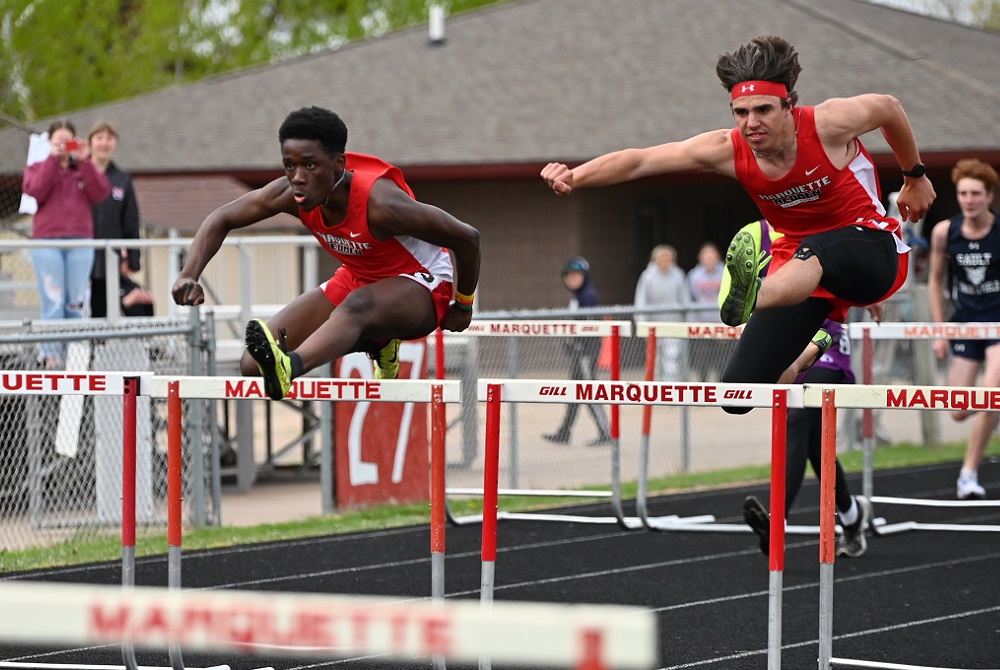
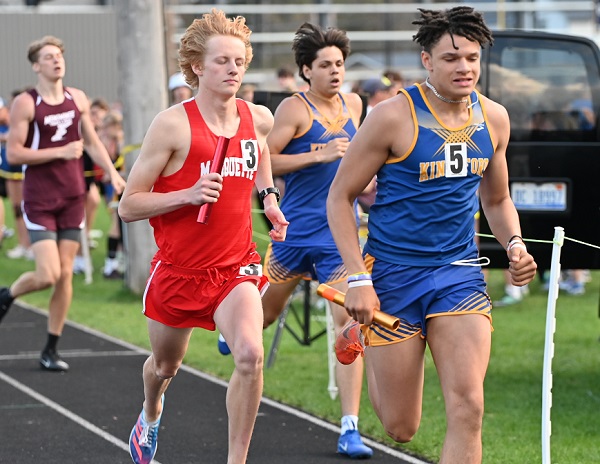
PHOTOS (Top) Marquette’s Lamb Ngafeeson (left) and Samuel Markey are step for step with each other near the start of their 110 hurdles Regional race last month. (Middle) Kingsford’s Cardel Morton (5) retains a slight lead on Marquette’s Colin VanderSchaaf (3) after the final handoff of the 1,600 relay at the May 13 Negaunee Lions Invitational. (Photos by Cara Kamps.)