


Add, Subtract, Divide, Multiply: MHSAA Not Alone
July 25, 2017
By Rob Kaminski
MHSAA benchmarks editor
This is the third part in a series on MHSAA tournament classification, past and present, that will be published over the next two weeks. This series originally ran in this spring's edition of MHSAA benchmarks.
As the MHSAA faces its most recent classification task with 8-Player Football, and opinions continue to swirl about as to the method, timeframe, location and other procedures, a look around the country provides plenty of company among state association brethren factoring variables into their own equations.
In the Pacific Northwest, the Oregon School Activities Association Football Playoffs are under public scrutiny as leadership ponders a five or six classification format beginning with the 2018-19 school year.
The OSAA has crowned six champions on the gridiron since 2006-07. Many of the state’s smaller schools would like to keep it that way, while larger schools lean toward a five-classification system, citing larger leagues, ease of travel and credibility to state championships as the advantages.
Still others would prefer more than six classes, pointing to safety issues and the opportunity to increase participation numbers as positives.
Moving southeast of Oregon, the Nevada Interscholastic Activities Association recently voted to hold serve on a classification proposal that was volleyed to the membership.
However, changes still could be forthcoming by as early as the 2018-19 season which would add a fifth classification in more populated southern Nevada while allowing northern schools to participate in four classifications. Such divisions could mean no state championship for the fifth class in southern Nevada.
Because of that, the NIAA wants equal numbers of schools in each classification on both ends of the state. Complicating the issue is the fact that the 24 largest schools in the state, by enrollment, are all in Clark County in Southern Nevada.
Across Nevada’s border into Arizona, charter schools are asking the Arizona Interscholastic Association to reconsider classification that was voted upon and approved in September 2015. That agreement called for the largest 33 percent of charter schools by enrollment to be placed in the state’s largest school classification, 3A, the middle 33 percent into 2A, and the smallest 33 percent into 1A.
Less than two years later the charter schools have had a change of heart and have asked to be considered the same as other Arizona public schools and be placed appropriately by enrollment beginning with the 2018-19 school year.
The situation in Arizona further illustrates how the public/private debate that all state associations have faced throughout existence now has the added dynamic of rapidly growing charter schools in today’s educational system, along with virtual school enrollment.
In the nation’s heartland, Nebraska has retooled its football classifications by using enrollment of boys students only in its schools rather than total enrollment. The Nebraska School Activities Association football-playing schools will kick off the 2018 season using this alignment.
Nebraska has three classes of 11-player football, with the smallest class divided in two, Class C-1 and C-2. The state also will have 8-player football for boys enrollments under 47, and the NSAA will sponsor a new 6-player tournament in 2018 for schools with 27 or fewer boys.
“This is a good proposal because some schools have a sizable imbalance between the number of boys and girls, and there’s a large gap (in enrollment) between the largest and smallest schools in Classes A and B,” NSAA executive director Jim Tenopir said. “I think this addresses both of those concerns.”
Swimmers in Georgia, meanwhile, will feel like they are moving with the current, rather than upstream in 2017-18, as the Georgia High School Association recently doubled the number of team championship events from two to four.
Swim enthusiasts can also count on longer days at the finals, as the top 30 finishers from the prelims will advance to the finals instead of 20, and all championship events will have three heats versus two.
Escanaba Edges Negaunee to Claim Anticipated Battle for Best in UPD1
By
Jerry DeRoche
Special for MHSAA.com
June 1, 2022
KINGSFORD — All season long, the Escanaba Eskymos and the Negaunee Miners were the top two boys tennis teams in the Upper Peninsula, seemingly on a collision course to fight for the Division 1 championship for the second-straight year.
Turns out that premonition was accurate, and for the second-consecutive season, the Eskymos left with the championship, recording 17 points compared Negaunee’s 15. Marquette finished third with 13, Kingsford took fourth with five, Menominee placed fifth with two points and Gladstone did not score.
Escanaba won flight championships at No. 4 singles, No. 1 doubles, No. 2 doubles and No. 3 doubles. The Eskymos also finished runners-up at No. 2 singles and No. 4 doubles.
“I’m just happy for the kids,” said Escanaba coach Tom Penegor. “This is all about them. They put in a lot of hard work and practice time, and it’s just a bunch of kids that worked together. They deserve this.”
The Eskymos can thank their doubles players for their repeat. At No. 1 doubles, Isaac Maki and Dawson Williams upended James Thomsen and Jace Turri of Negaunee 6-1, 6-2, while No. 2 doubles Joseph Hubert and Joseph Montel defeated Negaunee’s Gavin Downey and Bryce Storms by the same score.
The No. 3 doubles tandem of Connor Smale and Troy Delvaux knocked off Marquette’s Isaac Johnson and Liam McFarren 6-2, 6-4 for the third doubles point.
Escanaba’s other flight championship came off the racquet of Sam Rivera, who battled back from a slow start to get past Mick Kumpala of Negaunee 0-6, 6-2, 6-3.
The No. 1 doubles match was indicative of the Eskymos’ efforts.
“I would say these were some of the best performances we had,” Williams said of his and Maki’s road to the championship. “I’m not going to look back and say, ‘Hey, we could have done better.’”
 Williams, the ground stroker, and Maki, the imposing net presence at 6-foot-4, drew a bye into the second round where they battled past Kingsford’s Isaac Nash and Ben Trevillian 4-6, 7-6, 6-4. With the win in the final, the Escanaba duo closed the season unbeaten and secured their second-straight U.P. Finals title.
Escanaba’s depth was in evidence during its run Wednesday and all season, Penegor said.
“We have 35 kids that went out this year, and that’s unusual,” said the seventh-year Escanaba coach. “There are some teams out there that barely have 12 kids. I think part of that is if you have success, that can bring more kids to play. And Escanaba for many years has been a tennis community. We have had a lot of past U.P. champions, a lot of people that played in college.”
Runner-up Negaunee, which had its three-year run at the top of Division 1 in the Upper Peninsula end last season, received championship efforts from No. 2 singles player Gavin Saunders and No. 3 singles Tyler Lajimodiere. Saunders defeated Nathan Howes of Escanaba 6-2, 7-5, while Lajimodiere knocked off Chase Thomsen of Marquette 6-2, 6-3.
Marquette scored victories in the other two flights. Senior Nick Olivier showed his powerful game in beating Luke Syrjala of Negaunee 6-3, 6-1 at No. 1 singles, and Seppi Camilli and Toby Camilli topped Evan St. Peter and Parker LaFond of Escanaba 6-3, 7-5 at No. 4 doubles.
For Olivier, his title was another in the long line of family U.P. singles championships. His father Wayne won the 1983 No. 1 singles flight, while his brother Alec won four titles at No. 1 singles from 2016 to 2019.
Additionally, Nick’s sister Elysa captured top flight singles championships in 2018 and 2019.
The new family champion said he improved his athleticism and his feet during the summer, and he showed that Wednesday as he was often able to run around his backhand in order to blast away with his forehand.
Olivier said his performance was inspired by the late Jordan DeMay, a friend and basketball teammate at Marquette High School who died in March.
“A lot of motivation to do this,” he said, “was for my friend Jordan.”
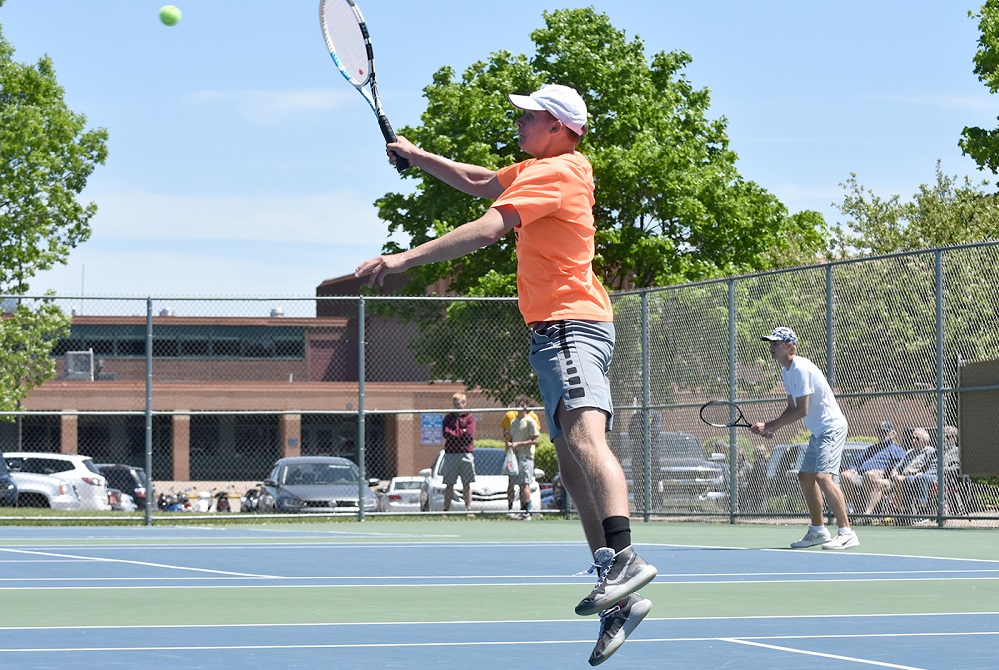
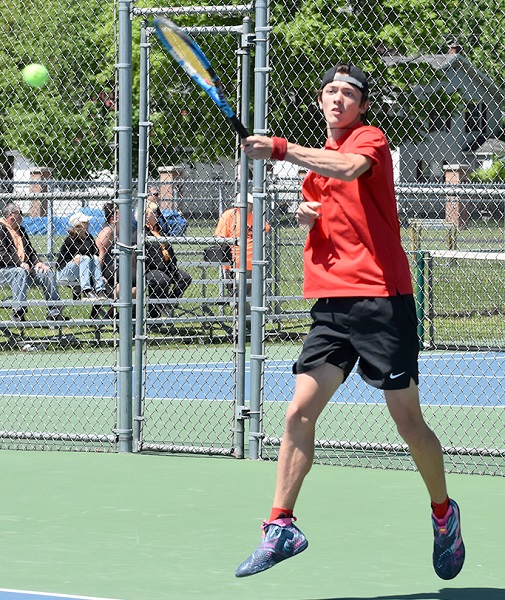
PHOTOS (Top) Escanaba's Nathan Howes gets airborne to return a shot during Wednesday's Division 1 Final at Kingsford. (Middle) Marquette's Nick Olivier returns a volley during a No. 1 singles match. (Photos by Dennis Mansfield.)