Add, Subtract, Divide, Multiply: MHSAA Not Alone
July 25, 2017
By Rob Kaminski
MHSAA benchmarks editor
This is the third part in a series on MHSAA tournament classification, past and present, that will be published over the next two weeks. This series originally ran in this spring's edition of MHSAA benchmarks.
As the MHSAA faces its most recent classification task with 8-Player Football, and opinions continue to swirl about as to the method, timeframe, location and other procedures, a look around the country provides plenty of company among state association brethren factoring variables into their own equations.
In the Pacific Northwest, the Oregon School Activities Association Football Playoffs are under public scrutiny as leadership ponders a five or six classification format beginning with the 2018-19 school year.
The OSAA has crowned six champions on the gridiron since 2006-07. Many of the state’s smaller schools would like to keep it that way, while larger schools lean toward a five-classification system, citing larger leagues, ease of travel and credibility to state championships as the advantages.
Still others would prefer more than six classes, pointing to safety issues and the opportunity to increase participation numbers as positives.
Moving southeast of Oregon, the Nevada Interscholastic Activities Association recently voted to hold serve on a classification proposal that was volleyed to the membership.
However, changes still could be forthcoming by as early as the 2018-19 season which would add a fifth classification in more populated southern Nevada while allowing northern schools to participate in four classifications. Such divisions could mean no state championship for the fifth class in southern Nevada.
Because of that, the NIAA wants equal numbers of schools in each classification on both ends of the state. Complicating the issue is the fact that the 24 largest schools in the state, by enrollment, are all in Clark County in Southern Nevada.
Across Nevada’s border into Arizona, charter schools are asking the Arizona Interscholastic Association to reconsider classification that was voted upon and approved in September 2015. That agreement called for the largest 33 percent of charter schools by enrollment to be placed in the state’s largest school classification, 3A, the middle 33 percent into 2A, and the smallest 33 percent into 1A.
Less than two years later the charter schools have had a change of heart and have asked to be considered the same as other Arizona public schools and be placed appropriately by enrollment beginning with the 2018-19 school year.
The situation in Arizona further illustrates how the public/private debate that all state associations have faced throughout existence now has the added dynamic of rapidly growing charter schools in today’s educational system, along with virtual school enrollment.
In the nation’s heartland, Nebraska has retooled its football classifications by using enrollment of boys students only in its schools rather than total enrollment. The Nebraska School Activities Association football-playing schools will kick off the 2018 season using this alignment.
Nebraska has three classes of 11-player football, with the smallest class divided in two, Class C-1 and C-2. The state also will have 8-player football for boys enrollments under 47, and the NSAA will sponsor a new 6-player tournament in 2018 for schools with 27 or fewer boys.
“This is a good proposal because some schools have a sizable imbalance between the number of boys and girls, and there’s a large gap (in enrollment) between the largest and smallest schools in Classes A and B,” NSAA executive director Jim Tenopir said. “I think this addresses both of those concerns.”
Swimmers in Georgia, meanwhile, will feel like they are moving with the current, rather than upstream in 2017-18, as the Georgia High School Association recently doubled the number of team championship events from two to four.
Swim enthusiasts can also count on longer days at the finals, as the top 30 finishers from the prelims will advance to the finals instead of 20, and all championship events will have three heats versus two.

Montrose's Skinner Center Built to Continue Beloved Mentor's Work
By
Geoff Kimmerly
MHSAA.com senior editor
April 19, 2022
For more than a decade, Montrose High School has provided aspiring students one of the strongest and most lauded high school broadcast journalism programs in Michigan.
And moving forward, those students will have the opportunity to learn the craft at the newly-unveiled studio named in honor of the mentor who poured so much into those efforts.
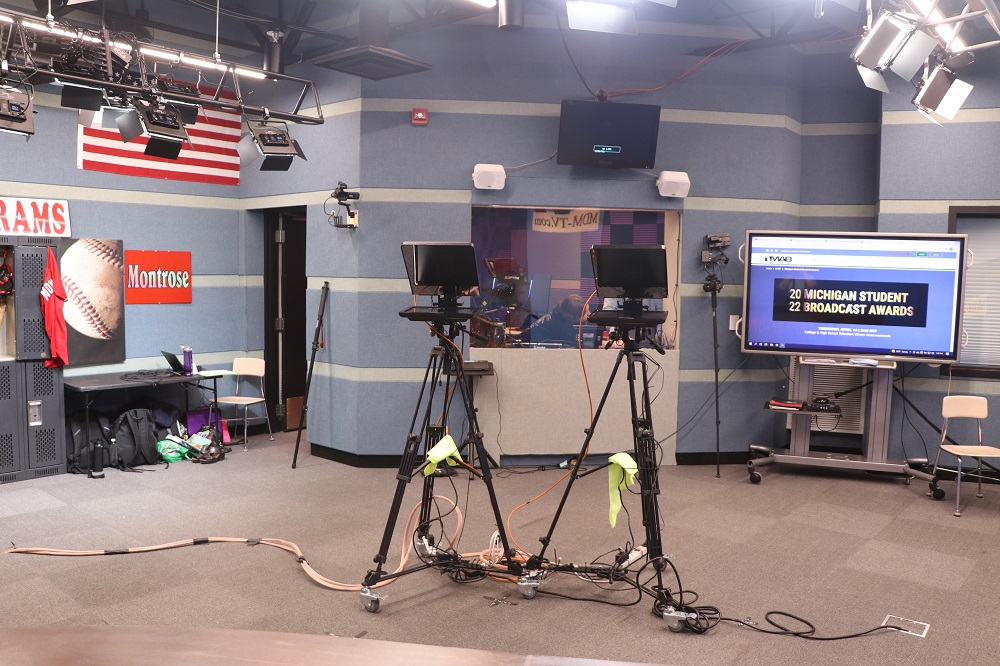
On Thursday, MDM-TV (Montrose Digital Media – Television) opened the doors to its Thomas E. Skinner Broadcast Center, a newly-created video and audio lab, studio and production space named for Tom Skinner, a well-known Flint-area sports broadcasting voice for four decades who played a starring role in building the school’s program over his final 12 years until his death in October.
The goal was to create a fully functioning place where students can learn to create top-notch sports and news products. The network’s new home includes a podcasting lab, video and audio editing lab, studio, and control room/soundproof room for recording voiceovers. The space, formerly a distance learning lab in the middle school used most recently for storage, replaced the former studio housed in a high school classroom. MDM-TV began making the move and transformation after COVID-19 shut down the program during the spring of 2020.
 Longtime teacher Jamie Kitts, who retired from fulltime classroom instruction in 2019 after 33 years in the district and remains the school’s digital media instructor and MDM-TV advisor, played a leading role in the creation of the Skinner Center – and said, frankly, the facility couldn’t have been named after anyone else. Skinner worked with the program’s on-air talent all though his dozen years, and also coordinated the summer camp for seven years.
“Tom is responsible for so much of the great work our kids have done,” Kitts said. “We could not have accomplished what we did without him. Plus, he really enjoyed working with the kids.”
Montrose’s program was named “Program of the Year” five straight from 2014-18 as part of the MHSAA’s School Broadcast Program Excellence Awards. In 2017, then-junior Eric Vandefifer was named the nation’s Best Student Broadcaster by the NFHS Network as part of its School Broadcast Program Awards. Kitts has been a finalist for the NFHS Network’s national Teacher of the Year award multiple times. Current students and Skinner proteges Danny Sackrider and Owen Leitelt recently were named the Best Sports Announcing Team in the high school division by the Michigan Association of Broadcasters – the third time Montrose has produced a winning pair.
The Skinner Center was financed through advertising sales, grants, career and technical education funding and donations, with plenty of volunteer labor and significant support from the district’s administration helping bring it to life.
Students past and present did much of the work, with local “do-everything guy” Joe Crimi playing a major role, and Kitts also gave substantial credit to the network’s sponsors Thumb Audio/Video’s Kevin Strieter.
“My wife, another retired teacher, asked me the other day, ‘What have you learned from building this broadcast center?’” Kitts said. “Typical teacher question! I have learned that even through tough times, you just can't let your dreams die. And that if you need help, just ask for it. People want to help. They just need to be asked.”