


Add, Subtract, Divide, Multiply: MHSAA Not Alone
July 25, 2017
By Rob Kaminski
MHSAA benchmarks editor
This is the third part in a series on MHSAA tournament classification, past and present, that will be published over the next two weeks. This series originally ran in this spring's edition of MHSAA benchmarks.
As the MHSAA faces its most recent classification task with 8-Player Football, and opinions continue to swirl about as to the method, timeframe, location and other procedures, a look around the country provides plenty of company among state association brethren factoring variables into their own equations.
In the Pacific Northwest, the Oregon School Activities Association Football Playoffs are under public scrutiny as leadership ponders a five or six classification format beginning with the 2018-19 school year.
The OSAA has crowned six champions on the gridiron since 2006-07. Many of the state’s smaller schools would like to keep it that way, while larger schools lean toward a five-classification system, citing larger leagues, ease of travel and credibility to state championships as the advantages.
Still others would prefer more than six classes, pointing to safety issues and the opportunity to increase participation numbers as positives.
Moving southeast of Oregon, the Nevada Interscholastic Activities Association recently voted to hold serve on a classification proposal that was volleyed to the membership.
However, changes still could be forthcoming by as early as the 2018-19 season which would add a fifth classification in more populated southern Nevada while allowing northern schools to participate in four classifications. Such divisions could mean no state championship for the fifth class in southern Nevada.
Because of that, the NIAA wants equal numbers of schools in each classification on both ends of the state. Complicating the issue is the fact that the 24 largest schools in the state, by enrollment, are all in Clark County in Southern Nevada.
Across Nevada’s border into Arizona, charter schools are asking the Arizona Interscholastic Association to reconsider classification that was voted upon and approved in September 2015. That agreement called for the largest 33 percent of charter schools by enrollment to be placed in the state’s largest school classification, 3A, the middle 33 percent into 2A, and the smallest 33 percent into 1A.
Less than two years later the charter schools have had a change of heart and have asked to be considered the same as other Arizona public schools and be placed appropriately by enrollment beginning with the 2018-19 school year.
The situation in Arizona further illustrates how the public/private debate that all state associations have faced throughout existence now has the added dynamic of rapidly growing charter schools in today’s educational system, along with virtual school enrollment.
In the nation’s heartland, Nebraska has retooled its football classifications by using enrollment of boys students only in its schools rather than total enrollment. The Nebraska School Activities Association football-playing schools will kick off the 2018 season using this alignment.
Nebraska has three classes of 11-player football, with the smallest class divided in two, Class C-1 and C-2. The state also will have 8-player football for boys enrollments under 47, and the NSAA will sponsor a new 6-player tournament in 2018 for schools with 27 or fewer boys.
“This is a good proposal because some schools have a sizable imbalance between the number of boys and girls, and there’s a large gap (in enrollment) between the largest and smallest schools in Classes A and B,” NSAA executive director Jim Tenopir said. “I think this addresses both of those concerns.”
Swimmers in Georgia, meanwhile, will feel like they are moving with the current, rather than upstream in 2017-18, as the Georgia High School Association recently doubled the number of team championship events from two to four.
Swim enthusiasts can also count on longer days at the finals, as the top 30 finishers from the prelims will advance to the finals instead of 20, and all championship events will have three heats versus two.
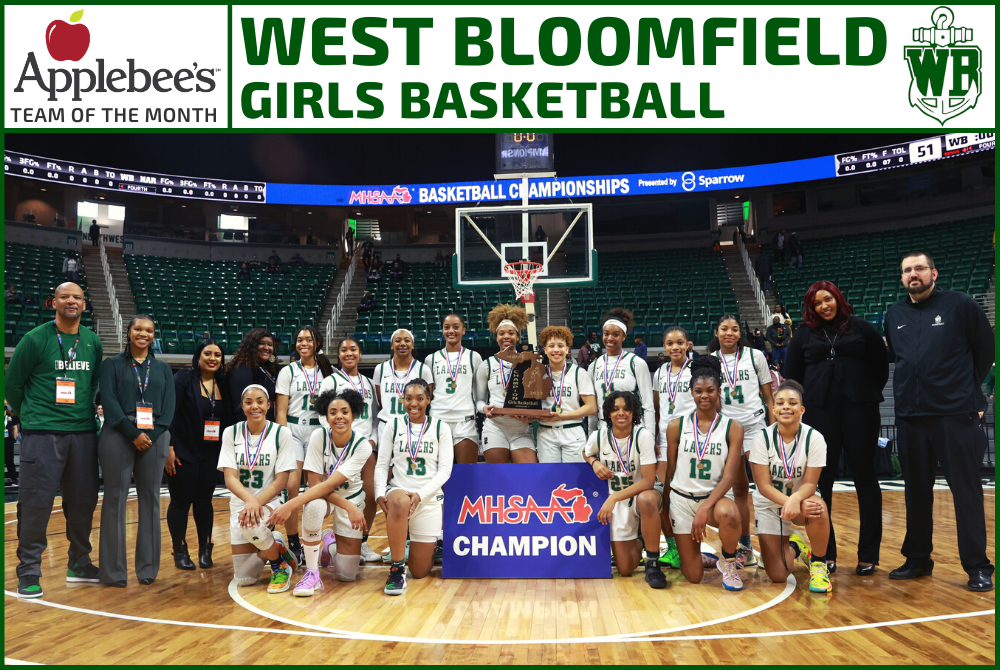
Team of the Month: West Bloomfield Girls Basketball
By
Geoff Kimmerly
MHSAA.com senior editor
April 14, 2022
One of the compelling moments of this season’s Girls Basketball Finals at Michigan State’s Breslin Center came just after the final buzzer of the Division 1 championship game.
As his players rushed each other to celebrate midcourt, West Bloomfield coach Darrin McAllister first leaned forward, hands just above his knees, before moving down into a crouch, head dipped to his chest, obviously breaking down a bit in joy at what his Lakers had just completed.
McCallister had played college football and helped Wayne State’s women’s basketball program to multiple NCAA Sweet 16 appearances as an assistant coach. But what the Lakers did last month – finish reeling off 25 straight wins with their first MHSAA Finals girls basketball championship – made his “Mount Rushmore,” if not much more.
“This is probably at the top,” he said this week, after a month of the experience settling in. “Because I knew the sacrifices that these players made, I knew the sacrifices that the coaches and the parents made, and then for (our players) to speak it into existence that they want to win a state championship, it’s great.”
It was not as easy as the Lakers – the MHSAA/Applebee’s “Team of the Month” for March – frequently made it appear.
Yes, West Bloomfield’s players said on their first day of practice Nov. 12 that they planned on winning the Division 1 championship. And that seemed like a logical goal for a team that eventually will send at least four players to Division I college programs and had won a league title and finished 10-3 during the COVID-interrupted 2020-21 season.
But the Lakers also entered the preseason having graduated five players from that team and with a young but talented lineup needing to learn how to be cohesive and efficient in their roles. Add in that McAllister got a late start, taking over the program after all of the summer training and majority of preseason prep were done.
West Bloomfield lost its season opener 59-46 to Dexter (which would go on to finish 19-3). But a week later, the Lakers started to show what they could do in coming back from a 19-point deficit to defeat Illinois power Bolingbrook 48-47.
Just before the midpoint of the regular season, McAllister could see things taking shape.
“We had talented players, but they were young. So we kinda started it all over and identified our identity,” he said. “Every had to establish their roles and buy into their roles, so it wasn’t easy. I think for me, it makes me more appreciative and makes me enjoy this experience more than anything else.”
Along the way, West Bloomfield repeated as Oakland Activities Association Red champion. Two weeks before the start of the playoffs, the Lakers also accomplished what for a few seasons had seemed unthinkable to most – hand Detroit Edison a 65-62 loss, the Pioneers’ first to an in-state opponent since 2017-18 and after Edison had defeated West Bloomfield by nine and 28 points the season before.
Perhaps the least surprised were the Lakers, who had started believing they could defeat Edison after the Bolingbrook win. They also believed they could compete with every other team as well – and they would continue impressing with a championship run that included wins over Bloomfield Hills Marian (15-7), Farmington Hills Mercy (18-5), Grosse Pointe North (18-6), Troy (13-12), Rockford (23-3) in the Semifinal and Hartland (25-2) in the championship game.
The pair of wins at Breslin showed what West Bloomfield has transformed into this winter. In defeating the Rams 66-63, the Lakers received double-digit scoring from four players – led by sophomore twins Indya Davis with 24 points and Summer Davis with 16 and six assists – with junior Sydney Hendrix posting a double-double of 10 points and 10 rebounds and guard Myonna Hooper setting the high-energy tone along with scoring 14 points. At the same time, senior center Zaneiya Batiste didn’t score and shot only twice – but grabbed nine rebounds, nearly the difference in the Lakers’ rebounding edge.
West Bloomfield defeated Hartland 51-42 with Indya Davis and Hendrix both posting double doubles, Summer Davis again dishing six assists, Hooper again energetically chipping in and Batiste again helping out big on the boards. In both games, sophomores Destiny Washington and Kendall Hendrix came off the bench to provide valuable minutes.
“March was the month everything came together,” McAllister said. “At the end of the (championship) game, I shed tears because it was emotional seeing it come together.”
West Bloomfield felt like it was just trying to catch up much of the season due to McAllister’s taking over late. But now, with five of this season’s top seven players coming back next year, it also feels like the Lakers are just getting started.
“Now I’m excited and looking forward to our offseason,” McCallister said. “I can’t wait to get the players in June and start getting workouts in and going to team camps, because I know that’s only going to make us better for the upcoming season.”
Past Teams of the Month, 2021-22
February: Cadillac girls skiing - Read
January: Hartland hockey - Read
December: Midland Dow girls basketball - Read
November: Reese girls volleyball - Read
October: Birmingham Groves boys tennis - Read