


Add, Subtract, Divide, Multiply: MHSAA Not Alone
July 25, 2017
By Rob Kaminski
MHSAA benchmarks editor
This is the third part in a series on MHSAA tournament classification, past and present, that will be published over the next two weeks. This series originally ran in this spring's edition of MHSAA benchmarks.
As the MHSAA faces its most recent classification task with 8-Player Football, and opinions continue to swirl about as to the method, timeframe, location and other procedures, a look around the country provides plenty of company among state association brethren factoring variables into their own equations.
In the Pacific Northwest, the Oregon School Activities Association Football Playoffs are under public scrutiny as leadership ponders a five or six classification format beginning with the 2018-19 school year.
The OSAA has crowned six champions on the gridiron since 2006-07. Many of the state’s smaller schools would like to keep it that way, while larger schools lean toward a five-classification system, citing larger leagues, ease of travel and credibility to state championships as the advantages.
Still others would prefer more than six classes, pointing to safety issues and the opportunity to increase participation numbers as positives.
Moving southeast of Oregon, the Nevada Interscholastic Activities Association recently voted to hold serve on a classification proposal that was volleyed to the membership.
However, changes still could be forthcoming by as early as the 2018-19 season which would add a fifth classification in more populated southern Nevada while allowing northern schools to participate in four classifications. Such divisions could mean no state championship for the fifth class in southern Nevada.
Because of that, the NIAA wants equal numbers of schools in each classification on both ends of the state. Complicating the issue is the fact that the 24 largest schools in the state, by enrollment, are all in Clark County in Southern Nevada.
Across Nevada’s border into Arizona, charter schools are asking the Arizona Interscholastic Association to reconsider classification that was voted upon and approved in September 2015. That agreement called for the largest 33 percent of charter schools by enrollment to be placed in the state’s largest school classification, 3A, the middle 33 percent into 2A, and the smallest 33 percent into 1A.
Less than two years later the charter schools have had a change of heart and have asked to be considered the same as other Arizona public schools and be placed appropriately by enrollment beginning with the 2018-19 school year.
The situation in Arizona further illustrates how the public/private debate that all state associations have faced throughout existence now has the added dynamic of rapidly growing charter schools in today’s educational system, along with virtual school enrollment.
In the nation’s heartland, Nebraska has retooled its football classifications by using enrollment of boys students only in its schools rather than total enrollment. The Nebraska School Activities Association football-playing schools will kick off the 2018 season using this alignment.
Nebraska has three classes of 11-player football, with the smallest class divided in two, Class C-1 and C-2. The state also will have 8-player football for boys enrollments under 47, and the NSAA will sponsor a new 6-player tournament in 2018 for schools with 27 or fewer boys.
“This is a good proposal because some schools have a sizable imbalance between the number of boys and girls, and there’s a large gap (in enrollment) between the largest and smallest schools in Classes A and B,” NSAA executive director Jim Tenopir said. “I think this addresses both of those concerns.”
Swimmers in Georgia, meanwhile, will feel like they are moving with the current, rather than upstream in 2017-18, as the Georgia High School Association recently doubled the number of team championship events from two to four.
Swim enthusiasts can also count on longer days at the finals, as the top 30 finishers from the prelims will advance to the finals instead of 20, and all championship events will have three heats versus two.
Beecher's Townsend Ready to Lead Chase Among State's Speediest Sprinters
By
Paul Costanzo
Special for MHSAA.com
April 13, 2022
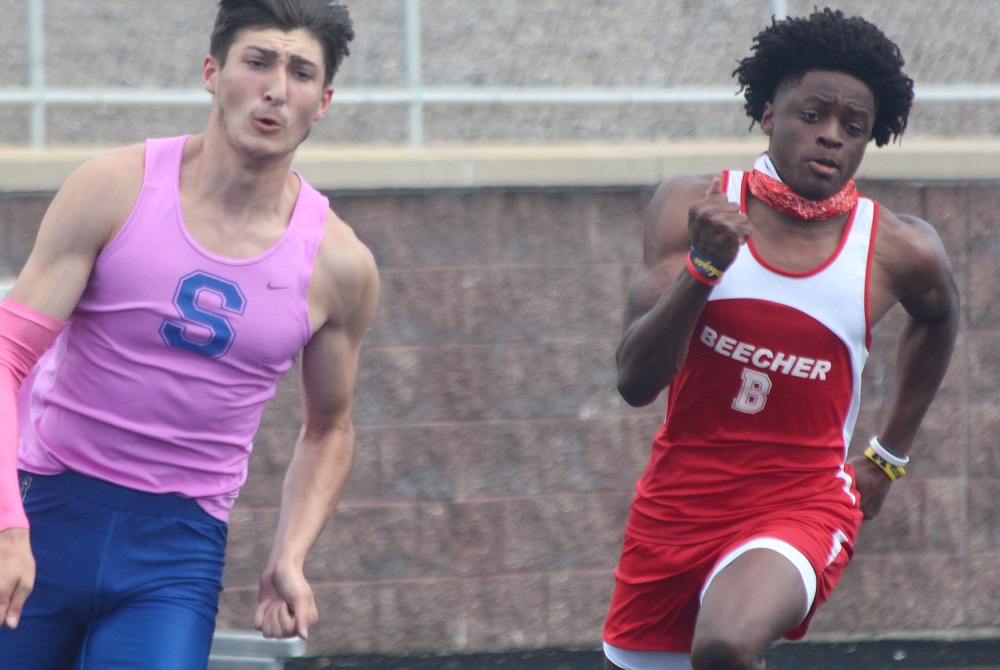
Jaylin Townsend’s introduction to the state’s track & field scene came a year later than planned, but it was quite a first impression.
 As a sophomore, the Flint Beecher star walked out of the Lower Peninsula Division 4 Finals with two individual titles, one relay title and a runner-up finish in another relay.
“It kind of surprised me,” Townsend said. “Coming into the season off of COVID, we could barely get into the weight room, and it was hard to get on the track and run. We couldn’t get the blocks out. It was kind of an eye opener, really.”
Despite it being his first season – the 2020 season was canceled completely – Townsend was dominant throughout. He won all but one of the individual races he competed in, with the lone loss coming in the 200 meters in the first meet of the season.
That was quickly corrected, as he cut nearly four seconds off his time in his next meet and never lost the race again.
He won the 100 meters at the Division 4 Finals with a personal best of 10.98 seconds. He won the 200 in 22.75. His personal best in that event is 22.37, which was run in the prelims of the Regional.
Beecher’s relay teams that featured Townsend were equally dominant. The 800-meter relay team suffered just one defeat – disqualification at the Genesee Area Conference championship meet. Townsend, Micah Brown, Danny Bradley and Jacoby Sanders ran a season-best 1:30.59 to win at the Division 4 Finals.
The 400 relay team of Townsend, Bradley, Carmelo Harris and James Cummings II took second at the Division 4 Finals with a time of 44.11. It was their first non-DQ loss of the season.
It was close, but Jaylin Townsend (@Jay23Trip) took home two State Championship medals for Flint Beecher, winning the 100 Meter Dash and the 200 Meter Dash.#StateChamps x @MHSAA pic.twitter.com/BMnhp2GaPV
— STATE CHAMPS! Michigan (@statechampsmich) June 19, 2021
Townsend’s contributions were good for 38 team points, which alone would have placed fourth in Division 4. Beecher as a team finished third with 54 points.
While the immediate success came as a surprise to Townsend, it didn't to his coach.
“I saw it in him,” Beecher coach Joe Wilkerson said. “I knew he could be something special. I told his mother when I talked to her, ‘This guy is going to be a state champ this year.’ There was just something about him that I saw it in him. Lo and behold, he was a three-time state champ. It just made me feel good, because I could trust my own instincts a little bit right now.”
Townsend knows his success will motivate his future opponents even more, but he’s fine with that.
“Going into this year, I know they’re coming for me,” he said. “I know I have to put in some extra work.”
Putting in extra work is something Townsend is used to, as he had to a year ago to get up to speed. He said working on his stride and coming out of the blocks were the main points of emphasis.
“I had to learn a lot, actually,” he said. “Most of the stuff, I was just doing off raw talent. I would make sure to ask Coach, ‘Hey, do you have an extra 30 minutes? Can you stay after?’ My first-ever track meet, when I came out of the blocks, I used to pop right up.”
That has Wilkerson excited, as he believes the sky is the limit for his young star.
 “This guy, he’s exceptional,” said Wilkerson, who has coached track at Beecher on and off since 1979. “I’ve been coaching for a long time, and I’ve never had a student quite like him with that kind of natural ability.”
Townsend’s focus on track is essentially limited to the spring season, as he also plays football and basketball for the Buccaneers.
“I’ve always been a great athlete, and I wanted to continue to be great,” Townsend said. “Going into basketball, it keeps me in shape for track.”
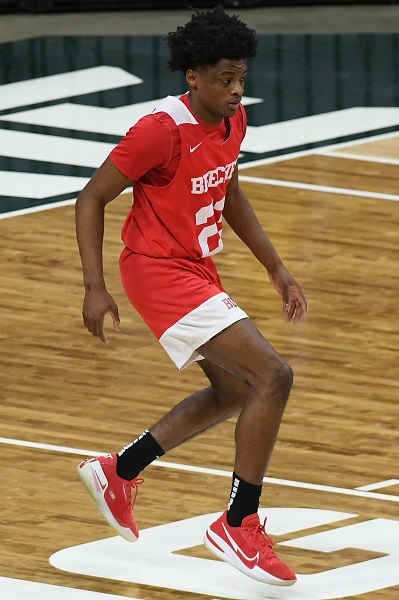
He was a key reserve forward for the Beecher basketball team, which advanced to the Division 3 Semifinals this season. He plays mostly in the post, despite being a shade under 6-foot-1 and 165 pounds.
Football is the sport he’s most focused on, particularly when it comes to competing in college. He plays receiver, free safety and cornerback for Beecher, and said he’s had talks with Central Michigan, Ferris State and Grand Valley State.
It was his performance on the track, though, that really helped to start those.
“When I started posting the speed, some of the colleges started to look like, ‘Hey, we can use this kid,’” Townsend said. “It helped out a lot.”
Heading into his junior track season, he hopes to turn a few more heads. He knows the best way to do that is to hold off the challengers who now have him in their sights, and continue to improve on his times. His goal is to work his 100 time down to 10.5 and his 200 time into the mid 21s.
“It kind of goes together,” he said. “Coming off last season, it put a target on my back, but it made some college coaches want to come to the track meets. They want to see me run. They want to see my speed. It’s nothing I can’t handle, though.”
 Paul Costanzo served as a sportswriter at The Port Huron Times Herald from 2006-15, including three years as lead sportswriter, and prior to that as sports editor at the Hillsdale Daily News from 2005-06. He can be reached at [email protected] with story ideas for Genesee, Lapeer, St. Clair, Sanilac, Huron, Tuscola, Saginaw, Bay, Arenac, Midland and Gladwin counties.
PHOTOS (Top) Flint Beecher’s Jaylin Townsend, right, turns a corner as he works to get a pace ahead of Saugatuck’s Benny Diaz on the way to winning last season’s LPD4 200 championship. (Middle) Townsend gets ready to defend during last month’s Division 3 Semifinal against Schoolcraft. (Top photo by Will Kennedy; middle photo by Hockey Weekly Action Photos.)