


Add, Subtract, Divide, Multiply: MHSAA Not Alone
July 25, 2017
By Rob Kaminski
MHSAA benchmarks editor
This is the third part in a series on MHSAA tournament classification, past and present, that will be published over the next two weeks. This series originally ran in this spring's edition of MHSAA benchmarks.
As the MHSAA faces its most recent classification task with 8-Player Football, and opinions continue to swirl about as to the method, timeframe, location and other procedures, a look around the country provides plenty of company among state association brethren factoring variables into their own equations.
In the Pacific Northwest, the Oregon School Activities Association Football Playoffs are under public scrutiny as leadership ponders a five or six classification format beginning with the 2018-19 school year.
The OSAA has crowned six champions on the gridiron since 2006-07. Many of the state’s smaller schools would like to keep it that way, while larger schools lean toward a five-classification system, citing larger leagues, ease of travel and credibility to state championships as the advantages.
Still others would prefer more than six classes, pointing to safety issues and the opportunity to increase participation numbers as positives.
Moving southeast of Oregon, the Nevada Interscholastic Activities Association recently voted to hold serve on a classification proposal that was volleyed to the membership.
However, changes still could be forthcoming by as early as the 2018-19 season which would add a fifth classification in more populated southern Nevada while allowing northern schools to participate in four classifications. Such divisions could mean no state championship for the fifth class in southern Nevada.
Because of that, the NIAA wants equal numbers of schools in each classification on both ends of the state. Complicating the issue is the fact that the 24 largest schools in the state, by enrollment, are all in Clark County in Southern Nevada.
Across Nevada’s border into Arizona, charter schools are asking the Arizona Interscholastic Association to reconsider classification that was voted upon and approved in September 2015. That agreement called for the largest 33 percent of charter schools by enrollment to be placed in the state’s largest school classification, 3A, the middle 33 percent into 2A, and the smallest 33 percent into 1A.
Less than two years later the charter schools have had a change of heart and have asked to be considered the same as other Arizona public schools and be placed appropriately by enrollment beginning with the 2018-19 school year.
The situation in Arizona further illustrates how the public/private debate that all state associations have faced throughout existence now has the added dynamic of rapidly growing charter schools in today’s educational system, along with virtual school enrollment.
In the nation’s heartland, Nebraska has retooled its football classifications by using enrollment of boys students only in its schools rather than total enrollment. The Nebraska School Activities Association football-playing schools will kick off the 2018 season using this alignment.
Nebraska has three classes of 11-player football, with the smallest class divided in two, Class C-1 and C-2. The state also will have 8-player football for boys enrollments under 47, and the NSAA will sponsor a new 6-player tournament in 2018 for schools with 27 or fewer boys.
“This is a good proposal because some schools have a sizable imbalance between the number of boys and girls, and there’s a large gap (in enrollment) between the largest and smallest schools in Classes A and B,” NSAA executive director Jim Tenopir said. “I think this addresses both of those concerns.”
Swimmers in Georgia, meanwhile, will feel like they are moving with the current, rather than upstream in 2017-18, as the Georgia High School Association recently doubled the number of team championship events from two to four.
Swim enthusiasts can also count on longer days at the finals, as the top 30 finishers from the prelims will advance to the finals instead of 20, and all championship events will have three heats versus two.
Winningest Coach Moving on from Matside, but Leaving Lasting Lakeshore Impact
By
Wes Morgan
Special for MHSAA.com
April 11, 2022
Bruce Bittenbender’s impact on the sport of wrestling in Michigan is immeasurable.
 And the fact that he’ll no longer occupy a chair next to the mats at Stevensville Lakeshore High School is almost unfathomable after a legendary 52-year career there.
His list of accomplishments over that span is staggering, though the incalculable number of lives he touched — a realization that came from the outpouring of messages from his former student-athletes following his retirement announcement in late March — is what Bittenbender believes is the most important part of his legacy.
“It is absolutely heartwarming,” Bittenbender said at his retirement press conference April 1. “In many cases (some students) are on the edge. I had a guy say to me yesterday, ‘Coach, I didn’t have a father. I want to thank you.’
“How many state titles is that worth? There is a lot of that I appreciate.”
What can be quantified are the competition results during his tenure.
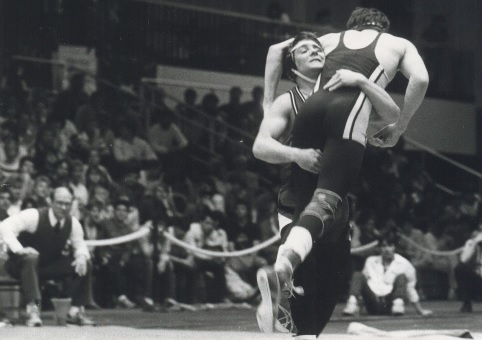
Bittenbender leaves with a dual meet record of 981-270-2 — the most victories in state history and the second most in the country. The program claimed 28 District titles, 13 Regional championships and 33 conference titles. The Lancers were undefeated in duals four times (1976, 1978, 1984 and 1986) and finished as MHSAA Finals runners-up twice (1986 and 1994).
“There are no shortcuts to being successful,” Lakeshore athletic director Greg Younger said. “Coach is always here. He’s probably here more than most teachers (although he retired in 2010). He is in the building early and often. He’s scrubbing the mats. I know it doesn’t magically happen. He’s always here preparing for a match and doing something here, talking to kids in the halls and building those relationships.
“He’s been a testament to hard work and what it takes to really have a goal all the time. When he steps into the wrestling room he’s always prepared, he’s always planning for tomorrow and he’s always planned for what’s coming up next. Nothing has ever surprised him.”
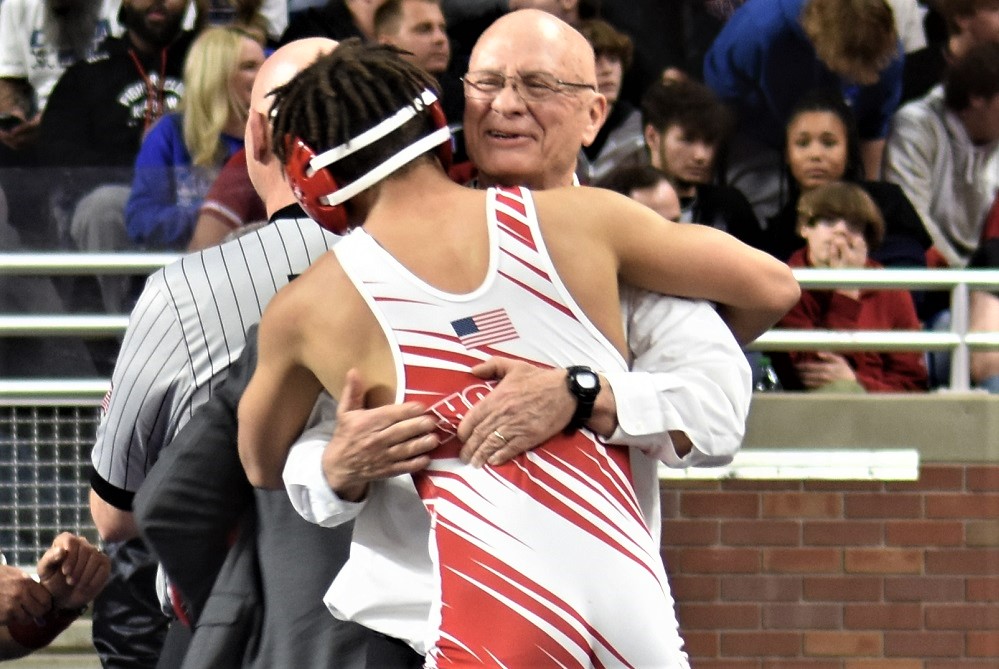
 There were a total of 26 Individual Finals champions and 116 state placers under his watch, with Micah Hanau (also a winner in 2020), Zamuel Thompson and Aaron Lucio the most recent to have stood atop the podium and celebrate championships with Bittenbender last month at Ford Field.
Shane Williams (2020), Riley Bettich (2018), Tyler Humes (2010), Tyler Daniel (2009), Ryan Huebner (2002), John King (1992), Scott Mabrey (1992), Mark McKie (1992, 1991), Jason Cluff (1988, 1987, 1986), Dave Strejc (1988), Matt Cluff (1987, 1986, 1985), John Spear (1986), Gary Smith (1981, 1980) John Murphy (1979), Doug Smith (1978), and Rick McGrath (1974) all were guided to the state’s top individual level by Bittenbender.
For his accomplishments, Bittenbender was named Regional Coach of the Year 11 times, Michigan Wrestling Coach of the Year by the Coaches Association (2002) and National Coach of the Year twice, by the National Federation of State High School Associations (2002) and National High School Athletic Coaches Association (2010). His rightful spot in the Michigan Wrestling Coaches Association Hall of Fame was claimed in 2010, and he was inducted into the National Coaches Association Hall of Fame the following year. In 2012, his home state honored Bittenbender with an induction into the Pennsylvania Wrestling Hall of Fame, and Milligan University (Tenn.), where he wrestled four years, did the same in 2019.
“We went through three years of pulling teeth and hard work,” said Bittenbender, who took over at struggling Lakeshore in 1970. “Finally, we hit pay dirt. We got a kid to be state champion (in 1974), Ricky McGrath. This guy opened it up. After that, kids wanted to be Lakeshore wrestlers.”
But there were thousands of others that also laid bricks over the years to help build the program up to where it is today.
“There were a lot of kids that weren’t state champions here; there were a lot of kids that weren’t District champions or Regional champions or even conference champions,” Bittenbender said. “But they were here everyday, they were working everyday, they were part of this program and you’ve got to give those kids credit.”
Ryan Quinn takes over the program after serving as assistant coach.
“I’m incredibly blessed, grateful and humbled to be part of this school, to be taking over the reins of such a successful wrestling program,” Quinn said. “It is truly an honor to succeed Coach Bittenbender. He has made such a lasting impression on my life in such a short period of time. I know with confidence he has made lasting impacts on all who are involved in his as well. His fingerprints will forever remain on this school district and wrestling program.”
Bittenbender thanked his family, all the parents, volunteers and sponsors that supported the program over the last 52 years.
“It was a great place to live; it was a great place to coach. I’m lucky. It is a great community, my kids got a great education here, and it has been great to see kids go on to be good fathers and go to work every day,” he said.
“I want to thank my family over the years. If you’re going to be a wrestling coach’s wife, you’ve got to be something special. We’re going to spend a lot more time together.”
When Bittenbender was named 2010 National Coach of the Year, Nebraska’s Tom Osborne was the keynote speaker. Bittenbender recalled him saying: ‘If you want to know if you’re a good man, write down the 10 things you want the guy to say in your obituary. If he says eight of them, you’re a good man.”
“I hope I’m a good man,” Bittenbender said.
 Wes Morgan has reported for the Kalamazoo Gazette, ESPN and ESPNChicago.com, 247Sports and Blue & Gold Illustrated over the last 12 years and is the publisher of JoeInsider.com. He can be reached at [email protected] with story ideas for Berrien, Cass, St. Joseph and Branch counties.
PHOTOS (Top) Retiring Stevensville Lakeshore wrestling coach Bruce Bittenbender, right, embraces Zamuel Thompson after Thompson’s Individual Finals championship win last month at Ford Field. (Middle) Lakeshore’s Matt Cluff lifts Eaton Rapids’ Scott Bolin during their 1986 Class B championship match. (Top photo by HighSchoolSportsScene.com, middle photo courtesy of the St. Joseph Herald-Palladium.)