


Add, Subtract, Divide, Multiply: MHSAA Not Alone
July 25, 2017
By Rob Kaminski
MHSAA benchmarks editor
This is the third part in a series on MHSAA tournament classification, past and present, that will be published over the next two weeks. This series originally ran in this spring's edition of MHSAA benchmarks.
As the MHSAA faces its most recent classification task with 8-Player Football, and opinions continue to swirl about as to the method, timeframe, location and other procedures, a look around the country provides plenty of company among state association brethren factoring variables into their own equations.
In the Pacific Northwest, the Oregon School Activities Association Football Playoffs are under public scrutiny as leadership ponders a five or six classification format beginning with the 2018-19 school year.
The OSAA has crowned six champions on the gridiron since 2006-07. Many of the state’s smaller schools would like to keep it that way, while larger schools lean toward a five-classification system, citing larger leagues, ease of travel and credibility to state championships as the advantages.
Still others would prefer more than six classes, pointing to safety issues and the opportunity to increase participation numbers as positives.
Moving southeast of Oregon, the Nevada Interscholastic Activities Association recently voted to hold serve on a classification proposal that was volleyed to the membership.
However, changes still could be forthcoming by as early as the 2018-19 season which would add a fifth classification in more populated southern Nevada while allowing northern schools to participate in four classifications. Such divisions could mean no state championship for the fifth class in southern Nevada.
Because of that, the NIAA wants equal numbers of schools in each classification on both ends of the state. Complicating the issue is the fact that the 24 largest schools in the state, by enrollment, are all in Clark County in Southern Nevada.
Across Nevada’s border into Arizona, charter schools are asking the Arizona Interscholastic Association to reconsider classification that was voted upon and approved in September 2015. That agreement called for the largest 33 percent of charter schools by enrollment to be placed in the state’s largest school classification, 3A, the middle 33 percent into 2A, and the smallest 33 percent into 1A.
Less than two years later the charter schools have had a change of heart and have asked to be considered the same as other Arizona public schools and be placed appropriately by enrollment beginning with the 2018-19 school year.
The situation in Arizona further illustrates how the public/private debate that all state associations have faced throughout existence now has the added dynamic of rapidly growing charter schools in today’s educational system, along with virtual school enrollment.
In the nation’s heartland, Nebraska has retooled its football classifications by using enrollment of boys students only in its schools rather than total enrollment. The Nebraska School Activities Association football-playing schools will kick off the 2018 season using this alignment.
Nebraska has three classes of 11-player football, with the smallest class divided in two, Class C-1 and C-2. The state also will have 8-player football for boys enrollments under 47, and the NSAA will sponsor a new 6-player tournament in 2018 for schools with 27 or fewer boys.
“This is a good proposal because some schools have a sizable imbalance between the number of boys and girls, and there’s a large gap (in enrollment) between the largest and smallest schools in Classes A and B,” NSAA executive director Jim Tenopir said. “I think this addresses both of those concerns.”
Swimmers in Georgia, meanwhile, will feel like they are moving with the current, rather than upstream in 2017-18, as the Georgia High School Association recently doubled the number of team championship events from two to four.
Swim enthusiasts can also count on longer days at the finals, as the top 30 finishers from the prelims will advance to the finals instead of 20, and all championship events will have three heats versus two.
With Lead Scorer Sidelined, West Catholic Finds Way to Saturday
By
Perry A. Farrell
Special for MHSAA.com
March 18, 2022
EAST LANSING – Abbey Kimball, Michigan State University recruit and Grand Rapids West Catholic star, was right at home Friday during her team’s Division 2 Semifinal against Detroit Country Day – until a collision while trying for a steal with 4 minutes, 37 seconds left in the first half sent her to the locker room after silencing the Breslin Center crowd.
The outcome was well in hand as the Falcons (25-1) were up nearly 20 points on the way to advancing to the Final with a 62-42 victory, but Kimball being at full strength for Saturday’s championship game suddenly was in doubt.
Kimball was the only senior starter on the floor for either side. Her day was done with six points. She sat on the bench in the second half with an ice pack over her blackened right eye.
“Yes, I will be ready to go tomorrow,” Kimball said after. The Falcons will play in their first Final at 6:15 p.m. Saturday since finishing runner-up in Class B in 1995.
She had future MSU teammates in the arena cheering her on.
“They supported me throughout my high school and AAU career,’’ added Kimball. “It was great to be able to play at my future home. COVID affected us the last two years. We just kept working with the goal of getting a championship.’’
Four Falcons scored in double figures with Anna Ignatoski dropping in 15 points, Reese Polega 13, Emma Tuttle 12 points and grabbing 11 rebounds, and Cadence Dykstra scoring 10.
 “You hate to see your best player go down. Your heart goes in your throat,” West Catholic coach Jill VanderEnde said. “We had our athletic trainer (Ryan Vogel) take her through the proper procedures. I thought our other players stepped up.’’
West Catholic’s defense forced 17 turnovers in the first half and shot 51.6 percent from the field in building a 45-25 lead. For the game, Country Day was stifled shooting 28.6 percent from the field while totaling 24 turnovers.
The Falcons length and athleticism caused problems for the young Yellowjackets at both ends.
“We had a hard time getting into any rhythm,’’ said Country Day coach Jerica Williams. “You can credit their defense for that. We had a lot of turnovers. If we had been able to protect the ball … . They are a very good team. We hope they win it all.‘’
West Catholic shot 50 percent from the field and 50 percent from 3-point land during the first quarter and took a commanding 21-5 lead as the Yellowjackets had more turnovers (seven) than points.
The Falcons scored the first five points of the second quarter to assume a 26-5 lead. Standout sub Ignatoski (12) and Polega (11) combined for 23 points during the first half.
Kimball took a wicked shot trying to get a steal from Aysia Yokely, who led the Yellowjackets with 21 points.
Sophomore Jaidyn Elam added 17 points for Country Day (14-8), which was appearing in the Division 2 Semifinals for the second straight season.
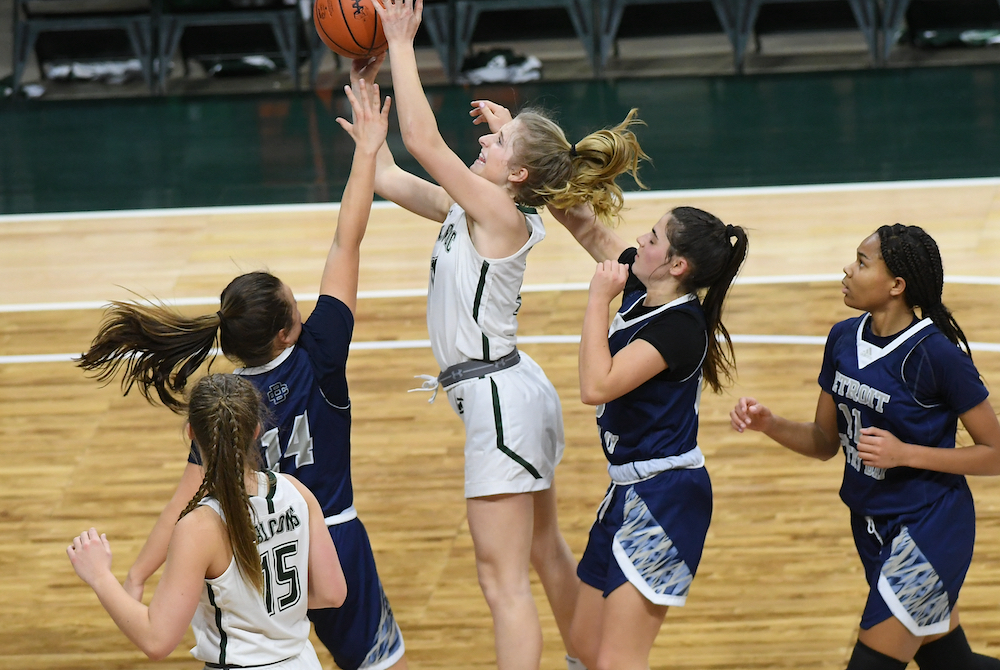
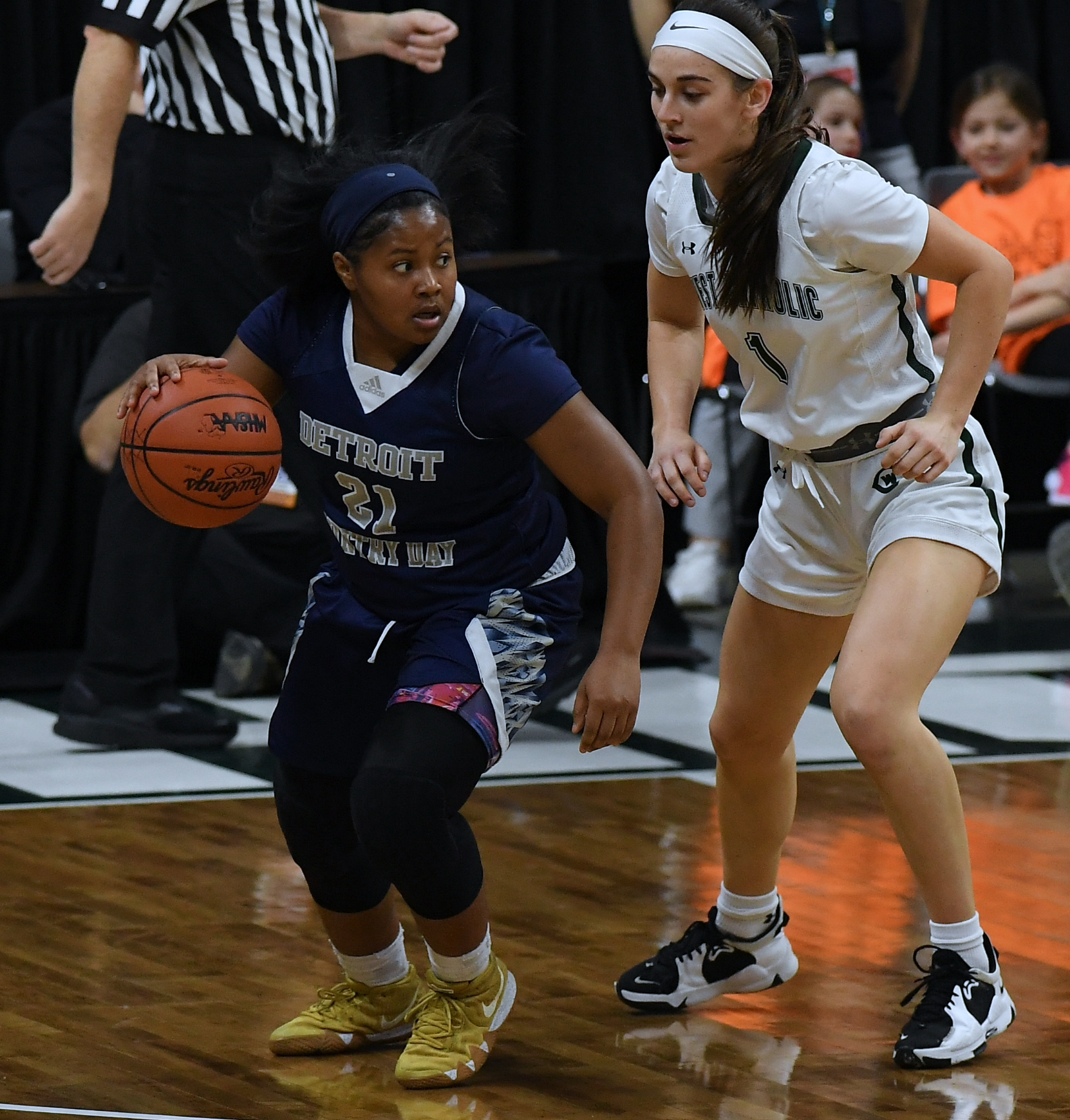
PHOTOS (Top) West Catholic’s Ellie Bies (11) reaches to grab a loose ball above a pair of Country Day players during her team's Semifinal win Friday. (Middle) The Yellowjackets' Aysia Yokely (21) looks for an open teammate, with Abbey Kimball defending. (Click for more from Hockey Weekly Action Photos.)