


Add, Subtract, Divide, Multiply: MHSAA Not Alone
July 25, 2017
By Rob Kaminski
MHSAA benchmarks editor
This is the third part in a series on MHSAA tournament classification, past and present, that will be published over the next two weeks. This series originally ran in this spring's edition of MHSAA benchmarks.
As the MHSAA faces its most recent classification task with 8-Player Football, and opinions continue to swirl about as to the method, timeframe, location and other procedures, a look around the country provides plenty of company among state association brethren factoring variables into their own equations.
In the Pacific Northwest, the Oregon School Activities Association Football Playoffs are under public scrutiny as leadership ponders a five or six classification format beginning with the 2018-19 school year.
The OSAA has crowned six champions on the gridiron since 2006-07. Many of the state’s smaller schools would like to keep it that way, while larger schools lean toward a five-classification system, citing larger leagues, ease of travel and credibility to state championships as the advantages.
Still others would prefer more than six classes, pointing to safety issues and the opportunity to increase participation numbers as positives.
Moving southeast of Oregon, the Nevada Interscholastic Activities Association recently voted to hold serve on a classification proposal that was volleyed to the membership.
However, changes still could be forthcoming by as early as the 2018-19 season which would add a fifth classification in more populated southern Nevada while allowing northern schools to participate in four classifications. Such divisions could mean no state championship for the fifth class in southern Nevada.
Because of that, the NIAA wants equal numbers of schools in each classification on both ends of the state. Complicating the issue is the fact that the 24 largest schools in the state, by enrollment, are all in Clark County in Southern Nevada.
Across Nevada’s border into Arizona, charter schools are asking the Arizona Interscholastic Association to reconsider classification that was voted upon and approved in September 2015. That agreement called for the largest 33 percent of charter schools by enrollment to be placed in the state’s largest school classification, 3A, the middle 33 percent into 2A, and the smallest 33 percent into 1A.
Less than two years later the charter schools have had a change of heart and have asked to be considered the same as other Arizona public schools and be placed appropriately by enrollment beginning with the 2018-19 school year.
The situation in Arizona further illustrates how the public/private debate that all state associations have faced throughout existence now has the added dynamic of rapidly growing charter schools in today’s educational system, along with virtual school enrollment.
In the nation’s heartland, Nebraska has retooled its football classifications by using enrollment of boys students only in its schools rather than total enrollment. The Nebraska School Activities Association football-playing schools will kick off the 2018 season using this alignment.
Nebraska has three classes of 11-player football, with the smallest class divided in two, Class C-1 and C-2. The state also will have 8-player football for boys enrollments under 47, and the NSAA will sponsor a new 6-player tournament in 2018 for schools with 27 or fewer boys.
“This is a good proposal because some schools have a sizable imbalance between the number of boys and girls, and there’s a large gap (in enrollment) between the largest and smallest schools in Classes A and B,” NSAA executive director Jim Tenopir said. “I think this addresses both of those concerns.”
Swimmers in Georgia, meanwhile, will feel like they are moving with the current, rather than upstream in 2017-18, as the Georgia High School Association recently doubled the number of team championship events from two to four.
Swim enthusiasts can also count on longer days at the finals, as the top 30 finishers from the prelims will advance to the finals instead of 20, and all championship events will have three heats versus two.
Many Gators Chip In As Arbor Prep Earns Championship Game Return
By
Dean Holzwarth
Special for MHSAA.com
March 17, 2022
EAST LANSING – Mya Petticord finished as the leading scorer for top-ranked Ypsilanti Arbor Prep in Thursday's Division 3 Semifinal at the Breslin Center.
But key contributions from her teammates also helped pave the way in a 57-44 victory over Maple City Glen Lake.
Arbor Prep (24-2) handed the Lakers (25-1) their lone loss of the season, and will play Kent City in Saturday’s Division 2 Final at 4 p.m.
“One of the TV reporters asked me before the game what one player did I need to score for us to win the game, and I didn’t have an answer,” Gators coach Scott Stine said. “Mya can score 12 and we can still win this game, because every night somebody steps up. We’re really tough to guard because any of the girls in the rotation can score.”
Petticord, a Miss Basketball Award finalist who will play next season at Texas A&M, scored a game-high 20 points, only three below her average, despite shooting an uncharacteristic 5-of-18 from the field – entering this week she was connecting on 52 percent of her shots.
Senior Karianne Woods, a Bethune-Cookman commit, added 10 points and six assists.
 “I didn’t feel like I had to score for us to win, not at all,” Petticord said. “I feel like all my teammates have scoring abilities.”
Stephanie and Stacy Utomi combined for 14 points and 17 rebounds, while sophomore Taylor Wallace pitched in with eight points and two steals.
“Stacy from the tip rebounded for us and brought energy,” said Stine, whose team was making its first appearance in the Semifinals since 2019. “Her and her sister are tough, and they live in the gym.”
The Gators’ defense forced 11 first-half turnovers as they led 26-21 at the half before pulling away in the third quarter with an inspired 12-0 run sparked by defense and 3-point shooting.
Wallace drained a pair of 3-pointers from the corner to make it 34-24. Ensuing layups by Jazmin Chupp and Woods pushed the lead to 38-24.
“We were a little bit nervous and rattled to begin the game,” Stine said. “We were fumbling the ball and missing defensive assignments, and our shooting was uncharacteristically terrible in the first half. But we weathered through it and played a little more like Arbor Prep is supposed to play.”
Glen Lake cut the deficit to 51-41 with less than three minutes remaining, but Petticord went 6-for-6 from the free throw line down the stretch to seal it.
This was Glen Lake’s third trip to the Semifinals over the last six years, but first since 2018.
Senior all-state guard Grace Bradford led the Lakers with 17 points and 13 rebounds. Junior Ruby Hogan added 10 points.
“We knew it was going to be physical coming out, and the biggest thing was if we could get past that trap then we would be fine, but we had a hiccup there not being able to get through and take care of the ball,” Glen Lake coach Jason Bradford said. “We struggled setting up our offense due to their pressure.”
The loss was only the second for Glen Lake over the last two seasons.
“Every one of these girls have been together since the third grade, and that’s a special thing,” Bradford said. “They step on the floor and they know what the meaning of winning is, and this team leaned on each other.”
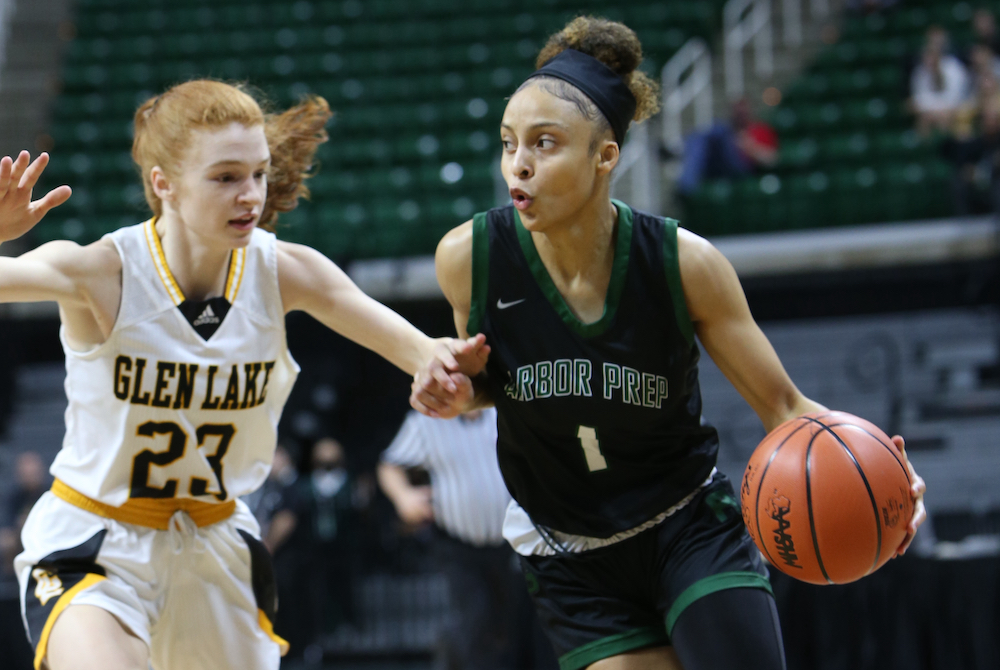
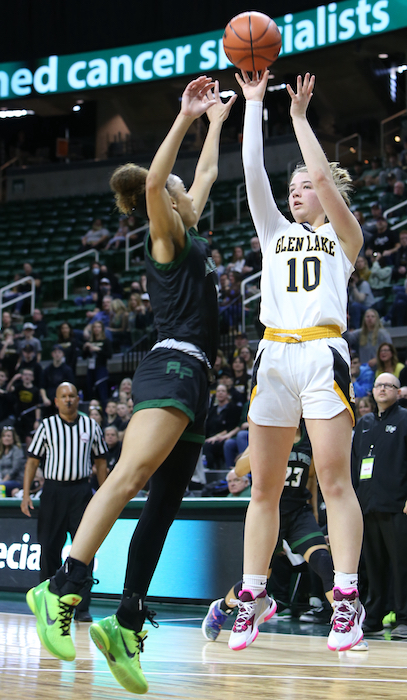
PHOTOS (Top) Arbor Prep's Mya Petticord (1) makes a move toward the basket with Glen Lake's Jessica Robbins defending. (Middle) The Lakers' Maddie Bradford (10) gets up a shot over Petticord's outstretched arm. (Click for more from Hockey Weekly Action Photos.)