


Add, Subtract, Divide, Multiply: MHSAA Not Alone
July 25, 2017
By Rob Kaminski
MHSAA benchmarks editor
This is the third part in a series on MHSAA tournament classification, past and present, that will be published over the next two weeks. This series originally ran in this spring's edition of MHSAA benchmarks.
As the MHSAA faces its most recent classification task with 8-Player Football, and opinions continue to swirl about as to the method, timeframe, location and other procedures, a look around the country provides plenty of company among state association brethren factoring variables into their own equations.
In the Pacific Northwest, the Oregon School Activities Association Football Playoffs are under public scrutiny as leadership ponders a five or six classification format beginning with the 2018-19 school year.
The OSAA has crowned six champions on the gridiron since 2006-07. Many of the state’s smaller schools would like to keep it that way, while larger schools lean toward a five-classification system, citing larger leagues, ease of travel and credibility to state championships as the advantages.
Still others would prefer more than six classes, pointing to safety issues and the opportunity to increase participation numbers as positives.
Moving southeast of Oregon, the Nevada Interscholastic Activities Association recently voted to hold serve on a classification proposal that was volleyed to the membership.
However, changes still could be forthcoming by as early as the 2018-19 season which would add a fifth classification in more populated southern Nevada while allowing northern schools to participate in four classifications. Such divisions could mean no state championship for the fifth class in southern Nevada.
Because of that, the NIAA wants equal numbers of schools in each classification on both ends of the state. Complicating the issue is the fact that the 24 largest schools in the state, by enrollment, are all in Clark County in Southern Nevada.
Across Nevada’s border into Arizona, charter schools are asking the Arizona Interscholastic Association to reconsider classification that was voted upon and approved in September 2015. That agreement called for the largest 33 percent of charter schools by enrollment to be placed in the state’s largest school classification, 3A, the middle 33 percent into 2A, and the smallest 33 percent into 1A.
Less than two years later the charter schools have had a change of heart and have asked to be considered the same as other Arizona public schools and be placed appropriately by enrollment beginning with the 2018-19 school year.
The situation in Arizona further illustrates how the public/private debate that all state associations have faced throughout existence now has the added dynamic of rapidly growing charter schools in today’s educational system, along with virtual school enrollment.
In the nation’s heartland, Nebraska has retooled its football classifications by using enrollment of boys students only in its schools rather than total enrollment. The Nebraska School Activities Association football-playing schools will kick off the 2018 season using this alignment.
Nebraska has three classes of 11-player football, with the smallest class divided in two, Class C-1 and C-2. The state also will have 8-player football for boys enrollments under 47, and the NSAA will sponsor a new 6-player tournament in 2018 for schools with 27 or fewer boys.
“This is a good proposal because some schools have a sizable imbalance between the number of boys and girls, and there’s a large gap (in enrollment) between the largest and smallest schools in Classes A and B,” NSAA executive director Jim Tenopir said. “I think this addresses both of those concerns.”
Swimmers in Georgia, meanwhile, will feel like they are moving with the current, rather than upstream in 2017-18, as the Georgia High School Association recently doubled the number of team championship events from two to four.
Swim enthusiasts can also count on longer days at the finals, as the top 30 finishers from the prelims will advance to the finals instead of 20, and all championship events will have three heats versus two.
Downriver Dominates Again as Allen Park Leads League's top 3 in 3-Peat
By
Tom Kendra
Special for MHSAA.com
March 5, 2022
GRAND RAPIDS – Allen Park senior captain Adri Carone answered the question before it was even asked.
“It never, ever, ever gets old,” said Carone with a big smile, after helping her team secure its third-consecutive Division 2 championship Saturday morning at the Delta Plex.
“I can honestly say it feels just as amazing every time.”
The Jaguars had their huge throng of fans sweating it out, but another powerhouse Round 3 performance was the difference as Allen Park (791.60) edged upset-minded Downriver League rival Gibralter Carlson (788.02).
Southgate Anderson placed third with 773.54 points, giving the nine-school Downriver League the top three spots in the state in Division 2 – and the same order of finish as the league tournament and last week’s Regional.
Carlson made things interesting by taking the lead by one tenth of a point after Round 1, then still hung within a razor-thin, 0.38 of a point after Round 2.
 It came down to a test of physical and mental discipline in the final round, and that’s when Allen Park’s tradition and experience showed through.
“Round 3 has been our strength all year, and that was the case again today,” said veteran Allen Park coach Julie Goodwin, now in her 16th year. “We have amazing stunters who rise to the challenge.”
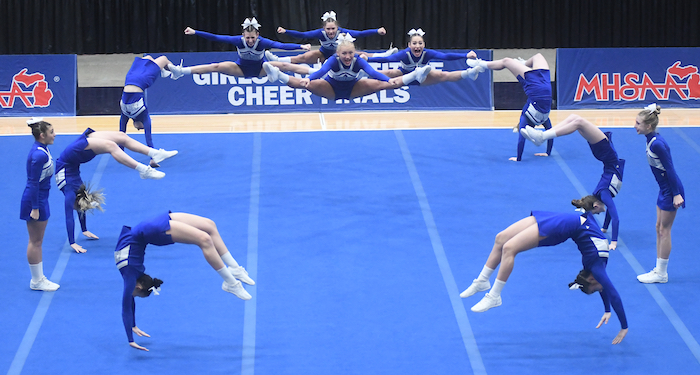
Carlson went last in the final round and delivered a fantastic performance of its own. The Marauders’ third-round score of 317.30 was more than five points better than six other teams – all but Allen Park.
The Jaguars, going sixth out of the eight teams in the last round, scored a 320.60 – pushing them over 790 points for the sixth time in their last seven competitions.
“I am so proud of this team because we worked so hard this season – day after day after day,” said Cassidy Kuhn, one of two returning senior all-staters for Allen Park, along with Carone. “Today just feels like a dream.”
Kuhn and Carone are two of nine seniors for the Jaguars, who will leave with a runner-up finish as freshmen and championships the past three years. Other seniors were Kirstyn Ferguson, Sharlotte Kehr, Cassidy Reardon, Emily Unger, Makenzy Varner, Mackenzie Waddell and Cara Wischow.
Dearborn Divine Child placed fourth, followed by last year’s runner-up, DeWitt.
First-year Carlson coach Alyssa Tocco knows all about the Allen Park cheer program. Tocco was a standout and 2016 graduate of Allen Park, who coached the past five years at Plymouth before taking over a Gibralter Carlson program which has won 11 Finals titles (the last in 2019) and now has seven runner-up finishes.
“I am so proud of this team because 18 of the 23 girls we brought here are at the state finals for the very first time,” said Tocco, who had just three seniors on the roster. “They truly are the hardest-working team I’ve ever met.”
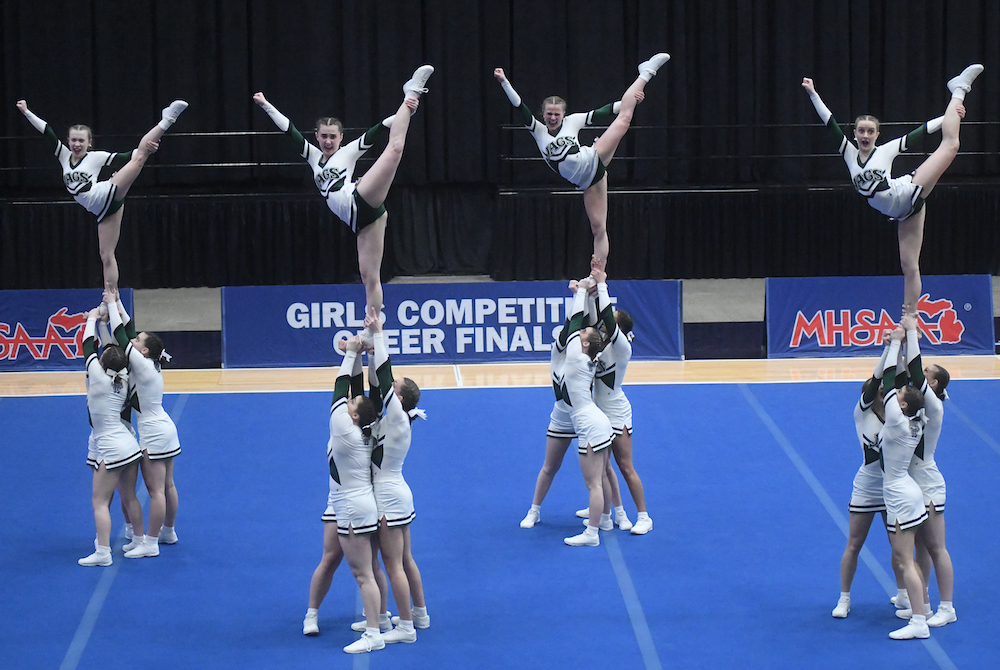
Goodwin gave a special shoutout to the Allen Park community, which seemingly abandoned town Saturday morning and packed the Delta Plex, shaking the building’s rafters in all three rounds – particularly the pivotal Round 3 as the Jaguars nailed stunt after stunt and landing after landing.
“Our crowd makes us who we are,” said Goodwin, who is assisted by Meaghan Terry, Tina Johnson, Jessica Tremonti, Theresa Couturier and Tera Waddell. “We feed off of them. It takes all of us.”
PHOTOS Allen Park (top) and Gibraltar Carlson (middle) compete during Saturday’s Division 2 Final at Grand Rapids’ Delta Plex. (Click for more from Hockey Weekly Action Photo.)