


Add, Subtract, Divide, Multiply: MHSAA Not Alone
July 25, 2017
By Rob Kaminski
MHSAA benchmarks editor
This is the third part in a series on MHSAA tournament classification, past and present, that will be published over the next two weeks. This series originally ran in this spring's edition of MHSAA benchmarks.
As the MHSAA faces its most recent classification task with 8-Player Football, and opinions continue to swirl about as to the method, timeframe, location and other procedures, a look around the country provides plenty of company among state association brethren factoring variables into their own equations.
In the Pacific Northwest, the Oregon School Activities Association Football Playoffs are under public scrutiny as leadership ponders a five or six classification format beginning with the 2018-19 school year.
The OSAA has crowned six champions on the gridiron since 2006-07. Many of the state’s smaller schools would like to keep it that way, while larger schools lean toward a five-classification system, citing larger leagues, ease of travel and credibility to state championships as the advantages.
Still others would prefer more than six classes, pointing to safety issues and the opportunity to increase participation numbers as positives.
Moving southeast of Oregon, the Nevada Interscholastic Activities Association recently voted to hold serve on a classification proposal that was volleyed to the membership.
However, changes still could be forthcoming by as early as the 2018-19 season which would add a fifth classification in more populated southern Nevada while allowing northern schools to participate in four classifications. Such divisions could mean no state championship for the fifth class in southern Nevada.
Because of that, the NIAA wants equal numbers of schools in each classification on both ends of the state. Complicating the issue is the fact that the 24 largest schools in the state, by enrollment, are all in Clark County in Southern Nevada.
Across Nevada’s border into Arizona, charter schools are asking the Arizona Interscholastic Association to reconsider classification that was voted upon and approved in September 2015. That agreement called for the largest 33 percent of charter schools by enrollment to be placed in the state’s largest school classification, 3A, the middle 33 percent into 2A, and the smallest 33 percent into 1A.
Less than two years later the charter schools have had a change of heart and have asked to be considered the same as other Arizona public schools and be placed appropriately by enrollment beginning with the 2018-19 school year.
The situation in Arizona further illustrates how the public/private debate that all state associations have faced throughout existence now has the added dynamic of rapidly growing charter schools in today’s educational system, along with virtual school enrollment.
In the nation’s heartland, Nebraska has retooled its football classifications by using enrollment of boys students only in its schools rather than total enrollment. The Nebraska School Activities Association football-playing schools will kick off the 2018 season using this alignment.
Nebraska has three classes of 11-player football, with the smallest class divided in two, Class C-1 and C-2. The state also will have 8-player football for boys enrollments under 47, and the NSAA will sponsor a new 6-player tournament in 2018 for schools with 27 or fewer boys.
“This is a good proposal because some schools have a sizable imbalance between the number of boys and girls, and there’s a large gap (in enrollment) between the largest and smallest schools in Classes A and B,” NSAA executive director Jim Tenopir said. “I think this addresses both of those concerns.”
Swimmers in Georgia, meanwhile, will feel like they are moving with the current, rather than upstream in 2017-18, as the Georgia High School Association recently doubled the number of team championship events from two to four.
Swim enthusiasts can also count on longer days at the finals, as the top 30 finishers from the prelims will advance to the finals instead of 20, and all championship events will have three heats versus two.
Traverse City West Follows Another Lewandowski to 2nd-Straight Title
By
Andrew Rosenthal
Special for Second Half
February 28, 2022
BOYNE FALLS — Traverse City West’s two-year ski dynasty is bookended by two Lewandowski brothers.
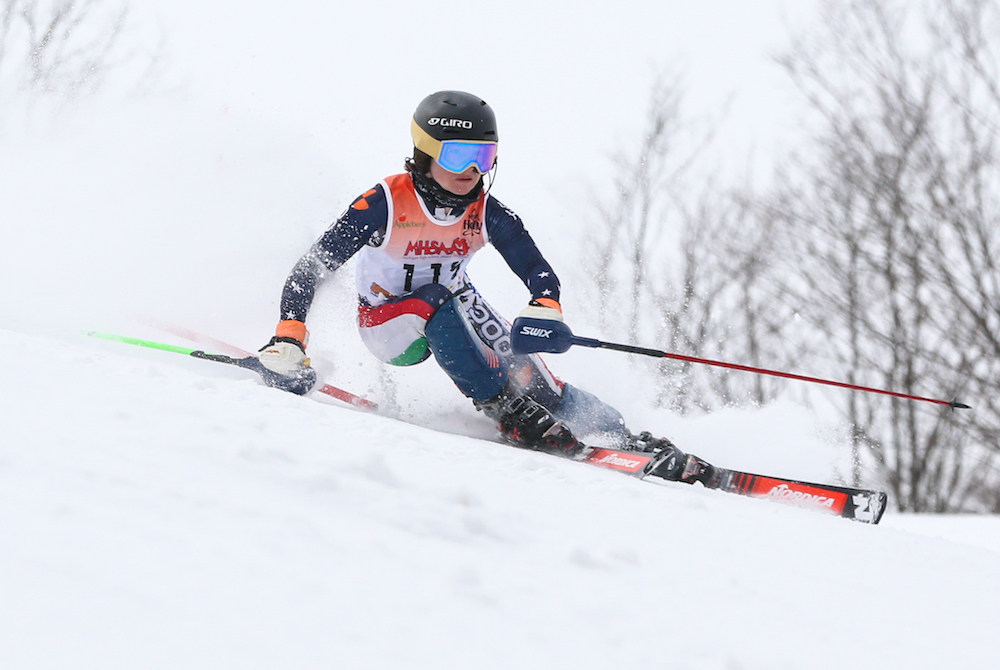
Sophomore Caleb Lewandowski won the slalom championship Monday at the Division 1 Finals at Boyne Mountain to lead the Titans to the second of their first back-to-back ski team titles since the school opened in 1997. His older brother Aiden had led West's 2021 championship run with a giant slalom win.
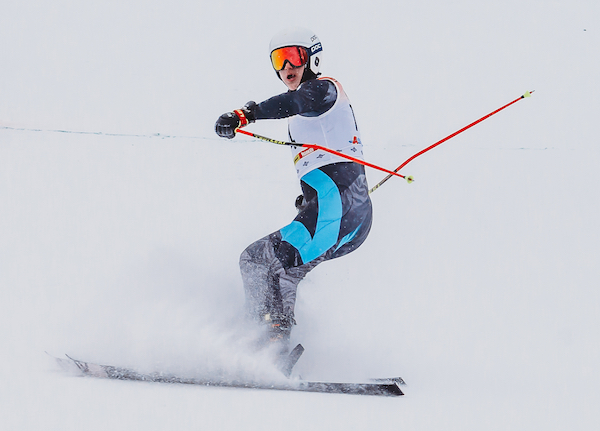
Aiden also had won the respect of Rochester Adams senior Nathan Dehart, Monday’s GS winner. The two schools are separated by nearly a four-hour drive and 227 miles, but Dehart knew the Lewandkowski brothers well. He competed with Aiden in USSA Team Michigan events across the country.
“I’ve raced against (Aiden) for a long time,” Dehart said after he gave Caleb a celebratory carry at the finish line.
“I trained really hard to get into this situation, and I try to win every week. It feels good to finally win one my senior year.”
The two first-time Finals champions were runners-up in each-others disciplines, with Dehart edging Lewandowski in GS and Lewandowski racing past Dehart in slalom. They congratulated each other, they celebrated with each other on the podium, and Dehart even spent most of the awards ceremony hanging out with the Titans' boys team.
“I was trying to make it down, but also get a fast time. The team was doing really well, so I had to finish for them too,” Lewandowski. “I still have two more years to try and win some more.”
Traverse City West claimed the title over Traverse City Central by 36.5 points. The Titans should next season return several from a sophomore-heavy group, including Lewandowski.
 A few seniors graduate — including all-state slalom finisher and captain Andy Hill — but West also returns several fast underclassmen. For example: TC West’s all-state sophomore Charlie Licht (3rd) wasn’t even on the Finals title roster last year. Juniors Luke Wiersma (fifth in GS, eighth in slalom) and Ben Schramski (seventh in GS, fifth in slalom) both had two all-state finishes.
“Any one of those top 4-5 boys could have won today,” TC West coach Ed Johnson said. “All of them skied where they needed to within their abilities. It was exciting to see Caleb win and then be able to have his teammates kind of stack up right behind him.”
Crosstown foe Traverse City Central finished runner-up to the Titans with a trio of all-state finishers. Asher Paul (eighth in GS, fifth in slalom) came home with two medals. Jace Rowell took third in GS, and Michael Booher claimed eighth in slalom.
The Trojans have now hit the 30 mark in boys skiing trophies, capturing their program’s 11th runner-up nod with 19 Finals championships. They finished fourth last year and have been runners-up in five of the past eight seasons.
It wouldn’t be fair to call the two schools rivals — well, at least for skiing. The two schools celebrated with each other for nearly a half hour.
Central coach Amy Kudary said the Trojans have been solid all year long and a runner-up nod to West is still a great accomplishment. The Trojans defeated the Titans at the Peppi Town Slalom meet earlier in the year — the biggest ski meet within the city limits of Traverse City.
“We knew that was a possibility, but still a lot of stars had to align to make it happen,” Kudary said.
Adams took third with a score of 90, led by Dehart’s all-state finishes. The Highlanders had a good showing in slalom, with Brayden Tapert (eighth) and Bryce Tapert (seventh) both landing in the top 10.
Individual all-state medalists not from the top-three finishing teams were Marquette’s Sam Dehlin (fourth in GS, fifth in slalom), Grand Rapids Forest Hills Northern-Eastern’s JD Amann (sixth in GS), Hart’s Bryce Natter (ninth in GS, 10th in slalom), Clarkston’s Luke Farella (10th in GS) and Okemos’ Michael Benevegna (seventh in slalom).
PHOTO (Top) Traverse City West’s Caleb Lewandowski leans into a turn during a slalom run Monday at Boyne Mountain. (Middle) Rochester Adams’ Nathan Dehart pulls into the finish of a giant slalom run. (Click for more from Sports in Motion.)