


Add, Subtract, Divide, Multiply: MHSAA Not Alone
July 25, 2017
By Rob Kaminski
MHSAA benchmarks editor
This is the third part in a series on MHSAA tournament classification, past and present, that will be published over the next two weeks. This series originally ran in this spring's edition of MHSAA benchmarks.
As the MHSAA faces its most recent classification task with 8-Player Football, and opinions continue to swirl about as to the method, timeframe, location and other procedures, a look around the country provides plenty of company among state association brethren factoring variables into their own equations.
In the Pacific Northwest, the Oregon School Activities Association Football Playoffs are under public scrutiny as leadership ponders a five or six classification format beginning with the 2018-19 school year.
The OSAA has crowned six champions on the gridiron since 2006-07. Many of the state’s smaller schools would like to keep it that way, while larger schools lean toward a five-classification system, citing larger leagues, ease of travel and credibility to state championships as the advantages.
Still others would prefer more than six classes, pointing to safety issues and the opportunity to increase participation numbers as positives.
Moving southeast of Oregon, the Nevada Interscholastic Activities Association recently voted to hold serve on a classification proposal that was volleyed to the membership.
However, changes still could be forthcoming by as early as the 2018-19 season which would add a fifth classification in more populated southern Nevada while allowing northern schools to participate in four classifications. Such divisions could mean no state championship for the fifth class in southern Nevada.
Because of that, the NIAA wants equal numbers of schools in each classification on both ends of the state. Complicating the issue is the fact that the 24 largest schools in the state, by enrollment, are all in Clark County in Southern Nevada.
Across Nevada’s border into Arizona, charter schools are asking the Arizona Interscholastic Association to reconsider classification that was voted upon and approved in September 2015. That agreement called for the largest 33 percent of charter schools by enrollment to be placed in the state’s largest school classification, 3A, the middle 33 percent into 2A, and the smallest 33 percent into 1A.
Less than two years later the charter schools have had a change of heart and have asked to be considered the same as other Arizona public schools and be placed appropriately by enrollment beginning with the 2018-19 school year.
The situation in Arizona further illustrates how the public/private debate that all state associations have faced throughout existence now has the added dynamic of rapidly growing charter schools in today’s educational system, along with virtual school enrollment.
In the nation’s heartland, Nebraska has retooled its football classifications by using enrollment of boys students only in its schools rather than total enrollment. The Nebraska School Activities Association football-playing schools will kick off the 2018 season using this alignment.
Nebraska has three classes of 11-player football, with the smallest class divided in two, Class C-1 and C-2. The state also will have 8-player football for boys enrollments under 47, and the NSAA will sponsor a new 6-player tournament in 2018 for schools with 27 or fewer boys.
“This is a good proposal because some schools have a sizable imbalance between the number of boys and girls, and there’s a large gap (in enrollment) between the largest and smallest schools in Classes A and B,” NSAA executive director Jim Tenopir said. “I think this addresses both of those concerns.”
Swimmers in Georgia, meanwhile, will feel like they are moving with the current, rather than upstream in 2017-18, as the Georgia High School Association recently doubled the number of team championship events from two to four.
Swim enthusiasts can also count on longer days at the finals, as the top 30 finishers from the prelims will advance to the finals instead of 20, and all championship events will have three heats versus two.
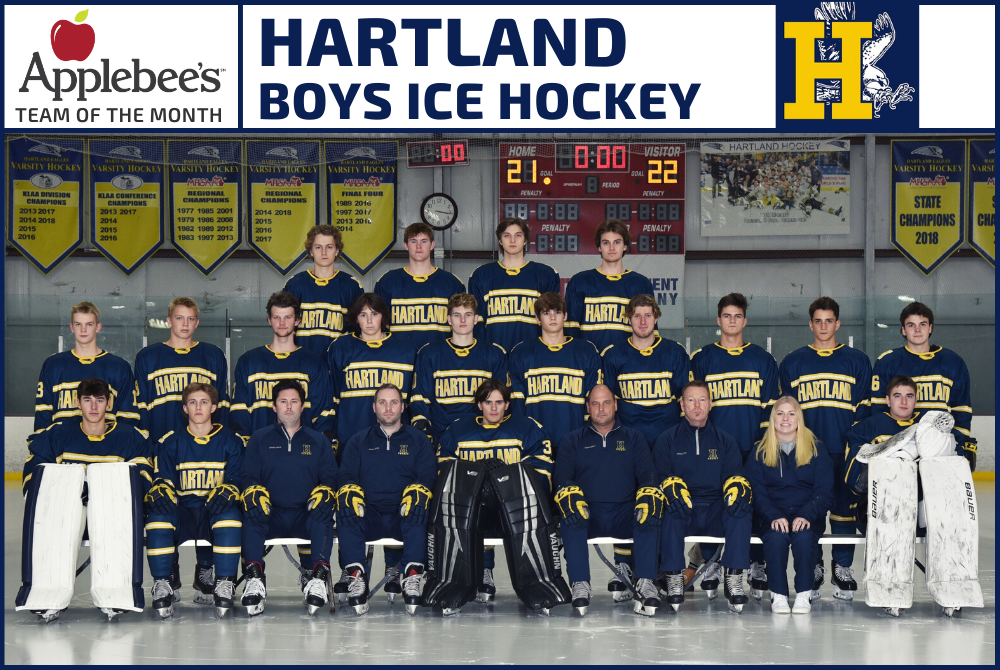
Team of the Month: Hartland Ice Hockey
By
Geoff Kimmerly
MHSAA.com senior editor
February 18, 2022
The Hartland hockey team finished the month of January with an 8-1 record since the turn of the calendar year, still ranked No. 1 statewide in Division 2 and having earned the Kensington Lakes Activities Association West and overall championships.
But those achievements didn’t come easily. Not even close.
The MHSAA/Applebee’s Team of the Month for January has had its share of success over the last decade, with Division 2 championships in 2018 and 2019 and runner-up finishes in 2013 and 2014. But the Eagles’ January run made an impressive statement as the team builds toward another possible title run.
Hartland earned five of those eight January wins over ranked teams, improved a 9-3 record after December to 17-4 by the start of February. The lone loss in January came 2-1 to Division 3 top-ranked Flint Powers Catholic.
“It’s nice when it all comes together, because you can say it was part of the plan. But we knew we were going to have to take a step after the new year, and we discussed that as a group,” Hartland coach Rick Gadwa said. “The big thing is our schedule was ramping up even more. December was hard enough, but then if you look at that track that we had in January, we knew it was going to be tough.
“The guys just took that with a little bit of a drive and wanted to try and run the slate. Obviously, it’s a really hard thing to do, and we did have that loss and we could’ve had a couple of others. But we had some great learning experiences in January … and gained some confidence.”
Hartland’s 2-1 win over Division 1 No. 2 Brighton on Jan. 15 paved the way for the KLAA West title, and the Eagles avenged a November loss to Division 2 No. 2 Livonia Stevenson with a 3-1 win Jan. 26 to earn the overall KLAA championship.
Hartland also won the Westside Invitational by defeating Division 2 No. 5 Byron Center 7-3 and No. 6 Muskegon Mona Shore 3-2 in overtime despite missing Gadwa, who was ill. The Byron Center win avenged last year’s Quarterfinal loss to the Bulldogs, and the Eagles didn’t lead against Mona Shores until scoring the deciding goal.
Earlier in the month, Hartland also came back to win 6-4 over Orchard Lake St. Mary’s, the No. 3-ranked team in Division 3.
“These guys just have this calmness about them, and I appreciate that group,” Gadwa said. “They’re a skilled group, and to see how this group stayed the course when things aren’t going well for them, it’s a trait that’s tough to get high school teams to buy into at times. I’m just appreciative for how they’ve been able to grasp that adversity and overcome it and adjust.”
Hartland is up to 19-5, and has received contributions from throughout the roster. Fourteen of 16 skaters have scored, all 16 have at least three points and 10 Eagles have at least 10 points.
Seniors Ashton Trombley (18 goals, 14 assists) and Jack Paweski (17 goals, 12 assists) lead five players with at least 11 goals, followed on the points list by juniors Lucas Henry (11 goals, 17 assists), Ben Pouliot (11/16) and Braden Pietila (11/15) and assists leader Brendan Pietila (7/19). Senior Kameron Ragon is 15-0 in goal with a 1.19 goals-against average and .946 save percentage.
The Eagles face Division 1 No. 6 Saginaw Heritage tonight before beginning Division 2 Regional play next week at Dort Federal Event Center in Flint.
“Every team has to define themselves,” Gadwa said, “and they’re doing a good job of that.”
Past Teams of the Month, 2021-22
December: Midland Dow girls basketball - Read
November: Reese girls volleyball - Read
October: Birmingham Groves boys tennis - Read