


Add, Subtract, Divide, Multiply: MHSAA Not Alone
July 25, 2017
By Rob Kaminski
MHSAA benchmarks editor
This is the third part in a series on MHSAA tournament classification, past and present, that will be published over the next two weeks. This series originally ran in this spring's edition of MHSAA benchmarks.
As the MHSAA faces its most recent classification task with 8-Player Football, and opinions continue to swirl about as to the method, timeframe, location and other procedures, a look around the country provides plenty of company among state association brethren factoring variables into their own equations.
In the Pacific Northwest, the Oregon School Activities Association Football Playoffs are under public scrutiny as leadership ponders a five or six classification format beginning with the 2018-19 school year.
The OSAA has crowned six champions on the gridiron since 2006-07. Many of the state’s smaller schools would like to keep it that way, while larger schools lean toward a five-classification system, citing larger leagues, ease of travel and credibility to state championships as the advantages.
Still others would prefer more than six classes, pointing to safety issues and the opportunity to increase participation numbers as positives.
Moving southeast of Oregon, the Nevada Interscholastic Activities Association recently voted to hold serve on a classification proposal that was volleyed to the membership.
However, changes still could be forthcoming by as early as the 2018-19 season which would add a fifth classification in more populated southern Nevada while allowing northern schools to participate in four classifications. Such divisions could mean no state championship for the fifth class in southern Nevada.
Because of that, the NIAA wants equal numbers of schools in each classification on both ends of the state. Complicating the issue is the fact that the 24 largest schools in the state, by enrollment, are all in Clark County in Southern Nevada.
Across Nevada’s border into Arizona, charter schools are asking the Arizona Interscholastic Association to reconsider classification that was voted upon and approved in September 2015. That agreement called for the largest 33 percent of charter schools by enrollment to be placed in the state’s largest school classification, 3A, the middle 33 percent into 2A, and the smallest 33 percent into 1A.
Less than two years later the charter schools have had a change of heart and have asked to be considered the same as other Arizona public schools and be placed appropriately by enrollment beginning with the 2018-19 school year.
The situation in Arizona further illustrates how the public/private debate that all state associations have faced throughout existence now has the added dynamic of rapidly growing charter schools in today’s educational system, along with virtual school enrollment.
In the nation’s heartland, Nebraska has retooled its football classifications by using enrollment of boys students only in its schools rather than total enrollment. The Nebraska School Activities Association football-playing schools will kick off the 2018 season using this alignment.
Nebraska has three classes of 11-player football, with the smallest class divided in two, Class C-1 and C-2. The state also will have 8-player football for boys enrollments under 47, and the NSAA will sponsor a new 6-player tournament in 2018 for schools with 27 or fewer boys.
“This is a good proposal because some schools have a sizable imbalance between the number of boys and girls, and there’s a large gap (in enrollment) between the largest and smallest schools in Classes A and B,” NSAA executive director Jim Tenopir said. “I think this addresses both of those concerns.”
Swimmers in Georgia, meanwhile, will feel like they are moving with the current, rather than upstream in 2017-18, as the Georgia High School Association recently doubled the number of team championship events from two to four.
Swim enthusiasts can also count on longer days at the finals, as the top 30 finishers from the prelims will advance to the finals instead of 20, and all championship events will have three heats versus two.
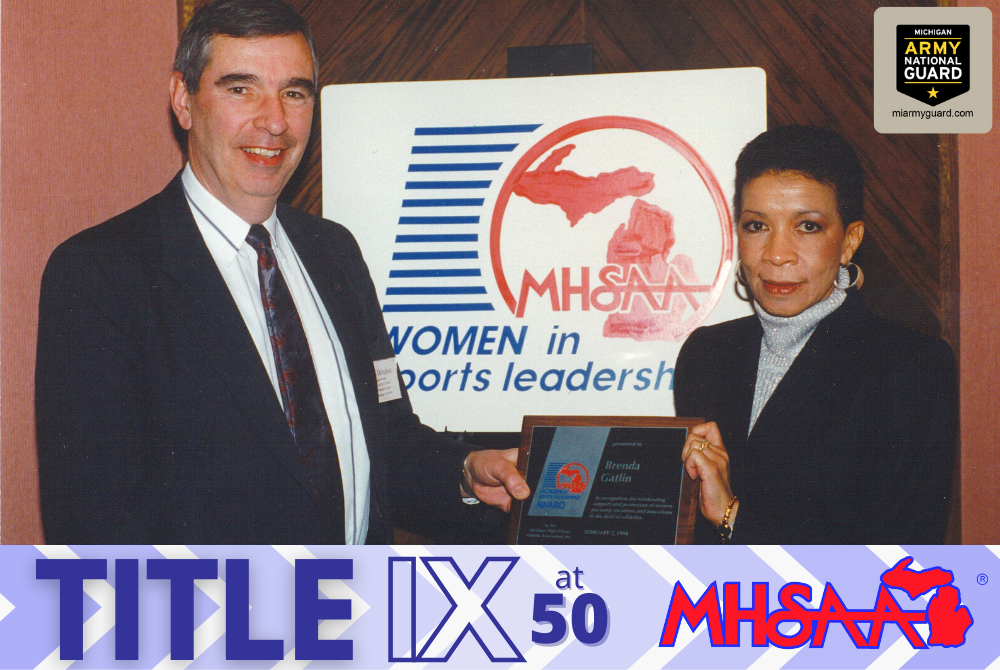
Title IX at 50: WISL Award Honors Builders of State's Girls Sports Tradition
By
Geoff Kimmerly
MHSAA.com senior editor
February 1, 2022
Michigan’s school sports history is filled with women who and have and continue to take on giant roles to advance girls athletics and the opportunities and benefits they provide.
Since 1990, the MHSAA has celebrated pioneers, advocates, voices and leaders with the Women In Sports Leadership Award.
From L’Anse’s Carol Seavoy in 1990 through St. Ignace’s Dorene Ingalls in 2021, 34 women have received the WISL Award, which most recently has been presented either during the biennial WISL Conference in Lansing or during the Girls Basketball Finals at Michigan State’s Breslin Center.
The 35th WISL Award winner will be announced in coming weeks.
Below is the list of the first 34 honorees:
1990 – Carol Seavoy, L’Anse
1991 – Diane Laffey, Harper Woods
1992 – Patricia Ashby, Scotts
1993 – Jo Lake, Grosse Pointe
1994 – Brenda Gatlin, Detroit
1995 – Jane Bennett, Ann Arbor
1996 – Cheryl Amos-Helmicki, Huntington Woods
1997 – Delores L. Elswick, Detroit
1998 – Karen S. Leinaar, Delton
1999 – Kathy McGee, Flint
2000 – Pat Richardson, Grass Lake
2001 – Suzanne Martin, East Lansing
2002 – Susan Barthold, Kentwood
2003 – Nancy Clark, Flint
2004 – Kathy Vruggink Westdorp, Grand Rapids
2005 – Barbara Redding, Capac
2006 – Melanie Miller, Lansing
2007 – Jan Sander, Warren Woods
2008 – Jane Bos, Grand Rapids
2009 – Gail Ganakas, Flint; Deb VanKuiken, Holly
2010 – Gina Mazzolini, Lansing
2011 – Ellen Pugh, West Branch; Patti Tibaldi, Traverse City
2012 – Janet Gillette, Comstock Park
2013 – Barbara Beckett, Traverse City
2014 – Teri Reyburn, DeWitt
2015 – Jean LaClair, Bronson
2016 – Betty Wroubel, Pontiac
2017 – Dottie Davis, Ann Arbor
2018 – Meg Seng, Ann Arbor
2019 – Kris Isom, Adrian
2020 – Nikki Norris, East Lansing
2021 – Dorene Ingalls, St. Ignace
Second Half's weekly Title IX Celebration posts are sponsored by Michigan Army National Guard.
Previous Title IX at 50 Spotlights
Jan. 18: Decades Later, Edwards' Legend Continues to Grow - Read
Jan. 18: Iron Mountain Completes Championship Climb - Read
Jan. 11: Harrold's Achievement Heralds Growth of Girls Wrestling - Read
Dec. 20: Competitive Cheer Gives Michigan Plenty to Cheer About - Read
Dec. 14: Evelyn's Game Had Plenty of Magic - Read
Dec. 7: Council Term Ends, But Leinaar Leaves Lasting Impact - Read
Nov. 30: Basketball Season Ready to Add to Rich Tradition - Read
Nov. 23: Marysville Builds Winning Streak Yet to be Challenged - Read
Nov. 16: Wroubel Has Championed Girls School Sports from Their Start - Read
Nov. 9: Pioneer's Joyce Legendary in Michigan, National Swim History - Read
Nov. 2: Royal Oak's Finch Leading Way on Football Field - Read
Oct. 26: Coach Clegg Sets Championship Standard at Grand Blanc - Read
Oct. 19: Rockford Girls Set Pace, Hundreds After Have Continued to Chase - Read
Oct. 12: Bedford Volleyball Pioneer Continues Blazing Record-Setting Trail - Read
Oct. 5: Warner Paved Way to Legend Status with Record Rounds - Read
Sept. 28: Taylor Kennedy Gymnasts Earn Fame as 1st Champions - Read
Sept. 21: Portage Northern Star Byington Becomes Play-by-Play Pioneer - Read
Sept. 14: Guerra/Groat Legacy Continues to Serve St. Philip Well - Read
Sept. 7: Best-Ever Conversation Must Include Leland's Glass - Read
Aug. 31: We Will Celebrate Many Who Paved the Way - Read
PHOTO Brenda Gatlin accepts the 1994 WISL Award from former MHSAA Representative Council president Brian Callaghan. (MHSAA file photo.)