


Add, Subtract, Divide, Multiply: MHSAA Not Alone
July 25, 2017
By Rob Kaminski
MHSAA benchmarks editor
This is the third part in a series on MHSAA tournament classification, past and present, that will be published over the next two weeks. This series originally ran in this spring's edition of MHSAA benchmarks.
As the MHSAA faces its most recent classification task with 8-Player Football, and opinions continue to swirl about as to the method, timeframe, location and other procedures, a look around the country provides plenty of company among state association brethren factoring variables into their own equations.
In the Pacific Northwest, the Oregon School Activities Association Football Playoffs are under public scrutiny as leadership ponders a five or six classification format beginning with the 2018-19 school year.
The OSAA has crowned six champions on the gridiron since 2006-07. Many of the state’s smaller schools would like to keep it that way, while larger schools lean toward a five-classification system, citing larger leagues, ease of travel and credibility to state championships as the advantages.
Still others would prefer more than six classes, pointing to safety issues and the opportunity to increase participation numbers as positives.
Moving southeast of Oregon, the Nevada Interscholastic Activities Association recently voted to hold serve on a classification proposal that was volleyed to the membership.
However, changes still could be forthcoming by as early as the 2018-19 season which would add a fifth classification in more populated southern Nevada while allowing northern schools to participate in four classifications. Such divisions could mean no state championship for the fifth class in southern Nevada.
Because of that, the NIAA wants equal numbers of schools in each classification on both ends of the state. Complicating the issue is the fact that the 24 largest schools in the state, by enrollment, are all in Clark County in Southern Nevada.
Across Nevada’s border into Arizona, charter schools are asking the Arizona Interscholastic Association to reconsider classification that was voted upon and approved in September 2015. That agreement called for the largest 33 percent of charter schools by enrollment to be placed in the state’s largest school classification, 3A, the middle 33 percent into 2A, and the smallest 33 percent into 1A.
Less than two years later the charter schools have had a change of heart and have asked to be considered the same as other Arizona public schools and be placed appropriately by enrollment beginning with the 2018-19 school year.
The situation in Arizona further illustrates how the public/private debate that all state associations have faced throughout existence now has the added dynamic of rapidly growing charter schools in today’s educational system, along with virtual school enrollment.
In the nation’s heartland, Nebraska has retooled its football classifications by using enrollment of boys students only in its schools rather than total enrollment. The Nebraska School Activities Association football-playing schools will kick off the 2018 season using this alignment.
Nebraska has three classes of 11-player football, with the smallest class divided in two, Class C-1 and C-2. The state also will have 8-player football for boys enrollments under 47, and the NSAA will sponsor a new 6-player tournament in 2018 for schools with 27 or fewer boys.
“This is a good proposal because some schools have a sizable imbalance between the number of boys and girls, and there’s a large gap (in enrollment) between the largest and smallest schools in Classes A and B,” NSAA executive director Jim Tenopir said. “I think this addresses both of those concerns.”
Swimmers in Georgia, meanwhile, will feel like they are moving with the current, rather than upstream in 2017-18, as the Georgia High School Association recently doubled the number of team championship events from two to four.
Swim enthusiasts can also count on longer days at the finals, as the top 30 finishers from the prelims will advance to the finals instead of 20, and all championship events will have three heats versus two.
Receiver-Turned-QB Finishes Job Helping GRCC Run Title Streak to 3
By
Scott DeCamp
Special for MHSAA.com
November 27, 2021
DETROIT – To the casual observer, Grand Rapids Catholic Central’s fifth MHSAA football title in six years may seem a little ho-hum.
Don’t tell that to John Passinault. This one was special – way different than what he may have envisioned at the start of the season.
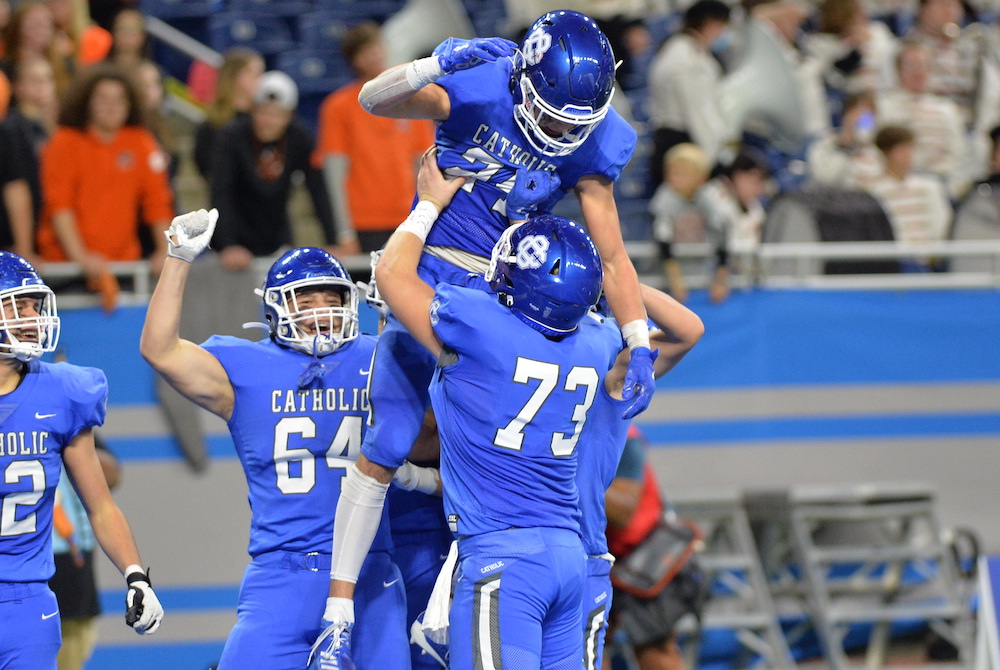
The senior quarterback connected with Notre Dame commit Nolan Ziegler on a pair of second-half touchdown passes, and the GRCC defense did the rest in a 31-7 victory over Marine City in the Division 5 Final on Saturday at Ford Field.
Joey Silveri, GRCC’s three-year starting QB, suffered a season-ending knee injury in Week 4. That’s when Passinault, a 6-foot, 180-pound converted receiver, switched to the signal-caller position. Passinault picked up where Silveri left off and helped lead the Cougars to a second-straight Division 5 title, their sixth championship in the last dozen years and seventh overall.
“Well, it’s surreal. Before the season, if you would have told me this was going to happen, I would have told you you’re crazy,” said Passinault, who finished the game 15-of-28 passing for 221 yards with one interception.
“A bad thing happened to a really good kid, Joey Silveri, and that’s just the mindset of the team to step in where it’s needed. I went from wide receiver to quarterback and it’s pretty easy to do that when I have guys around me like Nolan, Ronin Russell-Dixon, Devin Fridley-Bell, Luke Kuzner, Jack Rellinger. I have all those guys around me, it’s easy to step into that role and just settle in.”
GRCC (14-0) completed its third perfect season in the last five years, but Marine City (13-1) made the Cougars work for it for the better part of three quarters Saturday.
GRCC led 10-0 in the second quarter after a 29-yard field goal by junior John Meyer and a 2-yard TD run by Rellinger, a senior. Marine City hung in there, however, and pulled within 10-7 on junior QB Jeff Heaslip’s 3-yard scoring pass to senior Charles Tigert with a little more than three minutes left in the half.
The score remained that way until the closing seconds of the third quarter. Ziegler, a 6-4, 210-pound receiver and linebacker, caught a pass over the middle from Passinault, turned the corner and raced down the sideline for a 59-yard scoring play.
That seemed to ignite the Cougars’ offense a bit.
 “My team, they blocked well, it was a great pass by John,” Ziegler said. “We were just kind of playing backyard football out there honestly, and we just got things going. I got a good block from the receivers, and I just got down and got it in.”
The Passinault-to-Ziegler connection struck again four minutes later, this time on a 17-yard TD play, as the Cougars began to pull away. Ziegler finished with seven receptions for 136 yards, plus he notched a game-high 13 tackles in displaying his Power Five college football credentials.
Senior linebacker Jack Klafeta put the exclamation point on the victory for GRCC with a 34-yard scoop-and-score midway through the fourth quarter. Klafeta notched nine tackles, as did junior Jack Cook.
“Just their athleticism all over the field, their physicality up front, made things very difficult,” said Marine City coach Daryn Letson, whose team allowed no more than 14 points in a single game this season prior to Saturday.
“You know, our defense played their hearts out. I think our whole team played their hearts out,” Letson said. “You know, they have those kids and we just weren’t able to do enough offensively when we needed to.”
GRCC finished with a narrow edge in total offense, 228-215. The Mariners outrushed the Cougars, 77-7.
Heaslip was 14-of-22 passing for 138 yards. Senior Wyatt Walker led Marine City defensively with nine tackles.
This was the sixth state title in 10 seasons overall for GRCC coach Todd Kolster, who is now 112-12 at the Cougars’ helm. They also won titles under him in 2010, 2016, 2017, 2019 and 2020. GRCC’s first came in 1987.
Kolster said the Cougars made great strides from the start of this season.
“It’s a pretty surreal thing for these guys up here – just unbelievably proud of them for so much that they’ve accomplished this year,” he said. “This team probably has come as far as any football team in a season that I’ve coached.
“Just coming together, learning what it takes, getting experience, understanding each other, fighting, competing. That’s a process and we were far, far away with them at the beginning of the season. To come here and be able to get this done, the credit goes 100 percent to our seniors.”
It was an emotional farewell for Passinault. He carried on the strong QB play provided by Silveri, who is a college prospect and led the Cougars to Finals titles in 2019 and 2020.
As a passer, Passinault proved more than capable in his own right. He threw for 2,307 yards and 37 TDs this season.
“This is it. That will probably be the last time I ever play football, so it’s just crazy to think that that’s the last time I’ll play specifically with these people,” Passinault said. “ … It’s just crazy. As a kid, you just dream about this. And to have it happen, it’s just a surreal feeling – and having dreams come true, it’s crazy.”
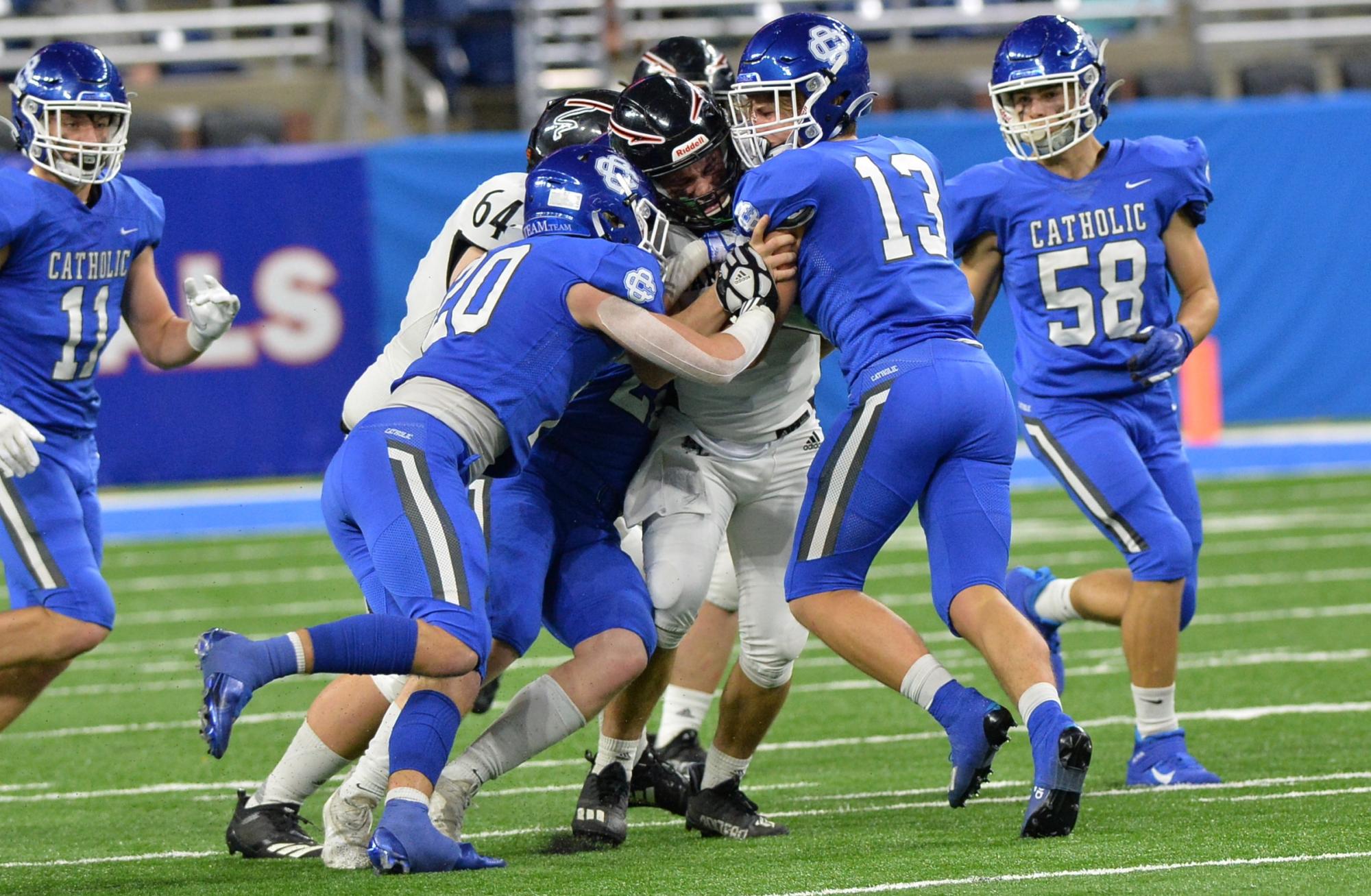
PHOTOS (Top) Grand Rapids Catholic Central’s Will Smith (73) hoists teammate Nolan Ziegler as they celebrate during Friday’s Division 5 championship win. (Middle) A host of GRCC and Marine City players stack up to a standstill. (Photos by Hockey Weekly Action Photos.)