


Add, Subtract, Divide, Multiply: MHSAA Not Alone
July 25, 2017
By Rob Kaminski
MHSAA benchmarks editor
This is the third part in a series on MHSAA tournament classification, past and present, that will be published over the next two weeks. This series originally ran in this spring's edition of MHSAA benchmarks.
As the MHSAA faces its most recent classification task with 8-Player Football, and opinions continue to swirl about as to the method, timeframe, location and other procedures, a look around the country provides plenty of company among state association brethren factoring variables into their own equations.
In the Pacific Northwest, the Oregon School Activities Association Football Playoffs are under public scrutiny as leadership ponders a five or six classification format beginning with the 2018-19 school year.
The OSAA has crowned six champions on the gridiron since 2006-07. Many of the state’s smaller schools would like to keep it that way, while larger schools lean toward a five-classification system, citing larger leagues, ease of travel and credibility to state championships as the advantages.
Still others would prefer more than six classes, pointing to safety issues and the opportunity to increase participation numbers as positives.
Moving southeast of Oregon, the Nevada Interscholastic Activities Association recently voted to hold serve on a classification proposal that was volleyed to the membership.
However, changes still could be forthcoming by as early as the 2018-19 season which would add a fifth classification in more populated southern Nevada while allowing northern schools to participate in four classifications. Such divisions could mean no state championship for the fifth class in southern Nevada.
Because of that, the NIAA wants equal numbers of schools in each classification on both ends of the state. Complicating the issue is the fact that the 24 largest schools in the state, by enrollment, are all in Clark County in Southern Nevada.
Across Nevada’s border into Arizona, charter schools are asking the Arizona Interscholastic Association to reconsider classification that was voted upon and approved in September 2015. That agreement called for the largest 33 percent of charter schools by enrollment to be placed in the state’s largest school classification, 3A, the middle 33 percent into 2A, and the smallest 33 percent into 1A.
Less than two years later the charter schools have had a change of heart and have asked to be considered the same as other Arizona public schools and be placed appropriately by enrollment beginning with the 2018-19 school year.
The situation in Arizona further illustrates how the public/private debate that all state associations have faced throughout existence now has the added dynamic of rapidly growing charter schools in today’s educational system, along with virtual school enrollment.
In the nation’s heartland, Nebraska has retooled its football classifications by using enrollment of boys students only in its schools rather than total enrollment. The Nebraska School Activities Association football-playing schools will kick off the 2018 season using this alignment.
Nebraska has three classes of 11-player football, with the smallest class divided in two, Class C-1 and C-2. The state also will have 8-player football for boys enrollments under 47, and the NSAA will sponsor a new 6-player tournament in 2018 for schools with 27 or fewer boys.
“This is a good proposal because some schools have a sizable imbalance between the number of boys and girls, and there’s a large gap (in enrollment) between the largest and smallest schools in Classes A and B,” NSAA executive director Jim Tenopir said. “I think this addresses both of those concerns.”
Swimmers in Georgia, meanwhile, will feel like they are moving with the current, rather than upstream in 2017-18, as the Georgia High School Association recently doubled the number of team championship events from two to four.
Swim enthusiasts can also count on longer days at the finals, as the top 30 finishers from the prelims will advance to the finals instead of 20, and all championship events will have three heats versus two.
Title IX at 50: Pioneer's Joyce Legendary in Michigan, National Swim History
By
Geoff Kimmerly
MHSAA.com senior editor
November 9, 2021
Michigan has had no shortage of achievers in the swimming pool over a half-century of girls swimming & diving sponsorship by the MHSAA. But nearly two decades after her last high school race, Ann Arbor Pioneer’s Kara Lynn Joyce's achievements remain among the highest of standards.
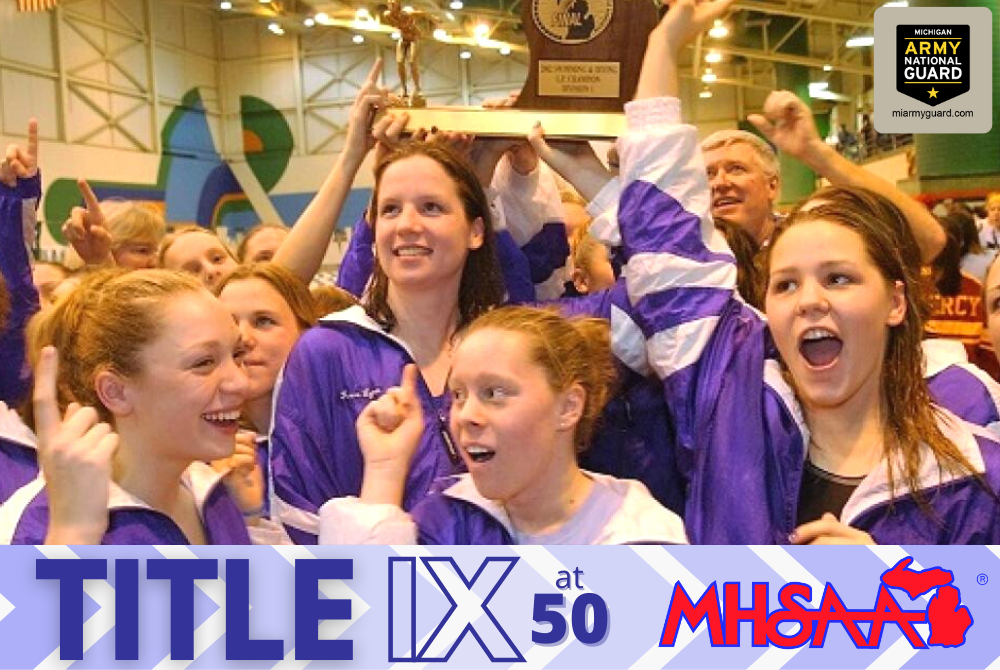
Joyce starred on the 2001 and 2002 teams that were the second and third, respectively, of Pioneer’s nine straight champions in Lower Peninsula Class A and then Division 1 (with that reclassification in 2002). She was part of four race champions both years – in the 100-yard freestyle and as part of the 400 freestyle relay at both Finals, while as a junior in the 50 and as part of the 200 medley relay and as a senior in 200 freestyle and 200 free relay.
Her name remains an incredible 16 times in the MHSAA girls swimming & diving record book, including seven times on the all-Finals lists (for performances from all Classes and Divisions combined). Her 50 (22.04 seconds – leading off a relay) and 100 (48.59) freestyles in 2002 remain all-Finals record, as does the 200 freestyle relay (1:32.77) she swam with Margaret Kelly, Leigh Cole and Jennifer Merte that season. Her winning 1:46.34 in the 200 as a senior is second all-time at the Finals only to another future Olympian, Canton’s Allison Schmitt, who finished nine hundredths of a second faster five years later.
Joyce’s 50 remains fifth all-time in the national record book, and her 100 ranks 13th on that list. Pioneer’s 2002 200 freestyle relay ranks sixth nationally.
Joyce went on to swim at University of Georgia and then during the 2004, 2008 and 2012 Olympics. She won four silver medals, two each as part of 400-meter freestyle and 400-meter medley relays.
That 2002 Pioneer team is still considered arguably the most dominant in MHSAA history. The Pioneers claimed that first LP Division 1 title with 476 points, by 275 over the rest of the field. No LP Division 1 team has broken 400 points at a Final since.
Joyce has become a strong voice in leadership training for teenage girls in athletics. In 2017, she founded Lead Sports Co., which serves as a “home base for teenage girl athletes, parents and coaches with comprehensive online courses in Leadership, Confidence, Sports Psychology, and more.”
Second Half's weekly Title IX Celebration posts are sponsored by Michigan Army National Guard.
Previous Title IX at 50 Spotlights
Nov. 2: Royal Oak's Finch Leading Way on Football Field - Read
Oct. 26: Coach Clegg Sets Championship Standard at Grand Blanc - Read
Oct. 19: Rockford Girls Set Pace, Hundreds After Have Continued to Chase - Read
Oct. 12: Bedford Volleyball Pioneer Continues Blazing Record-Setting Trail - Read
Oct. 5: Warner Paved Way to Legend Status with Record Rounds - Read
Sept. 28: Taylor Kennedy Gymnasts Earn Fame as 1st Champions - Read
Sept. 21: Portage Northern Star Byington Becomes Play-by-Play Pioneer - Read
Sept. 14: Guerra/Groat Legacy Continues to Serve St. Philip Well - Read
Sept. 7: Best-Ever Conversation Must Include Leland's Glass - Read
Aug. 31: We Will Celebrate Many Who Paved the Way - Read
PHOTOS Ann Arbor Pioneer celebrates the Lower Peninsula Division 1 championship; Olympian Kara Lynn Joyce stands middle, just below the trophy. (MHSAA File Photos.)