


Add, Subtract, Divide, Multiply: MHSAA Not Alone
July 25, 2017
By Rob Kaminski
MHSAA benchmarks editor
This is the third part in a series on MHSAA tournament classification, past and present, that will be published over the next two weeks. This series originally ran in this spring's edition of MHSAA benchmarks.
As the MHSAA faces its most recent classification task with 8-Player Football, and opinions continue to swirl about as to the method, timeframe, location and other procedures, a look around the country provides plenty of company among state association brethren factoring variables into their own equations.
In the Pacific Northwest, the Oregon School Activities Association Football Playoffs are under public scrutiny as leadership ponders a five or six classification format beginning with the 2018-19 school year.
The OSAA has crowned six champions on the gridiron since 2006-07. Many of the state’s smaller schools would like to keep it that way, while larger schools lean toward a five-classification system, citing larger leagues, ease of travel and credibility to state championships as the advantages.
Still others would prefer more than six classes, pointing to safety issues and the opportunity to increase participation numbers as positives.
Moving southeast of Oregon, the Nevada Interscholastic Activities Association recently voted to hold serve on a classification proposal that was volleyed to the membership.
However, changes still could be forthcoming by as early as the 2018-19 season which would add a fifth classification in more populated southern Nevada while allowing northern schools to participate in four classifications. Such divisions could mean no state championship for the fifth class in southern Nevada.
Because of that, the NIAA wants equal numbers of schools in each classification on both ends of the state. Complicating the issue is the fact that the 24 largest schools in the state, by enrollment, are all in Clark County in Southern Nevada.
Across Nevada’s border into Arizona, charter schools are asking the Arizona Interscholastic Association to reconsider classification that was voted upon and approved in September 2015. That agreement called for the largest 33 percent of charter schools by enrollment to be placed in the state’s largest school classification, 3A, the middle 33 percent into 2A, and the smallest 33 percent into 1A.
Less than two years later the charter schools have had a change of heart and have asked to be considered the same as other Arizona public schools and be placed appropriately by enrollment beginning with the 2018-19 school year.
The situation in Arizona further illustrates how the public/private debate that all state associations have faced throughout existence now has the added dynamic of rapidly growing charter schools in today’s educational system, along with virtual school enrollment.
In the nation’s heartland, Nebraska has retooled its football classifications by using enrollment of boys students only in its schools rather than total enrollment. The Nebraska School Activities Association football-playing schools will kick off the 2018 season using this alignment.
Nebraska has three classes of 11-player football, with the smallest class divided in two, Class C-1 and C-2. The state also will have 8-player football for boys enrollments under 47, and the NSAA will sponsor a new 6-player tournament in 2018 for schools with 27 or fewer boys.
“This is a good proposal because some schools have a sizable imbalance between the number of boys and girls, and there’s a large gap (in enrollment) between the largest and smallest schools in Classes A and B,” NSAA executive director Jim Tenopir said. “I think this addresses both of those concerns.”
Swimmers in Georgia, meanwhile, will feel like they are moving with the current, rather than upstream in 2017-18, as the Georgia High School Association recently doubled the number of team championship events from two to four.
Swim enthusiasts can also count on longer days at the finals, as the top 30 finishers from the prelims will advance to the finals instead of 20, and all championship events will have three heats versus two.

Okemos Finds Scoring Touch, Championship Stride in Comeback Win
By
Perry A. Farrell
Special for MHSAA.com
November 6, 2021
NOVI – For three quarters of the Division 1 championship match Saturday at Novi High School, undefeated Okemos’ offense was lifeless against New Baltimore Anchor Bay.
The Tars paid close attention to Jack Guggemos, and the Chiefs had no answers until suddenly, their preparation for a late-game, must-score scenario played out with a dream result.
Down by a goal, Okemos (20-0-4) scored two within two minutes, 17 seconds of each other during the final 10 minutes to claim its third Finals title in a physical 2-1 victory.
Ben Hussey scored off a great assist from Guggemos to tie the game at 1-1, and Aidan Antcliff scored the game-winner on a free kick from 20 yards out with seven minutes, 42 second to play.
“I just tried to get to the end line, and Ben was there,’’ said Guggemos. “He made a great run to the box and tapped it in. You have to deal with what’s thrown at you.
Guggemos had a lot to live up to. His coach and father, Brian, won a Class B title as a senior at Mason in 1989.
“No pressure, right,’’ Jack said, laughing. “It’s a great feeling being able to celebrate this with him.’’
Antcliff knew his shot was in once he booted it.
“It’s an unbelievable feeling,’’ said Antcliff, who scored just his second goal of the year. “It was a great shot. I practice that shot in the summertime. I got the opportunity in this game, and I made the most of it. Once I hit it, I knew it was going in.’’
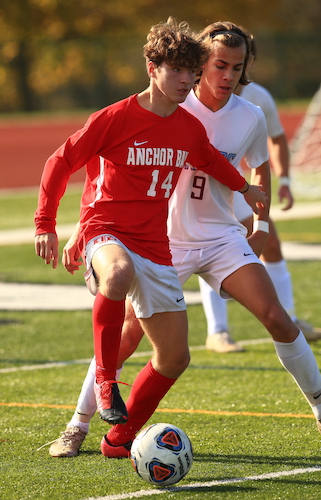 Anchor Bay (22-2-1) made its first appearance in Final, while Okemos won the 2004 Division 1 title and was the B-C champ in 1984.
Okemos was led by all-state senior Guggemos, who set the school record with 45 goals this fall. Anchor Bay featured three past all-state players in Tanner Hodgson (first team), twin brother Carson Hodgson (second team) and goalie Evan Linsley (second team).
The Tars made sure Guggemos was surrounded any time he had the ball, sometimes with as many as three defenders.
“He was part of our game plan,’’ said Tars coach Nate Williams.
“It was a great game between two great soccer teams. We knew even up 1-0 we couldn’t take our foot off the gas.’’
Neither team generated offense in the first half, with most play at mid-field.
With 2:03 left in the first half, junior midfielder Francesco DiLorenzo blasted a shot past the Okemos keeper to give the upstart Tars a 1-0 lead heading into halftime.
Anchor Bay came out even more aggressive in the second half with the lead and a chance at the state title.
Guggemos was shackled, but he got free to send a pass near the net with 9:59 left that Hussey redirected into the net to tie the game at 1-1.
“It’s funny because my assistant coaches were talking about it,’’ said Okemos coach Brian Guggemos. “I’ve been doing it long enough to know you need to prepare for moments where you’re going to be down a goal. In the last three weeks we’ve practiced being down a goal. We’ve tried to make sure we were prepared for it. We said look, if we’re down a goal here’s the formation. We went into it right away, and then I told Ben and Owen (Brewer), our two forwards, get in there and crash the goal. That obviously turns the game around a little bit.
"Aidan hits a banger to win the state championship. We also practice those things everyday this time of the year. The guys have listened to the things we needed to do in practice. They paid attention, and that attention to detail has been pretty good for us."
PHOTO (Top) Okemos celebrates its first Finals championship since 2004 on Saturday. (Middle) Anchor Bay's Tanner Hodgson (14) works to control possession with Okemos' Ben Hussey defending. (Photos by Hockey Weekly Action Photos.)