


Add, Subtract, Divide, Multiply: MHSAA Not Alone
July 25, 2017
By Rob Kaminski
MHSAA benchmarks editor
This is the third part in a series on MHSAA tournament classification, past and present, that will be published over the next two weeks. This series originally ran in this spring's edition of MHSAA benchmarks.
As the MHSAA faces its most recent classification task with 8-Player Football, and opinions continue to swirl about as to the method, timeframe, location and other procedures, a look around the country provides plenty of company among state association brethren factoring variables into their own equations.
In the Pacific Northwest, the Oregon School Activities Association Football Playoffs are under public scrutiny as leadership ponders a five or six classification format beginning with the 2018-19 school year.
The OSAA has crowned six champions on the gridiron since 2006-07. Many of the state’s smaller schools would like to keep it that way, while larger schools lean toward a five-classification system, citing larger leagues, ease of travel and credibility to state championships as the advantages.
Still others would prefer more than six classes, pointing to safety issues and the opportunity to increase participation numbers as positives.
Moving southeast of Oregon, the Nevada Interscholastic Activities Association recently voted to hold serve on a classification proposal that was volleyed to the membership.
However, changes still could be forthcoming by as early as the 2018-19 season which would add a fifth classification in more populated southern Nevada while allowing northern schools to participate in four classifications. Such divisions could mean no state championship for the fifth class in southern Nevada.
Because of that, the NIAA wants equal numbers of schools in each classification on both ends of the state. Complicating the issue is the fact that the 24 largest schools in the state, by enrollment, are all in Clark County in Southern Nevada.
Across Nevada’s border into Arizona, charter schools are asking the Arizona Interscholastic Association to reconsider classification that was voted upon and approved in September 2015. That agreement called for the largest 33 percent of charter schools by enrollment to be placed in the state’s largest school classification, 3A, the middle 33 percent into 2A, and the smallest 33 percent into 1A.
Less than two years later the charter schools have had a change of heart and have asked to be considered the same as other Arizona public schools and be placed appropriately by enrollment beginning with the 2018-19 school year.
The situation in Arizona further illustrates how the public/private debate that all state associations have faced throughout existence now has the added dynamic of rapidly growing charter schools in today’s educational system, along with virtual school enrollment.
In the nation’s heartland, Nebraska has retooled its football classifications by using enrollment of boys students only in its schools rather than total enrollment. The Nebraska School Activities Association football-playing schools will kick off the 2018 season using this alignment.
Nebraska has three classes of 11-player football, with the smallest class divided in two, Class C-1 and C-2. The state also will have 8-player football for boys enrollments under 47, and the NSAA will sponsor a new 6-player tournament in 2018 for schools with 27 or fewer boys.
“This is a good proposal because some schools have a sizable imbalance between the number of boys and girls, and there’s a large gap (in enrollment) between the largest and smallest schools in Classes A and B,” NSAA executive director Jim Tenopir said. “I think this addresses both of those concerns.”
Swimmers in Georgia, meanwhile, will feel like they are moving with the current, rather than upstream in 2017-18, as the Georgia High School Association recently doubled the number of team championship events from two to four.
Swim enthusiasts can also count on longer days at the finals, as the top 30 finishers from the prelims will advance to the finals instead of 20, and all championship events will have three heats versus two.

Ithaca's Bloom Gets Her Title, Hart Ties LP Finals Team Record
November 6, 2021
BROOKLYN — A year ago, Lani Bloom of Ithaca was in first place with a decisive lead, less than 100 meters from the finish line at Michigan International Speedway.
But then she fell and was reduced to a slow crawl.
As she desperately tried to reach the line on her hands and knees, three runners passed her. It was the second year in a row that Bloom led coming down the stretch at MIS, only to experience a catastrophe. She was 18th in 2019 after leading with 800 yards remaining, collapsing after crossing the line.
So, that fist pump she gave when she crossed the line at MIS on Saturday was almost as much for the fact she finished upright as it was for winning the MHSAA Lower Peninsula Division 3 individual championship.
There would be no drama awaiting Bloom on the home stretch this year, as she cruised through the finish line in 17:29.69, winning by 30 seconds ahead of Hart sophomore Alyson Enns.
“I was in the same position last year,” Bloom said. “I was ahead by quite a bit. I just fell. This year, I made a conscious effort, I got to that point and I said, ‘You have never run this part of the course. You have crawled it for the past three years. It’s time to run it. It’s time to finish it.’”
Perhaps because of her past issues at MIS, Bloom showed empathy for fellow runners who were struggling after crossing the line.
She helped sixth-place Mylie Kelly of Benzie Central get back to her feet and moving, then helped hold up two teammates who were completely spent after racing 3.1 miles.
 “Usually if I’m feeling good enough to stand up on my own, I’m feeling good enough to help people,” Bloom said. “The girls I went back for are girls I’ve competed against, ran with forever now. It seems they’ve given me so much respect that the least I could do is hold them up at the end.”
Bloom went through the mile mark in 5:38.1, holding a 7.8-second lead over Hart freshman Jessica Jazwinski. The lead stretched to 19.2 seconds when Bloom reached two miles in 11:17.3.
“I was expecting them to hang on to me for a little longer,” Bloom said. “I was reading these Michigan Speed Ratings. He said these girls get out hard and dare the field to hang on. I said, ‘I’m going to do that. I’m going to see who is ready to race today.’”
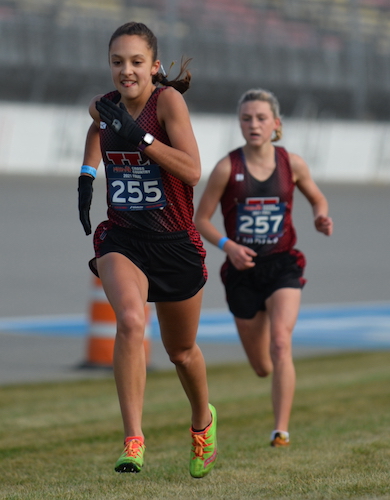
Following Bloom across the line were three Hart runners who took places two through four. Alyson Enns was second in 17:59.67, Jazwinski was third in 18:00.59 and senior Audrianna Enns was fourth in 18:32.27.
Hart’s strength up front was able to offset more consistent top-five finishes by the other contenders. Hart scored 143 points to win its fifth consecutive Division 3 championship by 36 points over Kent City.
The fifth-straight Finals title tied Rockford’s run in Class A/Division 1 from 1998-2002 for longest championship streak in Lower Peninsula girls cross country history.
Kent City’s top five runners were in the top 72 overall and top 53 among team runners, while Hart counted a runner who was 159th overall and 111th in the team race.
Lexie Beth Nienhuis was 31st in 19:36.65 for Hart, while Abigail Pretty completed the team score by taking 159th in 21:47.49.
PHOTOS (Top) Ithaca’s Lani Bloom approaches the finish line on the way to winning the LPD3 individual championship. (Middle) Hart’s Alyson Enns (255) and Jessica Jazwinski (257) lead the way as their team wins a record-tying fifth-straight title. (Click for more from RunMichigan.com.)