


Add, Subtract, Divide, Multiply: MHSAA Not Alone
July 25, 2017
By Rob Kaminski
MHSAA benchmarks editor
This is the third part in a series on MHSAA tournament classification, past and present, that will be published over the next two weeks. This series originally ran in this spring's edition of MHSAA benchmarks.
As the MHSAA faces its most recent classification task with 8-Player Football, and opinions continue to swirl about as to the method, timeframe, location and other procedures, a look around the country provides plenty of company among state association brethren factoring variables into their own equations.
In the Pacific Northwest, the Oregon School Activities Association Football Playoffs are under public scrutiny as leadership ponders a five or six classification format beginning with the 2018-19 school year.
The OSAA has crowned six champions on the gridiron since 2006-07. Many of the state’s smaller schools would like to keep it that way, while larger schools lean toward a five-classification system, citing larger leagues, ease of travel and credibility to state championships as the advantages.
Still others would prefer more than six classes, pointing to safety issues and the opportunity to increase participation numbers as positives.
Moving southeast of Oregon, the Nevada Interscholastic Activities Association recently voted to hold serve on a classification proposal that was volleyed to the membership.
However, changes still could be forthcoming by as early as the 2018-19 season which would add a fifth classification in more populated southern Nevada while allowing northern schools to participate in four classifications. Such divisions could mean no state championship for the fifth class in southern Nevada.
Because of that, the NIAA wants equal numbers of schools in each classification on both ends of the state. Complicating the issue is the fact that the 24 largest schools in the state, by enrollment, are all in Clark County in Southern Nevada.
Across Nevada’s border into Arizona, charter schools are asking the Arizona Interscholastic Association to reconsider classification that was voted upon and approved in September 2015. That agreement called for the largest 33 percent of charter schools by enrollment to be placed in the state’s largest school classification, 3A, the middle 33 percent into 2A, and the smallest 33 percent into 1A.
Less than two years later the charter schools have had a change of heart and have asked to be considered the same as other Arizona public schools and be placed appropriately by enrollment beginning with the 2018-19 school year.
The situation in Arizona further illustrates how the public/private debate that all state associations have faced throughout existence now has the added dynamic of rapidly growing charter schools in today’s educational system, along with virtual school enrollment.
In the nation’s heartland, Nebraska has retooled its football classifications by using enrollment of boys students only in its schools rather than total enrollment. The Nebraska School Activities Association football-playing schools will kick off the 2018 season using this alignment.
Nebraska has three classes of 11-player football, with the smallest class divided in two, Class C-1 and C-2. The state also will have 8-player football for boys enrollments under 47, and the NSAA will sponsor a new 6-player tournament in 2018 for schools with 27 or fewer boys.
“This is a good proposal because some schools have a sizable imbalance between the number of boys and girls, and there’s a large gap (in enrollment) between the largest and smallest schools in Classes A and B,” NSAA executive director Jim Tenopir said. “I think this addresses both of those concerns.”
Swimmers in Georgia, meanwhile, will feel like they are moving with the current, rather than upstream in 2017-18, as the Georgia High School Association recently doubled the number of team championship events from two to four.
Swim enthusiasts can also count on longer days at the finals, as the top 30 finishers from the prelims will advance to the finals instead of 20, and all championship events will have three heats versus two.
Successfully Juggling 2 Sports, Richmond Chases Cross Country Title
By
Paul Costanzo
Special for MHSAA.com
October 27, 2021
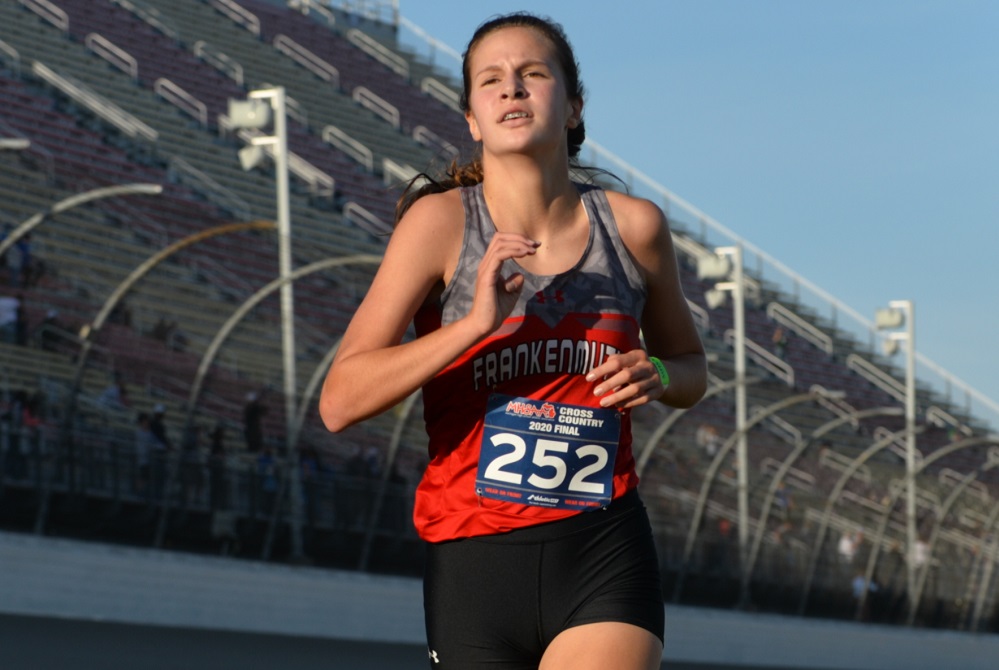
Mary Richmond is too busy to run slow.
 The Frankenmuth sophomore is splitting time this fall between the cross country and volleyball teams, while also working one day per week at an Italian restaurant in town. When those seasons end in the next month, she doesn’t exactly take a break. During the winter, school and work get balanced with travel volleyball. In the spring, track joins the fray, and in the summer, she plays travel softball.
“Both (fall) coaches are really accommodating with my schedules, and even with work, my boss is really good working with my schedules,” Richmond said. “My whole entire life I’ve been busy – I’ve always been going non-stop, so this isn’t a new thing this year.”
Richmond is passionate about each sport and the bonds created with teammates with whom she competes, which is why she wasn’t willing to give up volleyball or softball while becoming one of the state’s top runners.
Entering Saturday’s cross country Regional at Shepherd, Richmond shares the fastest time of the season in Lower Peninsula Division 2 (17 minutes, 56 seconds) with Grand Rapids Christian’s Madelyn Frens. She won a Regional title and placed fourth at the Division 2 Cross Country Finals as a freshman, and was all-state in a pair of events (third in the 1,600 meters, fourth in the 3,200) at last spring’s LP Division 2 Track & Field Finals.
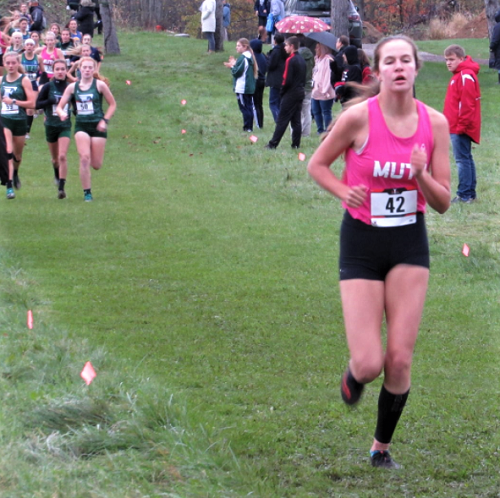
“Mary works extremely hard in practice, and has learned to run on her own in most of our meets this season,” Frankenmuth girls cross country coach Mike Snyder said. “When there is a lead Gator, we simply tell her to chase the Gator. She loves competition and enjoys meets where she can compete with girls that have faster times than her. She has the potential to be the Division 2 state champion, and has the work ethic and focus to go after that goal.”
 While Richmond is very busy, she said her focus is currently on the Regional race, which will be in the same location she ran her previous best – a time that is nearly a full minute faster than her closest competition.
“It’s a really good course, and I really want to work on my time and the little stuff, like my form and stuff, so I can get prepared for states,” Richmond said. “States are going to be really tough, because there are four or five girls within seconds of each other.”
Richmond has won nine of the 13 meets she’s run in this season, but her 17:56 came while she finished fifth. While running after the motorized vehicle that’s showing the way has provided some extra motivation in a lot of those meets, it’s racing the best that motivates Richmond the most.
“When my dad bikes next to me while I’m training, I always have him bike in front of me,” Richmond said. “With the Gator, I’m trying to catch it. It’s a racer’s mentality. I’ve never finished in first place when I’ve run a personal record.”
Anticipating she’ll get that chance again at the Finals has Richmond excited. And on that day, she said she won’t be concerned about time, just racing.
“Finishing at the top at states with those girls and being able to have a good race – being able to come out of it and saying I gave all I could give is probably my goal,” she said. “As long as I have no regrets afterward, I’ll be happy.”
In between the Regional and Finals, which are Nov. 6 at Michigan International Speedway, Richmond will be joining her volleyball teammates in trying to win a District title. Richmond, who stands 5 feet, 11½ inches tall, plays middle and outside hitter for the Eagles. She plays a reserve role on the volleyball court, but she’s enjoying it all the same.
“I’ve always loved volleyball, and I wasn’t ready to give it up,” Richmond said. “I don’t get much playing time, but we have such an athletic team that just being on the team and being there for all the practices has been great. I think I use volleyball as a little bit of a stress reliever from cross country. When I get to volleyball, I get to have fun with some of my friends, and at the same time compete.”
Frankenmuth will play in the District at Chesaning, and has a bye into the semifinal. Richmond thinks the team has the potential to make a run, and extend her busy fall.
“I think if we play like we can, those girls are just amazing when they come together,” she said. “Volleyball is barely any of their main sport, but when they come together, the athleticism in that group is nuts.”
 Paul Costanzo served as a sportswriter at The Port Huron Times Herald from 2006-15, including three years as lead sportswriter, and prior to that as sports editor at the Hillsdale Daily News from 2005-06. He can be reached at [email protected] with story ideas for Genesee, Lapeer, St. Clair, Sanilac, Huron, Tuscola, Saginaw, Bay, Arenac, Midland and Gladwin counties.
PHOTOS (Top) Frankenmuth’s Mary Richmond crosses the finish line during last season’s MHSAA Lower Peninsula Finals at Michigan International Speedway. (Middle) Richmond leads the pack during this season’s Tri-Valley Conference championship race. (Top photo by RunMichigan.com, middle courtesy of the Frankenmuth cross country program.)