


Add, Subtract, Divide, Multiply: MHSAA Not Alone
July 25, 2017
By Rob Kaminski
MHSAA benchmarks editor
This is the third part in a series on MHSAA tournament classification, past and present, that will be published over the next two weeks. This series originally ran in this spring's edition of MHSAA benchmarks.
As the MHSAA faces its most recent classification task with 8-Player Football, and opinions continue to swirl about as to the method, timeframe, location and other procedures, a look around the country provides plenty of company among state association brethren factoring variables into their own equations.
In the Pacific Northwest, the Oregon School Activities Association Football Playoffs are under public scrutiny as leadership ponders a five or six classification format beginning with the 2018-19 school year.
The OSAA has crowned six champions on the gridiron since 2006-07. Many of the state’s smaller schools would like to keep it that way, while larger schools lean toward a five-classification system, citing larger leagues, ease of travel and credibility to state championships as the advantages.
Still others would prefer more than six classes, pointing to safety issues and the opportunity to increase participation numbers as positives.
Moving southeast of Oregon, the Nevada Interscholastic Activities Association recently voted to hold serve on a classification proposal that was volleyed to the membership.
However, changes still could be forthcoming by as early as the 2018-19 season which would add a fifth classification in more populated southern Nevada while allowing northern schools to participate in four classifications. Such divisions could mean no state championship for the fifth class in southern Nevada.
Because of that, the NIAA wants equal numbers of schools in each classification on both ends of the state. Complicating the issue is the fact that the 24 largest schools in the state, by enrollment, are all in Clark County in Southern Nevada.
Across Nevada’s border into Arizona, charter schools are asking the Arizona Interscholastic Association to reconsider classification that was voted upon and approved in September 2015. That agreement called for the largest 33 percent of charter schools by enrollment to be placed in the state’s largest school classification, 3A, the middle 33 percent into 2A, and the smallest 33 percent into 1A.
Less than two years later the charter schools have had a change of heart and have asked to be considered the same as other Arizona public schools and be placed appropriately by enrollment beginning with the 2018-19 school year.
The situation in Arizona further illustrates how the public/private debate that all state associations have faced throughout existence now has the added dynamic of rapidly growing charter schools in today’s educational system, along with virtual school enrollment.
In the nation’s heartland, Nebraska has retooled its football classifications by using enrollment of boys students only in its schools rather than total enrollment. The Nebraska School Activities Association football-playing schools will kick off the 2018 season using this alignment.
Nebraska has three classes of 11-player football, with the smallest class divided in two, Class C-1 and C-2. The state also will have 8-player football for boys enrollments under 47, and the NSAA will sponsor a new 6-player tournament in 2018 for schools with 27 or fewer boys.
“This is a good proposal because some schools have a sizable imbalance between the number of boys and girls, and there’s a large gap (in enrollment) between the largest and smallest schools in Classes A and B,” NSAA executive director Jim Tenopir said. “I think this addresses both of those concerns.”
Swimmers in Georgia, meanwhile, will feel like they are moving with the current, rather than upstream in 2017-18, as the Georgia High School Association recently doubled the number of team championship events from two to four.
Swim enthusiasts can also count on longer days at the finals, as the top 30 finishers from the prelims will advance to the finals instead of 20, and all championship events will have three heats versus two.

Repeat-Minded North Central Rolling with Playoffs Approaching
By
John Vrancic
Special for MHSAA.com
October 22, 2021
POWERS — Eighteen and counting.
 That’s the number at which North Central’s football winning streak stands after taking a forfeit victory from Gogebic last weekend.
The reigning 8-player Division 2 champion, however, has bigger fish to fry.
“The winning streak is something you don’t focus on,” said junior quarterback Luke Gorzinski, who pulled his hamstring in a 71-6 rout of Ontonagon on Oct. 8 but has returned. “First we have Forest Park, then we have the playoffs. It feels great to be back on the field. It feels like I’m part of the team again.”
The Jets naturally hope to retain their title, but know they must first turn their attention to tonight’s regular-season finale at Crystal Falls Forest Park.
North Central (8-0) finished 10-0 last season after defeating Portland St. Patrick 70-48 in Division 2 Final on Jan. 16.
“We try to look at it as if we hadn’t won a state championship yet,” said senior lineman Lane Nehring. “We don’t want to get too comfortable. We still have Forest Park. We’re not close in distance, but we have a rivalry going. Both of us have good teams.”
What has been the key to North Central’s success on the field?
 “I think it’s our D line play,” said Nehring. “We work together and communicate. Ontonagon’s hook-and-ladder play caught us off guard. They scored on that play, which was bit of a wake-up call for us. Everybody looks at you to be a contender. We definitely have pressure on us to win another one.”
Off the field, coach Leo Gorzinski believes offseason work also has been key to the Jets’ success.
“The kids are invested,” he said. “They bought into the system and know what’s expected of them here at North Central. The interest in our program is there. The kids stay up, which makes it a little easier to keep them focused.
“We have a few people dinged up. We’re very fortunate to have a lot of depth. We have a couple people down who are key players.”
North Central is averaging 63 points per game, and its defense has allowed just 13 points this season. The Jets held Stephenson to minus-seven yards of total offense in a season-opening 46-0 win.
“You feel on top of the world right away,” said Luke Gorzinski. “You also have to be ready to play right away. It’s a good way to open the season, but any team can beat any other team on any given day or night. Stephenson has a good team. You can’t take any team for granted.”
No team is exempt from adversity, and the Jets will verify that.
They lost senior Alex Naser for the season Oct. 8 due to a hairline fracture below his right kneecap.
“I couldn’t have asked for a better year,” he said. “I’m going to stay on the sidelines and help as much as I can. I’ll be giving the guys a few pointers. It’s a little disappointing to not be able to play, but it’s all part of football.”
The Jets are taking this as a reminder of the importance of depth.
“Other guys have been involved in our offense,” said Coach Gorzinski. “They know what they need to do. We may not be as explosive as we were before, but we should still have an efficient offense.”
 John Vrancic has covered high school sports in the Upper Peninsula since joining the Escanaba Daily Press staff in 1985. He is known most prominently across the peninsula for his extensive coverage of cross country and track & field that frequently appears in newspapers from the Wisconsin border to Lake Huron. He received the James Trethewey Award for Distinguished Service in 2015 from the Upper Peninsula Sportswriters and Sportscasters Association.
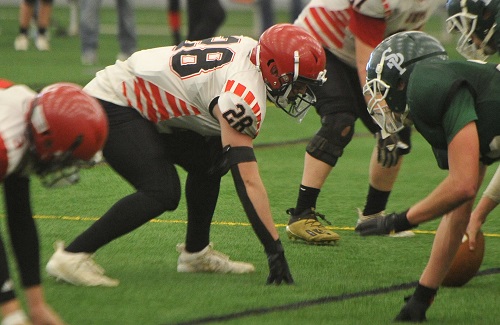
PHOTOS (Top) Luke Gorzinski (11) eludes a Portland St. Patrick defender during last season’s Division 2 championship win at Legacy Center in Brighton. (Middle) Wyatt Raab (28), another star of last season’s Final, is again a standout for the Jets.