


Add, Subtract, Divide, Multiply: MHSAA Not Alone
July 25, 2017
By Rob Kaminski
MHSAA benchmarks editor
This is the third part in a series on MHSAA tournament classification, past and present, that will be published over the next two weeks. This series originally ran in this spring's edition of MHSAA benchmarks.
As the MHSAA faces its most recent classification task with 8-Player Football, and opinions continue to swirl about as to the method, timeframe, location and other procedures, a look around the country provides plenty of company among state association brethren factoring variables into their own equations.
In the Pacific Northwest, the Oregon School Activities Association Football Playoffs are under public scrutiny as leadership ponders a five or six classification format beginning with the 2018-19 school year.
The OSAA has crowned six champions on the gridiron since 2006-07. Many of the state’s smaller schools would like to keep it that way, while larger schools lean toward a five-classification system, citing larger leagues, ease of travel and credibility to state championships as the advantages.
Still others would prefer more than six classes, pointing to safety issues and the opportunity to increase participation numbers as positives.
Moving southeast of Oregon, the Nevada Interscholastic Activities Association recently voted to hold serve on a classification proposal that was volleyed to the membership.
However, changes still could be forthcoming by as early as the 2018-19 season which would add a fifth classification in more populated southern Nevada while allowing northern schools to participate in four classifications. Such divisions could mean no state championship for the fifth class in southern Nevada.
Because of that, the NIAA wants equal numbers of schools in each classification on both ends of the state. Complicating the issue is the fact that the 24 largest schools in the state, by enrollment, are all in Clark County in Southern Nevada.
Across Nevada’s border into Arizona, charter schools are asking the Arizona Interscholastic Association to reconsider classification that was voted upon and approved in September 2015. That agreement called for the largest 33 percent of charter schools by enrollment to be placed in the state’s largest school classification, 3A, the middle 33 percent into 2A, and the smallest 33 percent into 1A.
Less than two years later the charter schools have had a change of heart and have asked to be considered the same as other Arizona public schools and be placed appropriately by enrollment beginning with the 2018-19 school year.
The situation in Arizona further illustrates how the public/private debate that all state associations have faced throughout existence now has the added dynamic of rapidly growing charter schools in today’s educational system, along with virtual school enrollment.
In the nation’s heartland, Nebraska has retooled its football classifications by using enrollment of boys students only in its schools rather than total enrollment. The Nebraska School Activities Association football-playing schools will kick off the 2018 season using this alignment.
Nebraska has three classes of 11-player football, with the smallest class divided in two, Class C-1 and C-2. The state also will have 8-player football for boys enrollments under 47, and the NSAA will sponsor a new 6-player tournament in 2018 for schools with 27 or fewer boys.
“This is a good proposal because some schools have a sizable imbalance between the number of boys and girls, and there’s a large gap (in enrollment) between the largest and smallest schools in Classes A and B,” NSAA executive director Jim Tenopir said. “I think this addresses both of those concerns.”
Swimmers in Georgia, meanwhile, will feel like they are moving with the current, rather than upstream in 2017-18, as the Georgia High School Association recently doubled the number of team championship events from two to four.
Swim enthusiasts can also count on longer days at the finals, as the top 30 finishers from the prelims will advance to the finals instead of 20, and all championship events will have three heats versus two.
'Let Them Lead' Shows How Through Coach's Eyes During Huron Hockey's Rise
By
John Johnson
MHSAA Communications Director emeritus
September 17, 2021
Over 30 years of riding shotgun with Jack Roberts, I quickly learned to respond whenever I was asked about the lifetime values of high school sports, with a laundry list with these two items at the top:
 Hard Work - Team Work
In reviewing the newly-released book by Ann Arbor’s own John U. Bacon – “Let Them Lead, Unexpected Lessons in Leadership From America’s Worst High School Hockey Team” – everything flows from those two values all of us in prep sports hold near and dear.
I met John in 1997 when he was a sportswriter at The Detroit News, where he was covering his high school alma mater – Ann Arbor Huron – in the Class AA Football Final at the Pontiac Silverdome. Just a few years later, the story that holds the detailed leadership lessons together in this book would begin when he was named the head hockey coach at Huron, inheriting a team that finished the previous season 0-22-3.
Building everything he put into that team with the premises that no one would outwork the River Rats, and as a team they supported each other, Bacon’s charges rose from not even being listed in the national team winning percentage listings - about 1,000 schools - prior to his arrival, to a top-five spot in the state’s rankings in his fourth year.
Along the way, the buy-in to the leadership themes made Huron Hockey cool again at the school and earned the River Rats the respect of their opponents. The values being taught gave value to the program. In making it hard to be a part of the team, more kids wanted to join it. They valued the experience. They led and supported themselves on and off the ice.
With the book being written nearly 20 years after the events it is based on, Bacon solicited input from a variety of players to verify the accuracy of events, and they flooded him with additional stories of their own from their playing days and adult lives which illustrated the leadership skills they learned in the locker room, training sessions, practices and games.
 Like any book on leadership, you forge through those details about applying certain things in the workplace, but what keeps you engaged is the team. You’ve gotten hooked by the River Rats, and you just have to see how this thing turns out.
This feel-good tome resonates whether you’re a coach or a corporate type. It’s an easy read, and you'll take a lot from it.
John U. Bacon did play ice hockey for the River Rats, owning the distinction for playing the most games at the time he graduated – but also never scoring a goal. His writing, teaching and speaking career have produced seven books which have been national best sellers; he’s an established historian on a variety of topics – including the football program at University of Michigan, where he currently teaches; and he’s in demand as a public speaker.
Let Them Lead is published by Houghton Mifflin Harcourt, and available through a variety of bookstores.
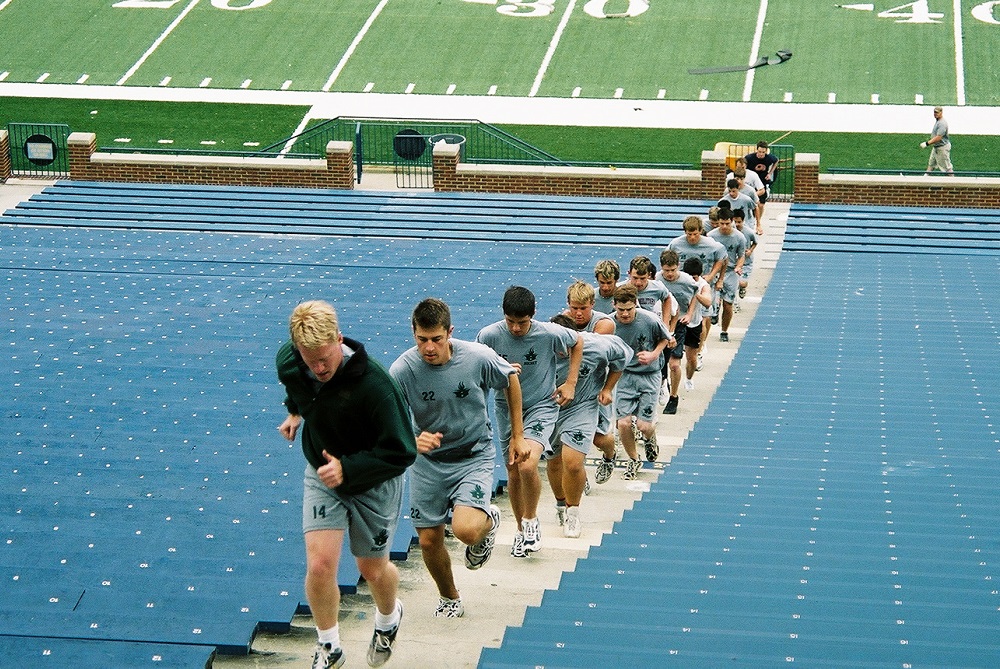
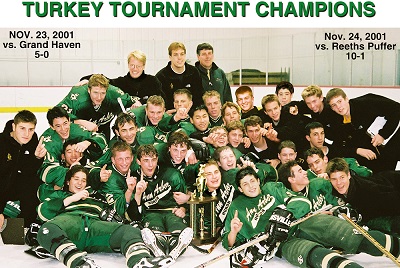
PHOTOS (Top) Huron's hockey team runs the Michigan Stadium stairs in 2002. (Middle) "Let Them Lead" tells the story of the program's transformation. (Below) The River Rats celebrate their Turkey Tournament championship in 2001. (Photos courtesy of John U Bacon.)