

Add, Subtract, Divide, Multiply: MHSAA Not Alone
July 25, 2017
By Rob Kaminski
MHSAA benchmarks editor
This is the third part in a series on MHSAA tournament classification, past and present, that will be published over the next two weeks. This series originally ran in this spring's edition of MHSAA benchmarks.
As the MHSAA faces its most recent classification task with 8-Player Football, and opinions continue to swirl about as to the method, timeframe, location and other procedures, a look around the country provides plenty of company among state association brethren factoring variables into their own equations.
In the Pacific Northwest, the Oregon School Activities Association Football Playoffs are under public scrutiny as leadership ponders a five or six classification format beginning with the 2018-19 school year.
The OSAA has crowned six champions on the gridiron since 2006-07. Many of the state’s smaller schools would like to keep it that way, while larger schools lean toward a five-classification system, citing larger leagues, ease of travel and credibility to state championships as the advantages.
Still others would prefer more than six classes, pointing to safety issues and the opportunity to increase participation numbers as positives.
Moving southeast of Oregon, the Nevada Interscholastic Activities Association recently voted to hold serve on a classification proposal that was volleyed to the membership.
However, changes still could be forthcoming by as early as the 2018-19 season which would add a fifth classification in more populated southern Nevada while allowing northern schools to participate in four classifications. Such divisions could mean no state championship for the fifth class in southern Nevada.
Because of that, the NIAA wants equal numbers of schools in each classification on both ends of the state. Complicating the issue is the fact that the 24 largest schools in the state, by enrollment, are all in Clark County in Southern Nevada.
Across Nevada’s border into Arizona, charter schools are asking the Arizona Interscholastic Association to reconsider classification that was voted upon and approved in September 2015. That agreement called for the largest 33 percent of charter schools by enrollment to be placed in the state’s largest school classification, 3A, the middle 33 percent into 2A, and the smallest 33 percent into 1A.
Less than two years later the charter schools have had a change of heart and have asked to be considered the same as other Arizona public schools and be placed appropriately by enrollment beginning with the 2018-19 school year.
The situation in Arizona further illustrates how the public/private debate that all state associations have faced throughout existence now has the added dynamic of rapidly growing charter schools in today’s educational system, along with virtual school enrollment.
In the nation’s heartland, Nebraska has retooled its football classifications by using enrollment of boys students only in its schools rather than total enrollment. The Nebraska School Activities Association football-playing schools will kick off the 2018 season using this alignment.
Nebraska has three classes of 11-player football, with the smallest class divided in two, Class C-1 and C-2. The state also will have 8-player football for boys enrollments under 47, and the NSAA will sponsor a new 6-player tournament in 2018 for schools with 27 or fewer boys.
“This is a good proposal because some schools have a sizable imbalance between the number of boys and girls, and there’s a large gap (in enrollment) between the largest and smallest schools in Classes A and B,” NSAA executive director Jim Tenopir said. “I think this addresses both of those concerns.”
Swimmers in Georgia, meanwhile, will feel like they are moving with the current, rather than upstream in 2017-18, as the Georgia High School Association recently doubled the number of team championship events from two to four.
Swim enthusiasts can also count on longer days at the finals, as the top 30 finishers from the prelims will advance to the finals instead of 20, and all championship events will have three heats versus two.
Four-Time Finals Placer Piot Earns Ultimate Amateur Championship
By
Tom Lang
Special for MHSAA.com
August 23, 2021
James Piot was a high school all-state Super Team member all four years he played golf at Detroit Catholic Central.
Piot – who has since moved on to play at Michigan State – was never an MHSAA Finals individual champion. But recently he achieved something much bigger, winning the ultimate individual crown for amateurs – the 121st U.S. Amateur Championship.
His championship run concluded Sunday, Aug. 15 at the iconic Oakmont Country Club with a 2 and 1 match play victory over Austin Greaser of Ohio and the University of North Carolina.
Piot led the Shamrocks to a Lower Peninsula Division 1 runner-up team finish in 2014 as a freshman, followed by three consecutive championships creating arguably the best era of high school golf for any one program in Michigan history.
According to his former assistant coach – Jimmy Dewling, now the boys golf head coach at Brighton – team titles suited Piot just fine.
“I think his team winning meant just as much to him than any individual title,” Dewling said. “Truly he’s one of those types of guys.”
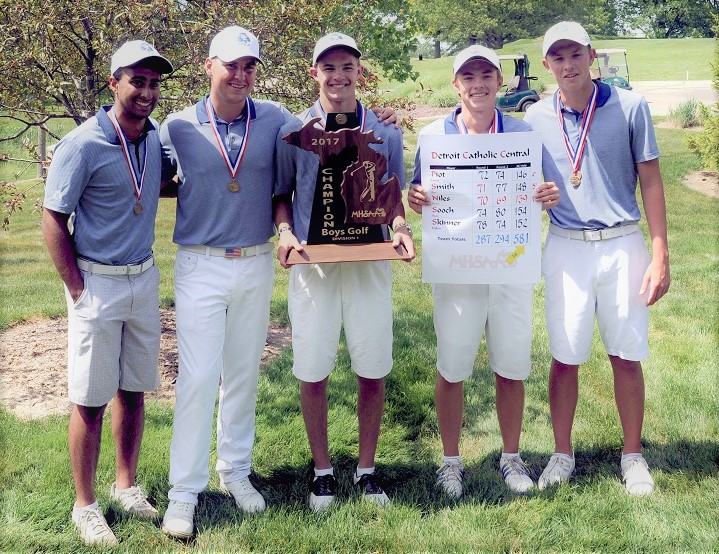
Piot’s senior year in 2017, Catholic Central had three players on the all-state Super Team: Piot, Ben Smith (Georgia Tech) and Sean Niles (MHSAA individual champ), while teammates Dyllan Skinner and Sean Sooch were first team all-state.
Now on the national stage, Piot defeated Greaser of Ohio, 2-and-1, by sinking a 20-foot par putt on the 17th hole of the day’s second round in the scheduled 36-hole national final.
“It's the greatest feeling in the world,” Piot said to the national media on site. “I mean, as an amateur it's the best thing you can do. It was making that putt on 17 was just like, ‘Oh, my God. I might've done it.’”
By winning the elite amateur tournament, Piot is to receive presumably automatic exemptions into three professional majors next year: The Masters, the U.S. Open and the British Open. That alone is a career-defining bucket list for anyone in golf – and he’s still a college student.
Piot was playing in the U.S. Amateur for the second straight year. In 2020 at Bandon Dunes (in Oregon), he was second in stroke play to enter the match play portion the No. 2 seed. He won his first match but then was bumped out in the round of 32.
 This year he finished his unfinished business by cruising through the match play, winning three of his six rounds with identical scores of 4-and-3. In the final, Piot was 1-up after the morning round of 18 holes. But after a lunch break and change of shirts from a dark color to a white one with a green Sparty golfer logo, there was a 4-hole swing where Piot found himself down three after 27 holes.
“I told myself on that tee box (on 10), I said, ‘I'm going to play this (last) nine 4-under.’ That's what I put in my head. Just self-belief.”
The tables turned hard at that point when Piot won four consecutive holes (10-13), and five of six, to go 2-up with three holes remaining, eventually grabbing the win 2-and-1.
Standing at that 10th tee, Piot was down three holes and TV commentator ‘Bones’ MacKay said it would be very difficult for Piot to get back into the match.
“I gave him the nickname when he was 9-years-old of ‘Spunkdog,’ because he’s got so much fight,” said Brian Cairns, his long-time teacher at Fox Hills Learning Center in Plymouth. “He’s in a corner by himself, he’ll come out every time by himself. He’s got spunk. You saw how he walked; you saw how mellow he was. You saw his shoulders go up on the back nine. He made the swings when he needed to make them.”
Dewling provided a similar but different angle on Piot.
“He took pride that he’s a public course guy and put that chip on his shoulder to beat people,” Dewling said about the high school years. “He’d watch other people practice and play and he believed he was doing things different and better than they were.
“I’ve been around high school golfers who practice because they feel like they have to. They think if they’re at the course it means they’re getting better than the next guy. But I think James would go to practice because he really wants to be there, and he really wants to know he’s preparing differently and he’s going to win more.”
Piot has always shown gratitude for the support he’s received over the years from high school buddies to his family and fans of both Catholic Central and MSU – who made up a huge section of the crowd that memorable Sunday afternoon at Oakmont.
“Mom and Dad have always been there, and I’ve been blessed to have the family and the support system I had before I even got to Michigan State,” he said. “I also had my high school coaches there (at Oakmont), Mike Anderson, Rick Williams (Detroit Catholic Central) and Jimmy Dewling, who are great mentors to me in life as well. It’s an extreme blessing to have some of the people in my life and seeing them (at Oakmont). Beyond golf, it was the coolest thing in the world.”
During his Catholic Central career, Piot was not one to dwell on “what could have been” after his MHSAA Finals individual title pursuits. He tied for sixth in Division 1 as a freshman, eighth as a sophomore, fifth as a junior and placed fourth alone as a senior in 2017.
“I think he understood the process better than anyone else – that one or two days of golf wasn’t going to define him. He’s got bigger aspirations than just one tournament," Dewling said. "He truly had an outlook and a perspective that’s so much greater than anything else. He’s so composed in high-pressure situations because he realizes his goals are still in front of him.
“James just plays with a chip on his shoulder, and I don’t think winning the U.S. Amateur is going to change that either. That’s the kind of competitive person he is.”
The people who know Piot well said he won’t change his life much in the short term at least, and will compete with the Spartans this fall and spring while finishing up his degree in finance. His Spartans have unfinished business as well, going after a Big Ten title.
“I just want to enjoy my last ride with the boys,” he said. “My school credit load might shift in the spring … but I’m looking forward to the college season and getting back out there with the Spartans. … We’re going to have a really good team and our goal this year is Big Ten champions, and hopefully we can do that.”
After receiving the U.S. Amateur trophy from the USGA officials, Piot gripped the golden hardware with a graceful respect, and turned it around a few times while looking it over. He was then asked if any past winners’ names stood out to him.
“I was just trying to see if it was real or not. I couldn't believe it. I mean, I honestly was like, did I just win the U.S. Am, in the back of my mind,” Piot answered. “I didn't really sit there and stare at all the names.”
Yet from now on and forever in history, James Piot’s name will be on that special trophy for others to search out and admire.
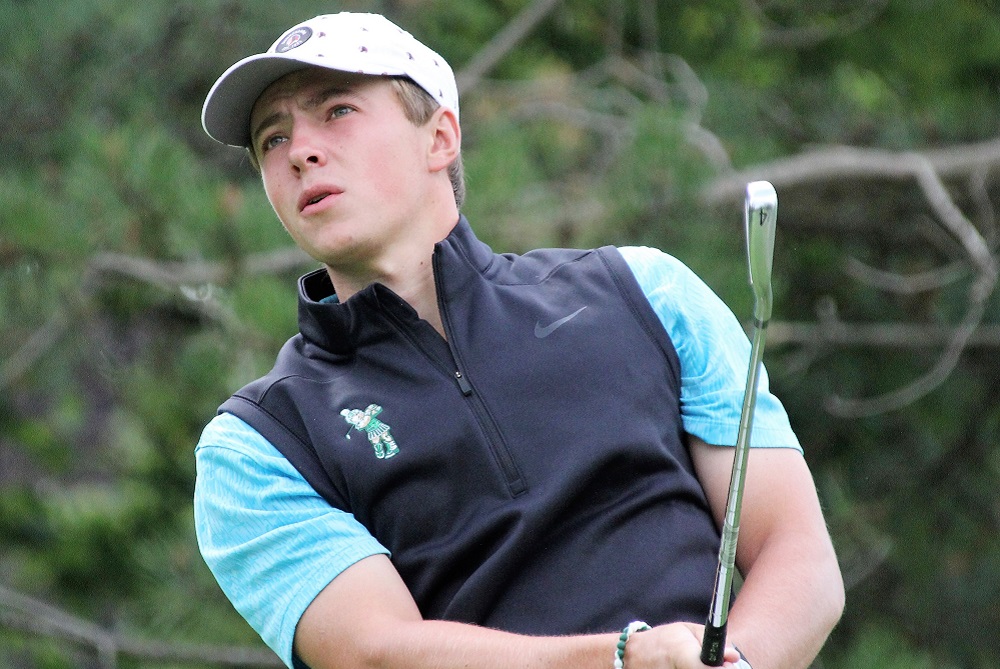
PHOTOS: (Top) Detroit Catholic Central grad James Piot, now playing at Michigan State, keeps an eye on his shot during a 2020 Golf Association of Michigan event. (Middle) Piot, second from right, stands with his Detroit Catholic Central team after the Shamrocks had clinched their third-straight Finals championship in 2017. (Top photo courtesy of Golf Association of Michigan; middle photo by HighSchoolSportsScene.com.)