

Add, Subtract, Divide, Multiply: MHSAA Not Alone
July 25, 2017
By Rob Kaminski
MHSAA benchmarks editor
This is the third part in a series on MHSAA tournament classification, past and present, that will be published over the next two weeks. This series originally ran in this spring's edition of MHSAA benchmarks.
As the MHSAA faces its most recent classification task with 8-Player Football, and opinions continue to swirl about as to the method, timeframe, location and other procedures, a look around the country provides plenty of company among state association brethren factoring variables into their own equations.
In the Pacific Northwest, the Oregon School Activities Association Football Playoffs are under public scrutiny as leadership ponders a five or six classification format beginning with the 2018-19 school year.
The OSAA has crowned six champions on the gridiron since 2006-07. Many of the state’s smaller schools would like to keep it that way, while larger schools lean toward a five-classification system, citing larger leagues, ease of travel and credibility to state championships as the advantages.
Still others would prefer more than six classes, pointing to safety issues and the opportunity to increase participation numbers as positives.
Moving southeast of Oregon, the Nevada Interscholastic Activities Association recently voted to hold serve on a classification proposal that was volleyed to the membership.
However, changes still could be forthcoming by as early as the 2018-19 season which would add a fifth classification in more populated southern Nevada while allowing northern schools to participate in four classifications. Such divisions could mean no state championship for the fifth class in southern Nevada.
Because of that, the NIAA wants equal numbers of schools in each classification on both ends of the state. Complicating the issue is the fact that the 24 largest schools in the state, by enrollment, are all in Clark County in Southern Nevada.
Across Nevada’s border into Arizona, charter schools are asking the Arizona Interscholastic Association to reconsider classification that was voted upon and approved in September 2015. That agreement called for the largest 33 percent of charter schools by enrollment to be placed in the state’s largest school classification, 3A, the middle 33 percent into 2A, and the smallest 33 percent into 1A.
Less than two years later the charter schools have had a change of heart and have asked to be considered the same as other Arizona public schools and be placed appropriately by enrollment beginning with the 2018-19 school year.
The situation in Arizona further illustrates how the public/private debate that all state associations have faced throughout existence now has the added dynamic of rapidly growing charter schools in today’s educational system, along with virtual school enrollment.
In the nation’s heartland, Nebraska has retooled its football classifications by using enrollment of boys students only in its schools rather than total enrollment. The Nebraska School Activities Association football-playing schools will kick off the 2018 season using this alignment.
Nebraska has three classes of 11-player football, with the smallest class divided in two, Class C-1 and C-2. The state also will have 8-player football for boys enrollments under 47, and the NSAA will sponsor a new 6-player tournament in 2018 for schools with 27 or fewer boys.
“This is a good proposal because some schools have a sizable imbalance between the number of boys and girls, and there’s a large gap (in enrollment) between the largest and smallest schools in Classes A and B,” NSAA executive director Jim Tenopir said. “I think this addresses both of those concerns.”
Swimmers in Georgia, meanwhile, will feel like they are moving with the current, rather than upstream in 2017-18, as the Georgia High School Association recently doubled the number of team championship events from two to four.
Swim enthusiasts can also count on longer days at the finals, as the top 30 finishers from the prelims will advance to the finals instead of 20, and all championship events will have three heats versus two.

Loy Norrix Career Prepped Crocker for U-M Success, Law Degree Pursuit
By
Pam Shebest
Special for MHSAA.com
July 29, 2021
KALAMAZOO — After graduating from University of Michigan in 2018, Davis Crocker suddenly found himself surrounded by green, white and Spartys.
 With a degree in sports management from the Maize and Blue, Crocker is currently enrolled at Michigan State University’s College of Law in East Lansing.
“The first few months with all the green and Spartan heads, it’s a little bit of a culture shock,” Crocker, 25, said, laughing.
“I get the occasional comments every now and then. I try to be respectful.”
He has some backup. His brother, Reed, is on the MSU tennis team.
The Loy Norrix alumnus credits his four years playing high school tennis as “the kickstart to everything at Michigan and at law school now, balancing tennis and school with the team aspect, the coaches, the teammates.
“It laid the foundation for who I am now. My work ethic and leadership stem from that time.”
While many top tennis players opt out of high school tennis to concentrate on USTA tournaments, Crocker combined the two.
He said three things influenced his decision.
“First, that team aspect,” he said. “I think that’s so valuable. I played team sports when I was a kid, but when I just focused on tennis there weren’t as many opportunities for that. I enjoyed that aspect.
“Two, I felt I needed to give back to the school in some way. They were very flexible with my travel, my practicing and everything. I felt like doing things under their name was probably not enough, but at least a little bit.”
The third was that he just enjoyed being around the guys and going on road trips.
“The winning helped,” he added, laughing.
Winning, indeed.
He ended his high school career with some impressive numbers, enough to earn him the Michigan Mr. Tennis Award his senior year, when he went undefeated at 30-0.
His four-year record was 108-9, with seven of those losses his freshman year.
Loy Norrix did not qualify for the MHSAA Lower Peninsula Division 2 Championships as a team those four years, but Crocker did individually and won the No. 1 singles title his sophomore, junior and senior seasons.
“When I won the state championship that third time (in 2013), that meant a lot out of the three,” he said, reminiscing. “The guy I played in the finals ended up playing at Arizona State.”
Crocker, the top seed, defeated second-seeded William Kirkman from Midland Dow, 6-3, 6-1.
Telling defeat
Art Williams, who coached the team all four years, said one moment was indicative of Crocker’s work ethic.
“During Regionals of his junior year, Davis was rolling through the draw as usual. On the final day, in the final No. 1 singles match, Davis struggled with his opponent,” Williams recalled.
 “I rarely had to coach Davis through a defeat; it just rarely happened. But on this day something was off. His father told me Davis was dealing with a very upset stomach.”
Williams said Crocker made no excuses, but after losing that match took the time to walk to the net to shake his opponent’s hand.
“The story does have a happy ending though,” Williams added. “Even with the loss, Davis still qualified for the state tournament and proceeded to win his second state title by defeating the very same player (Portage Central’s Billy Heckman) he lost to just two weeks before.”
That Regional loss was Crocker’s last defeat of his high school career.
Crocker graduated early from Loy Norrix in January 2014 and headed to University of Michigan that same month.
He said high school tennis prepared him for a much different type of tennis in college.
“It helped a lot because college took the team part to even more of an extreme,” he said. “In high school, you’re only together for three or four months, then you see each other in the hallway.
“In college it’s pretty much year round. You’re either communicating or practicing or competing. I think just laying that (high school) groundwork made the transition easier.”
He said he is happy he had that extra semester at Michigan before actually competing.
“The levels were higher. With my teammates, I’m not the top guy any more. I’m just one of 12,” Crocker said. “There are no easy games at that level. You have to bring your ‘A’ game every time.”
By his senior year, Crocker was an ITA Scholar-Athlete, Academic All-Big Ten, Big Ten doubles indoor champion with Harry Brown and co-captain of the tennis team.
While at U-M, he spent three seasons as assistant to Loy Norrix coach Bill Jenkins and, before entering law school, spent a year as an instructor at West Hills Athletic Club in Kalamazoo.
After playing so much tennis, Crocker took a break from sports.
“I was mentally done with it, but now I feel ready to play a little more and be involved with the community,” he said.
“These last six months I started hitting a bit and training a little more. I did a couple tournaments recently.”
Following family traditions
Crocker’s dad, grandfather and uncle are U-M grads, and his great-great-grandfather graduated from what was then the Detroit College of Law.
Currently, his dad and uncle are partners in Crocker & Crocker, a law firm started by his grandfather in Kalamazoo.
 “I was always in that (law) environment when I was a kid,” Crocker said. “It lines up with all my interests like reading and writing and history. With sports business, I would like to do something potentially with sports and the law.
“I’ve also thought about compliance or something like that with the NCAA, which has changed a lot even since I first got into law school.”
He also has been working with his dad in telecommunications law.
“There are so many different areas that it can be overwhelming,” Crocker said. “I’ll sort that out in the next year and a half (before graduation).”
As for high school, Crocker has some advice for those in any sport:
“When you first begin, don’t be overwhelmed by the situation, just embrace it. You will look fondly back, even on those times when you are maybe teased by the older guys. You appreciate it later on because you grow so much from it.”
2020-21 Made in Michigan
July 19: Top PGA Pro Finish Latest Greatest Highlight as Cook Continues Climb - Read
July 16: TC West Standout Renews Ties to Titans, Cheers Past Teammates' Gold Pursuit - Read
July 8: Caro Champs Find Common Ground Again as Mental Health Providers - Read
June 28: Michigan's Minor Leaguers Making Up for Lost Season - Read
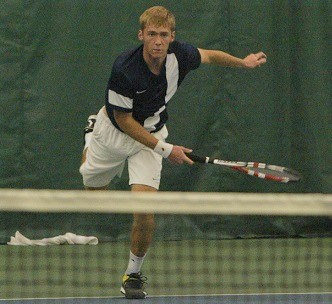
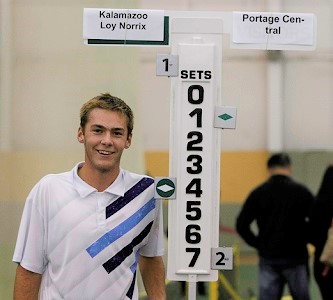
PHOTOS: (Top) Three-time MHSAA Finals tennis champion Davis Crocker has begun playing competitively again while also working toward a law degree. (Middle) Crocker unleashes a serve during his No. 1 singles title match in 2013. (Below) Crocker stands at the scoreboard during his championship match at the 2012 LP Division 2 Finals. (Top photo by Pam Shebest; middle and below photos by High School Sports Scene.)