

Add, Subtract, Divide, Multiply: MHSAA Not Alone
July 25, 2017
By Rob Kaminski
MHSAA benchmarks editor
This is the third part in a series on MHSAA tournament classification, past and present, that will be published over the next two weeks. This series originally ran in this spring's edition of MHSAA benchmarks.
As the MHSAA faces its most recent classification task with 8-Player Football, and opinions continue to swirl about as to the method, timeframe, location and other procedures, a look around the country provides plenty of company among state association brethren factoring variables into their own equations.
In the Pacific Northwest, the Oregon School Activities Association Football Playoffs are under public scrutiny as leadership ponders a five or six classification format beginning with the 2018-19 school year.
The OSAA has crowned six champions on the gridiron since 2006-07. Many of the state’s smaller schools would like to keep it that way, while larger schools lean toward a five-classification system, citing larger leagues, ease of travel and credibility to state championships as the advantages.
Still others would prefer more than six classes, pointing to safety issues and the opportunity to increase participation numbers as positives.
Moving southeast of Oregon, the Nevada Interscholastic Activities Association recently voted to hold serve on a classification proposal that was volleyed to the membership.
However, changes still could be forthcoming by as early as the 2018-19 season which would add a fifth classification in more populated southern Nevada while allowing northern schools to participate in four classifications. Such divisions could mean no state championship for the fifth class in southern Nevada.
Because of that, the NIAA wants equal numbers of schools in each classification on both ends of the state. Complicating the issue is the fact that the 24 largest schools in the state, by enrollment, are all in Clark County in Southern Nevada.
Across Nevada’s border into Arizona, charter schools are asking the Arizona Interscholastic Association to reconsider classification that was voted upon and approved in September 2015. That agreement called for the largest 33 percent of charter schools by enrollment to be placed in the state’s largest school classification, 3A, the middle 33 percent into 2A, and the smallest 33 percent into 1A.
Less than two years later the charter schools have had a change of heart and have asked to be considered the same as other Arizona public schools and be placed appropriately by enrollment beginning with the 2018-19 school year.
The situation in Arizona further illustrates how the public/private debate that all state associations have faced throughout existence now has the added dynamic of rapidly growing charter schools in today’s educational system, along with virtual school enrollment.
In the nation’s heartland, Nebraska has retooled its football classifications by using enrollment of boys students only in its schools rather than total enrollment. The Nebraska School Activities Association football-playing schools will kick off the 2018 season using this alignment.
Nebraska has three classes of 11-player football, with the smallest class divided in two, Class C-1 and C-2. The state also will have 8-player football for boys enrollments under 47, and the NSAA will sponsor a new 6-player tournament in 2018 for schools with 27 or fewer boys.
“This is a good proposal because some schools have a sizable imbalance between the number of boys and girls, and there’s a large gap (in enrollment) between the largest and smallest schools in Classes A and B,” NSAA executive director Jim Tenopir said. “I think this addresses both of those concerns.”
Swimmers in Georgia, meanwhile, will feel like they are moving with the current, rather than upstream in 2017-18, as the Georgia High School Association recently doubled the number of team championship events from two to four.
Swim enthusiasts can also count on longer days at the finals, as the top 30 finishers from the prelims will advance to the finals instead of 20, and all championship events will have three heats versus two.
TC West Standout Renews Ties to Titans, Cheers Past Teammates' Gold Pursuit
By
Tom Spencer
Special for MHSAA.com
July 16, 2021
Savanna Wojtanowski was made here. She played here. She stayed here — except for stints in Washington, D.C., where international soccer players joined her.
 Now she’s back as a high school soccer coach.
While lots of faces familiar to United States and Canadian television viewers and soccer fans are expected at the Olympic Games in Tokyo, some of those players will be personally familiar to Wojtanowski.
Wojtanowski played alongside a handful of current and recent players on the U.S. and Canadian women’s teams after serving as four-year starting goalie for Traverse City West and during a college career that began with two seasons at Ferris State and concluded with her final two at Michigan State in 2016 and 2017. During her time with the Spartans, Wojtanowski spent two offseasons with the reserve team for the Washington Spirit, one of the original eight teams when the National Women’s Soccer League (NWSL) was formed in 2012.
At West, Wojtanowski was named second team all-conference as a junior and senior, as well as first team all-district, first team all-region and all-state honorable mention her senior season in 2013. West winning the Big North Conference title that spring remains her favorite memory from high school soccer – and she quickly has matched that achievement as a coach, leading West to the BNC championship this past spring in her first season after taking over the program.
Wojtanowski is looking for the U.S. national team to come out with a vengeance after the disappointment of the 2016 Olympic Games in Brazil. There the U.S. fell to Sweden in a semifinal shootout, which meant failing to reach the gold medal match for the first time since women’s soccer was introduced to the Olympics in 1996 in Atlanta.
Sweden is the U.S.’s opening-game opponent July 21 in Tokyo.
“I believe there is a lot of revenge being chased after the Rio Olympics,” the 25-year-old former keeper said. “I was with the Spirit during Rio, and when the team returned from the Olympics, the sense of disappointment was felt for a long time.
 “I believe going into this year's Olympics, we will see a different type of fire displayed from the USWNT.”
Wojtanowski won’t see former Washington Spirit teammate Diana Matheson of Canadian fame and Estelle Johnson of Cameroon playing in Tokyo. Matheson recently announced her retirement after 18 years representing Canada’s national team. Johnson and her teammates lost a playoff with Chile for the last of 16 slots in the Olympics.
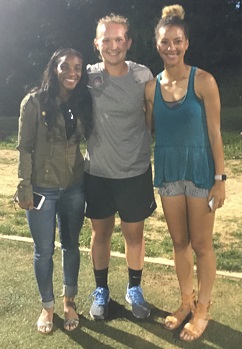 Wojtanowski feels fortunate that she had the chance to compete with and against the women trying to claim gold at Tokyo.
“During college I was able to play two years on the Washington Spirit reserves, which opened the door to the pro side of the game,” she said. “I was fortunate enough to be one of two college players training full-time with the pro squad for those two summers.
“Having the opportunity to play alongside some USWNT women and the Canada women was such a great experience.”
Wojtanowski played with current U.S. roster players Crystal Dunn and Kristie Mewis. The current Canadians she played with are Stephanie Labbe and Shelina Zadorsky. Labbe was Canada’s starting goalkeeper in Rio.
Dunn, though, stands out most to Wojtanowski. Dunn was with the Spirit but now plays for Portland. She has 24 goals and 19 assists in 116 appearances for the USWNT as primarily a defender.
“(Dunn) was such a treat to play with …. her humor, attitude, and training mentality is something I will forever remember,” Wojtanowski said. “She was constantly dancing, laughing, and having a great time at training, but when it was time to get serious she would get the job done.”
Wojtanowski also had the tough job of trying to stop U.S. standout Rose Lavelle during Lavelle’s time starring for Wisconsin. The past Badgers standout and now-Washington Spirit midfielder has 14 goals and nine assists in 56 appearances for the U.S.
Wojtanowski began her collegiate career with two seasons at Ferris State University. After transferring to MSU, she played two more seasons and as a junior in 2016 tied the MSU single-game record with 14 saves against then-No. 16 Penn State. She earned a bachelor’s degree in business with a focus on administration and management and a master’s certificate in supply chain management and procurement. She returned home to start the next chapters of life, and she works as a supply chain buyer fulltime along with her guidance of the Titans.
She’s thrilled to be back at her high school alma mater, which she guided to an overall 10-4-1 record this spring, with the Titans eventually falling to Midland Dow in a Division 1 District Final.
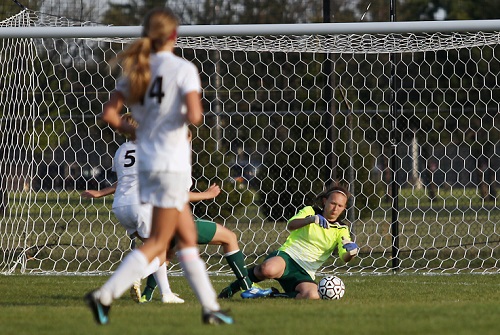 “I wanted to give back to the community,” said Wojtanowski, who previously had coached at the club level in Lansing. “West has always had a very special place in my heart ever since graduation.
“When this opportunity presented itself, I knew I had to take the opportunity to be a Titan again,” she continued. “It has been a special experience to coach the program that I grew up with.”
Wojtanowski wants to instill a family-based culture in the Titans program, something she came to know and love while at Michigan State.
“The biggest thing for me is growing them as individuals both on and off the soccer field,” she said.
Wojtanowski believes girls high school and women’s soccer in this country have changed for the better since she played. And, she’s not the least bit surprised by the consistent success of the USWNT.
“The women's game in the US has grown significantly since I started playing soccer in 2000,” Wojtanowski noted. “Our farm systems here in the U.S. along with club, college, and other programs feed a constantly-elite level of players through the USWNT system.”
2020-21 Made in Michigan
July 8: Caro Champs Find Common Ground Again as Mental Health Providers - Read
June 28: Michigan's Minor Leaguers Making Up for Lost Season - Read
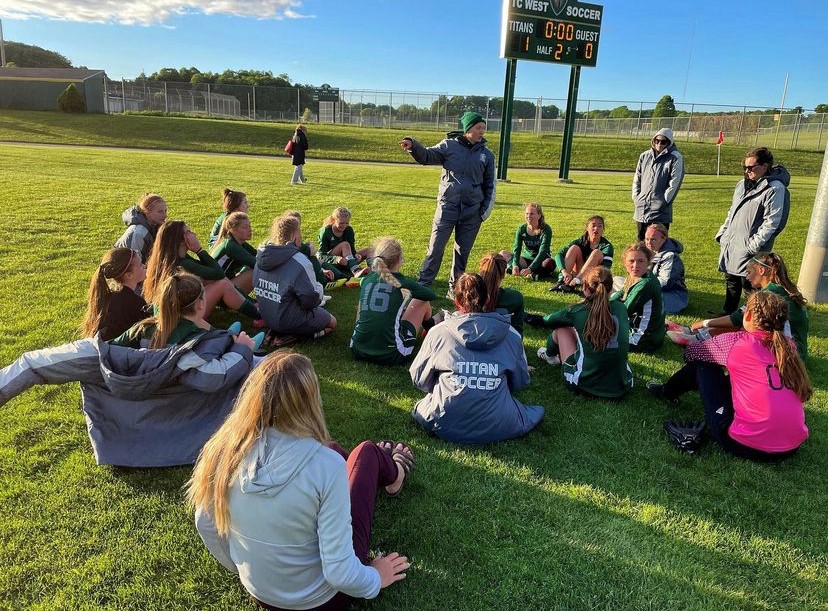
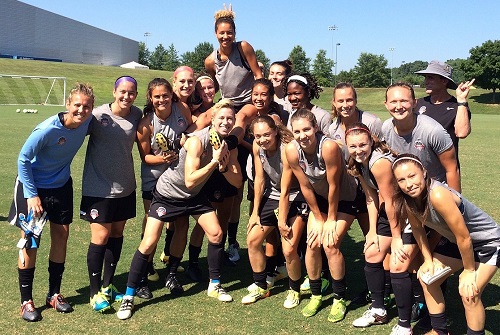
PHOTOS: (Top) Savanna Wojtanowski leads a halftime discussion this spring with her Traverse City West varsity. (Middle) Wojtanowski, second row standing far right in group photo, trained two seasons with the Washington Spirit’s reserves; the Spirit first team included U.S. national teamer Crystal Dunn (left in second photo) and Cameroon national teamer Estelle Johnson (far right). (Below) Wojtanowski makes a save for West against Traverse City Central in 2012. (Top photo by Daisy Kinney, middle courtesy of Savanna Wojtanowski and below courtesy of the Traverse City Record-Eagle.)