

Add, Subtract, Divide, Multiply: MHSAA Not Alone
July 25, 2017
By Rob Kaminski
MHSAA benchmarks editor
This is the third part in a series on MHSAA tournament classification, past and present, that will be published over the next two weeks. This series originally ran in this spring's edition of MHSAA benchmarks.
As the MHSAA faces its most recent classification task with 8-Player Football, and opinions continue to swirl about as to the method, timeframe, location and other procedures, a look around the country provides plenty of company among state association brethren factoring variables into their own equations.
In the Pacific Northwest, the Oregon School Activities Association Football Playoffs are under public scrutiny as leadership ponders a five or six classification format beginning with the 2018-19 school year.
The OSAA has crowned six champions on the gridiron since 2006-07. Many of the state’s smaller schools would like to keep it that way, while larger schools lean toward a five-classification system, citing larger leagues, ease of travel and credibility to state championships as the advantages.
Still others would prefer more than six classes, pointing to safety issues and the opportunity to increase participation numbers as positives.
Moving southeast of Oregon, the Nevada Interscholastic Activities Association recently voted to hold serve on a classification proposal that was volleyed to the membership.
However, changes still could be forthcoming by as early as the 2018-19 season which would add a fifth classification in more populated southern Nevada while allowing northern schools to participate in four classifications. Such divisions could mean no state championship for the fifth class in southern Nevada.
Because of that, the NIAA wants equal numbers of schools in each classification on both ends of the state. Complicating the issue is the fact that the 24 largest schools in the state, by enrollment, are all in Clark County in Southern Nevada.
Across Nevada’s border into Arizona, charter schools are asking the Arizona Interscholastic Association to reconsider classification that was voted upon and approved in September 2015. That agreement called for the largest 33 percent of charter schools by enrollment to be placed in the state’s largest school classification, 3A, the middle 33 percent into 2A, and the smallest 33 percent into 1A.
Less than two years later the charter schools have had a change of heart and have asked to be considered the same as other Arizona public schools and be placed appropriately by enrollment beginning with the 2018-19 school year.
The situation in Arizona further illustrates how the public/private debate that all state associations have faced throughout existence now has the added dynamic of rapidly growing charter schools in today’s educational system, along with virtual school enrollment.
In the nation’s heartland, Nebraska has retooled its football classifications by using enrollment of boys students only in its schools rather than total enrollment. The Nebraska School Activities Association football-playing schools will kick off the 2018 season using this alignment.
Nebraska has three classes of 11-player football, with the smallest class divided in two, Class C-1 and C-2. The state also will have 8-player football for boys enrollments under 47, and the NSAA will sponsor a new 6-player tournament in 2018 for schools with 27 or fewer boys.
“This is a good proposal because some schools have a sizable imbalance between the number of boys and girls, and there’s a large gap (in enrollment) between the largest and smallest schools in Classes A and B,” NSAA executive director Jim Tenopir said. “I think this addresses both of those concerns.”
Swimmers in Georgia, meanwhile, will feel like they are moving with the current, rather than upstream in 2017-18, as the Georgia High School Association recently doubled the number of team championship events from two to four.
Swim enthusiasts can also count on longer days at the finals, as the top 30 finishers from the prelims will advance to the finals instead of 20, and all championship events will have three heats versus two.
Unexpected Becomes Elite As Hartland Makes History
By
Tom Kendra
Special for MHSAA.com
June 19, 2021
EAST LANSING – Hartland wasn’t supposed to be in the Division 1 championship game.
And Julia Pietila wasn’t supposed to play.
So, naturally, it was Pietila – hobbling on a severely sprained left ankle which almost kept her out of the game altogether – who scored two goals as Hartland blanked Troy Athens, 4-0, in Saturday’s MHSAA Division 1 Girls Soccer Final.
“It was hurting, but it’s the state championship game,” explained Pietila, who scored the Eagles’ first and last goals in the weekend’s final game in calm, dry conditions at Michigan State University’s DeMartin Soccer Complex.
“It was now or never, so I just went with it. Once I got into the swing of things, I forgot about it.”
Hartland (20-4-1) had entered the postseason off a third-place league finish and ranked 23rd in Division 1 based on the Michigan Power Rating used to seed the top two teams at the District level.
But the Eagles seemingly forgot about all of that and the fact that it had never played in a girls soccer Finals game before, shutting out six of its seven postseason opponents.
The Eagles capped it Saturday by making Athens – No. 2 in final regular-season MPR – pay for its aggressiveness with an impressive counterattack, then cashing in on their opportunities.
It was an emotional win for veteran Hartland coach Andrew Kartsounes – who has been teaching at Hartland for 30 years and coaching soccer for 27, including the past 16 as the girls head coach – in his first appearance in a championship game.
“I was wondering if I was ever going to get here, and then to play the kind of game we did today was just amazing,” said Kartsounes, who is assisted by Wade Foster and Eric Anderson. “We just kept plugging away and created chances and, today, we finished a lot of our chances.”
Hartland grabbed a 1-0 halftime lead after junior Hannah Kastamo broke through the Athens defense and put a shot on goal, which Pietila booted in off the rebound at the 16:56 mark.
The key portion of the game was the first 10 minutes of the second half. During that period, the Red Hawks controlled play and had two excellent scoring chances – a header off a free kick that missed wide right and a nifty boot by junior Abby Mayne which just missed wide left.
 But just as Athens was feeling good about things and the crowd of red was coming alive in the stands, Hartland responded with its aforementioned counterattack.
Senior Maria Storm was able to break away and send a perfectly angled kick into the top-right corner of the net with 31:32 remaining to make it 2-0 – a goal which seemed to demoralize Athens. Just two minutes later, Hartland made it 3-0 on another goal by Kastamo.
“We haven’t seen that kind of counterattack in a while,” said 10th-year Athens coach Todd Heugh. “We generated corner kicks, and they generated goals. Soccer is a game of chances. They made good on theirs, and we did not on ours.”
Athens (17-2-4) has won four girls soccer championships, but its last title came 21 years ago in 2000. The Red Hawks, who had posted eight consecutive shutouts coming into Saturday’s Final, now have three runner-up finishes.
Kartsounes agreed the key to the victory was weathering the storm early in the second half.
“They started the second half and were really taking it to us,” said Kartsounes, who received tremendous on-field leadership from captains Kamryn Gereck, Justina L’Esperance and Storm. “I told my assistants that we can’t survive like this for 40 minutes, then we finally started possessing the ball.”
Pietila completed the scoring with her second goal of the day at the 18:21 mark. Alyse Daavettila and L’Esperance added assists for the Eagles.
Athens actually held the edge in total shots (16-14) and corner kicks (6-3), but Hartland held a 9-7 advantage in shots on goal. Athens senior keeper Nitya Balusu made five saves.
Hartland junior keeper Morgan Seog was outstanding in goal, finishing with six saves. The Eagles produced shutouts in the first five playoff games and final game.
The only postseason game in which Hartland allowed a goal was Wednesday’s Semifinal, a narrow 3-2 win over Grand Rapids Forest Hills Central. It was also seven minutes into that game when Pietila sprained her ankle on a sprinkler.
“On Wednesday night, there was no way she was going to play, Thursday was a little better and it wasn’t until after warmups today that we knew she was going to play for sure,” said Kartsounes. “Then she goes out there and scores the game-winning goal of the state finals on one leg.”
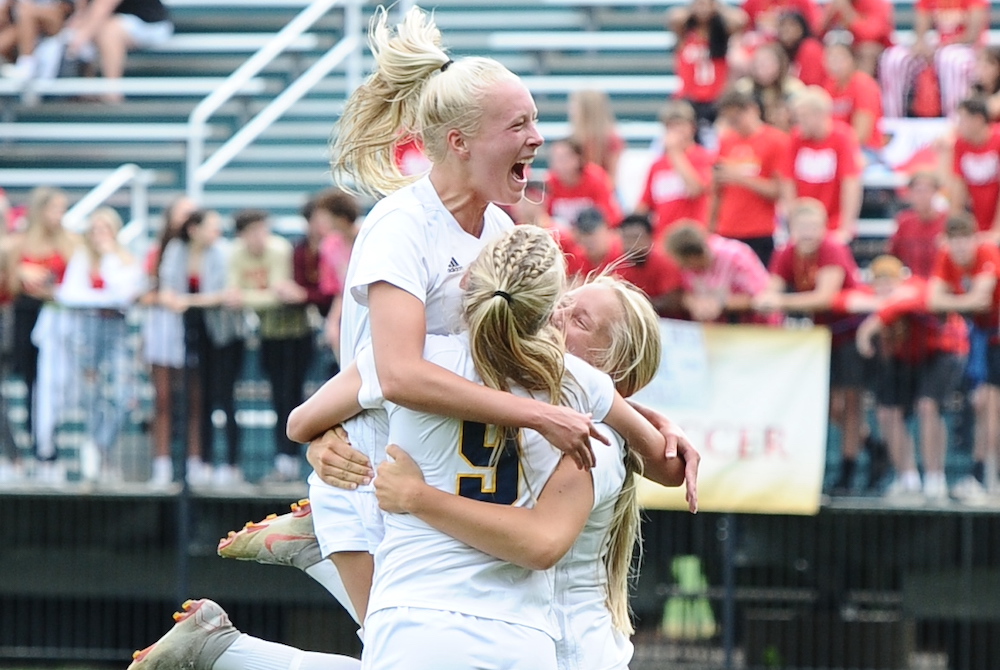
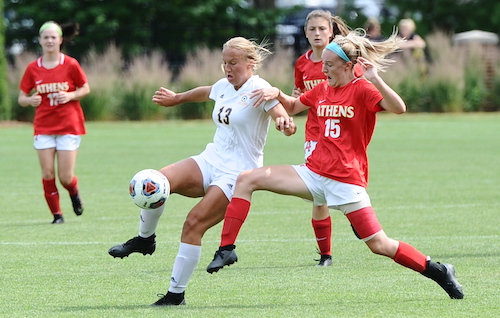
PHOTOS: (Top) Hartland players celebrate during their Division 1 Final win Saturday. (Middle) The Eagles’ Maria Storm (13) and Athens’ Meagan Lindgren (15) battle for possession.