


Add, Subtract, Divide, Multiply: MHSAA Not Alone
July 25, 2017
By Rob Kaminski
MHSAA benchmarks editor
This is the third part in a series on MHSAA tournament classification, past and present, that will be published over the next two weeks. This series originally ran in this spring's edition of MHSAA benchmarks.
As the MHSAA faces its most recent classification task with 8-Player Football, and opinions continue to swirl about as to the method, timeframe, location and other procedures, a look around the country provides plenty of company among state association brethren factoring variables into their own equations.
In the Pacific Northwest, the Oregon School Activities Association Football Playoffs are under public scrutiny as leadership ponders a five or six classification format beginning with the 2018-19 school year.
The OSAA has crowned six champions on the gridiron since 2006-07. Many of the state’s smaller schools would like to keep it that way, while larger schools lean toward a five-classification system, citing larger leagues, ease of travel and credibility to state championships as the advantages.
Still others would prefer more than six classes, pointing to safety issues and the opportunity to increase participation numbers as positives.
Moving southeast of Oregon, the Nevada Interscholastic Activities Association recently voted to hold serve on a classification proposal that was volleyed to the membership.
However, changes still could be forthcoming by as early as the 2018-19 season which would add a fifth classification in more populated southern Nevada while allowing northern schools to participate in four classifications. Such divisions could mean no state championship for the fifth class in southern Nevada.
Because of that, the NIAA wants equal numbers of schools in each classification on both ends of the state. Complicating the issue is the fact that the 24 largest schools in the state, by enrollment, are all in Clark County in Southern Nevada.
Across Nevada’s border into Arizona, charter schools are asking the Arizona Interscholastic Association to reconsider classification that was voted upon and approved in September 2015. That agreement called for the largest 33 percent of charter schools by enrollment to be placed in the state’s largest school classification, 3A, the middle 33 percent into 2A, and the smallest 33 percent into 1A.
Less than two years later the charter schools have had a change of heart and have asked to be considered the same as other Arizona public schools and be placed appropriately by enrollment beginning with the 2018-19 school year.
The situation in Arizona further illustrates how the public/private debate that all state associations have faced throughout existence now has the added dynamic of rapidly growing charter schools in today’s educational system, along with virtual school enrollment.
In the nation’s heartland, Nebraska has retooled its football classifications by using enrollment of boys students only in its schools rather than total enrollment. The Nebraska School Activities Association football-playing schools will kick off the 2018 season using this alignment.
Nebraska has three classes of 11-player football, with the smallest class divided in two, Class C-1 and C-2. The state also will have 8-player football for boys enrollments under 47, and the NSAA will sponsor a new 6-player tournament in 2018 for schools with 27 or fewer boys.
“This is a good proposal because some schools have a sizable imbalance between the number of boys and girls, and there’s a large gap (in enrollment) between the largest and smallest schools in Classes A and B,” NSAA executive director Jim Tenopir said. “I think this addresses both of those concerns.”
Swimmers in Georgia, meanwhile, will feel like they are moving with the current, rather than upstream in 2017-18, as the Georgia High School Association recently doubled the number of team championship events from two to four.
Swim enthusiasts can also count on longer days at the finals, as the top 30 finishers from the prelims will advance to the finals instead of 20, and all championship events will have three heats versus two.
St. Mary's Tops Off Tourney Run with Title, Record-Tying Win
By
Dean Holzwarth
Special for MHSAA.com
June 19, 2021
EAST LANSING – Orchard Lake St. Mary’s senior Tommy Allman stole the show on the mound in Saturday’s Division 2 Final.
His talented teammates did the same on the base paths.
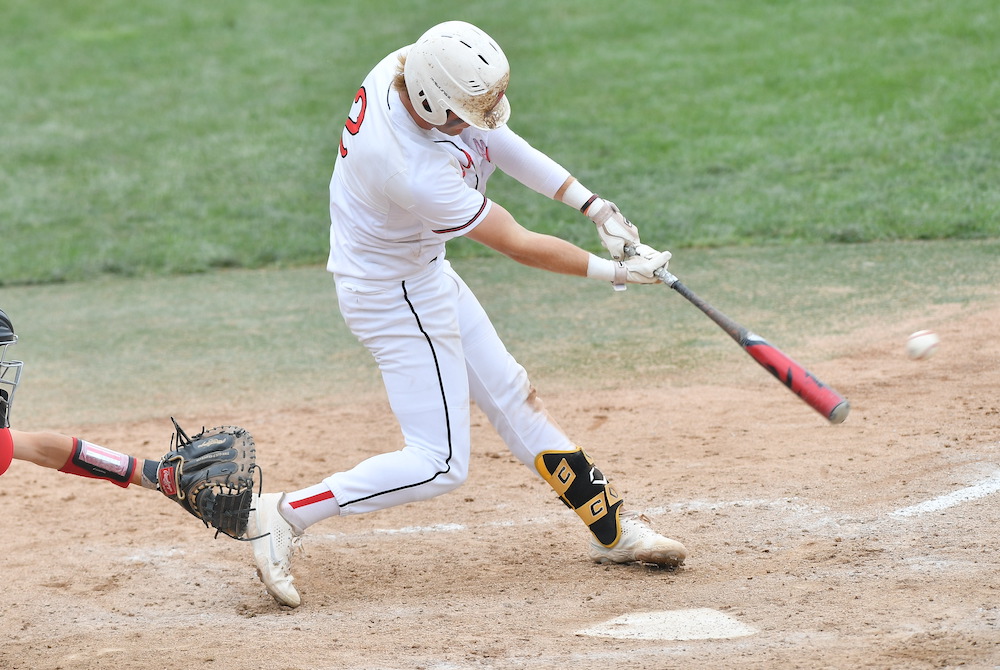
Allman pitched six solid innings, and the Eaglets set a new Finals record for stolen bases in a decisive 9-0 win over Stevensville Lakeshore at Michigan State’s McLane Stadium.
Top-ranked St. Mary’s (43-1) won its second Division 2 championship in a row and the program’s fifth Finals title overall. The 43 wins tied for the MHSAA record with four other teams: 2010 Ann Arbor Father Gabriel Richard, 1997 Midland Dow, 1995 Stevensville Lakeshore and 1985 Harper Woods Bishop Gallagher.
“It was a good outing, and I was dialed in,” said Allman, who’s headed next to Jacksonville University. “I trusted my team behind me, and everything was working; the off-speed, curveball and slider.
“This is the best way to end it, with a state championship. The whole year we battled, and we pulled it off. I’m proud of my team.”
Allman surrendered only two hits in 6 1/3 innings of work. He struck out seven and didn’t allow a walk.
Relief pitcher Jake Keaser recorded the final two outs.
 “It was a heck of a performance from Tommy; that was awesome,” St. Mary’s coach Matt Petry said. “The plan was to split the game among three guys, but Tommy was throwing so well that we didn’t do that. I made the decision to take him out (in the seventh), and he got a great ovation.”
The Eaglets finished with 12 stolen bases. The total eclipsed the previous Finals record of nine, set by Colon in the 1989 Class D Final against Gaylord St. Mary’s.
Alex Mooney and Ryan Mooney both tied the Finals individual record with three steals each.
“We work out all year trying to stay athletic, and I feel like it really helps,” said Alex Mooney, who scored twice and had two RBI.
“From the first inning we knew we were getting good jumps and their pitchers were not doing the best job of keeping us on. We got our timing down, and we knew we could swipe bags and we did.”
Nolan Schubart broke a scoreless tie in the fourth inning with a two-RBI double.
“Nolan is a stud, and I had all the confidence in the world that he was going to get a hit there,” Alex Mooney said. “It was a huge hit for us, and it really got us going and started that big inning for us.”
Ryan McKay followed with another double to drive in a pair and make it 4-0.
The Eaglets finished with six runs in the inning, then added another three in the sixth.
“This was the ultimate goal,” said Petry, whose starting lineup was loaded with Division I college talent.
“We have three goals each season: Win the Catholic League regular season, the Catholic League tournament championship and the state championship. We always had this day in the back of our mind, and we were able to close it out.”
Freshman Noah Chase started on the mound and went 3 ⅔ innings for the Lancers.
Lakeshore, which committed three errors and had only two hits, finished the season at 28-12 overall. The loss was its first in a Final after winning back-to-back Division 2 titles in 2017 and 2018 and a Class B crown in 1990.
“Going into the fourth, we felt really good about ourselves and the game plan was working,” Lancers coach Mark Nate said. “I’m proud of our kids for the way they fought early, and then their true talent came out and that's the bottom line.
“That team is a very, very good baseball team, and they’re deserving of winning it all.”
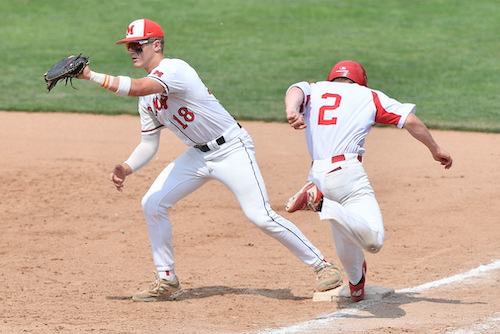
PHOTOS: (Top) Orchard Lake St. Mary's Alex Mooney (2) hones in on a pitch during Saturday's Division 2 Final. (Middle) Lakeshore's Andrew Lies (2) stretches for first base as St. Mary's Ike Irish takes a throw.