


Add, Subtract, Divide, Multiply: MHSAA Not Alone
July 25, 2017
By Rob Kaminski
MHSAA benchmarks editor
This is the third part in a series on MHSAA tournament classification, past and present, that will be published over the next two weeks. This series originally ran in this spring's edition of MHSAA benchmarks.
As the MHSAA faces its most recent classification task with 8-Player Football, and opinions continue to swirl about as to the method, timeframe, location and other procedures, a look around the country provides plenty of company among state association brethren factoring variables into their own equations.
In the Pacific Northwest, the Oregon School Activities Association Football Playoffs are under public scrutiny as leadership ponders a five or six classification format beginning with the 2018-19 school year.
The OSAA has crowned six champions on the gridiron since 2006-07. Many of the state’s smaller schools would like to keep it that way, while larger schools lean toward a five-classification system, citing larger leagues, ease of travel and credibility to state championships as the advantages.
Still others would prefer more than six classes, pointing to safety issues and the opportunity to increase participation numbers as positives.
Moving southeast of Oregon, the Nevada Interscholastic Activities Association recently voted to hold serve on a classification proposal that was volleyed to the membership.
However, changes still could be forthcoming by as early as the 2018-19 season which would add a fifth classification in more populated southern Nevada while allowing northern schools to participate in four classifications. Such divisions could mean no state championship for the fifth class in southern Nevada.
Because of that, the NIAA wants equal numbers of schools in each classification on both ends of the state. Complicating the issue is the fact that the 24 largest schools in the state, by enrollment, are all in Clark County in Southern Nevada.
Across Nevada’s border into Arizona, charter schools are asking the Arizona Interscholastic Association to reconsider classification that was voted upon and approved in September 2015. That agreement called for the largest 33 percent of charter schools by enrollment to be placed in the state’s largest school classification, 3A, the middle 33 percent into 2A, and the smallest 33 percent into 1A.
Less than two years later the charter schools have had a change of heart and have asked to be considered the same as other Arizona public schools and be placed appropriately by enrollment beginning with the 2018-19 school year.
The situation in Arizona further illustrates how the public/private debate that all state associations have faced throughout existence now has the added dynamic of rapidly growing charter schools in today’s educational system, along with virtual school enrollment.
In the nation’s heartland, Nebraska has retooled its football classifications by using enrollment of boys students only in its schools rather than total enrollment. The Nebraska School Activities Association football-playing schools will kick off the 2018 season using this alignment.
Nebraska has three classes of 11-player football, with the smallest class divided in two, Class C-1 and C-2. The state also will have 8-player football for boys enrollments under 47, and the NSAA will sponsor a new 6-player tournament in 2018 for schools with 27 or fewer boys.
“This is a good proposal because some schools have a sizable imbalance between the number of boys and girls, and there’s a large gap (in enrollment) between the largest and smallest schools in Classes A and B,” NSAA executive director Jim Tenopir said. “I think this addresses both of those concerns.”
Swimmers in Georgia, meanwhile, will feel like they are moving with the current, rather than upstream in 2017-18, as the Georgia High School Association recently doubled the number of team championship events from two to four.
Swim enthusiasts can also count on longer days at the finals, as the top 30 finishers from the prelims will advance to the finals instead of 20, and all championship events will have three heats versus two.
Hackett Catholic, Cardinal Mooney Carry Big Bats into Finale
By
Dean Holzwarth
Special for MHSAA.com
June 18, 2021
EAST LANSING – A big opening inning produced two positive results for the Kalamazoo Hackett Catholic Prep baseball team Friday.
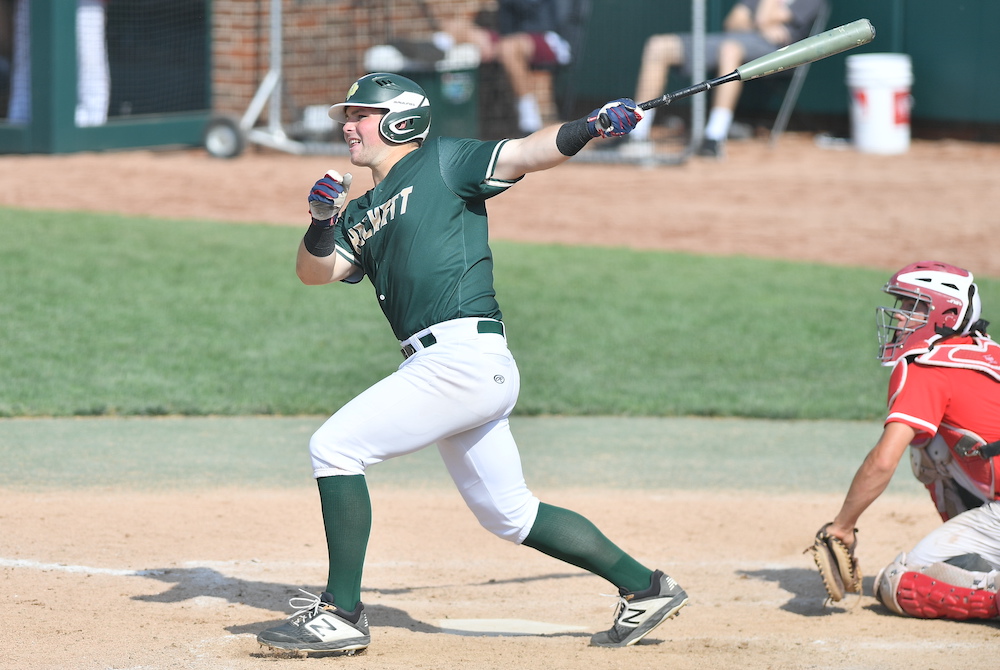
Seven early runs helped propel the Irish to an 11-1 six-inning win over Marlette in a Division 4 Semifinal at Michigan State’s McLane Stadium.
The opening surge also provided the opportunity to have starter Sam Shea pitch in Saturday’s 5 p.m. Final against Marine City Cardinal Mooney.
Shea threw only 23 pitches in the first inning, as he was quickly replaced by Alex Blasen.
“It did work out for us,” first-year Hackett coach Smiley Verduzco said. “The whole idea as we talked about before was that first inning. If we get close to 10 (runs) then you have a chance, and without that you don’t have a chance to do that because you have to win the game. There is no tomorrow.
“Sam was pitching fantastic, and then Alex came in and just shut them down. He did a great job.”
Blasen allowed only one run on two hits over the final five innings. He struck out four and walked four.
The fifth-ranked Irish (30-9) tallied those seven early runs on only two hits. They were aided by an error and walks.
After a leadoff triple by Steven Widger, who had a game-high three hits, and a pair of walks, Brenden Collins drove in a pair of runs with a single.
“We like to score a lot of runs, and when we came out and got that seven it was huge for momentum,” Collins said. “We knew it was crucial to get them down early so that we could roll over them and get to the win.”
Said Verduzco: “Did you see the energy (after the triple)? It just pumps the kids up, and let’s go. Then things started to happen. It was pretty fun to watch, and they have earned it. They’ve worked hard all year, and to get a win against a good team, it doesn’t get any better than that.”
Marlette’s starter didn't get out of the first inning after walking four and hitting a batter.
“The first inning was a killer; that was very disappointing,” said Marlette coach Dave Hayden, whose team was making its first appearance in the Semifinals.
“We knew after that first inning that it would be very difficult to come back on them. I thought we settled down after that, but the first inning kind of did us in.”
The Irish added two more runs in the third inning. Widger ripped an RBI single and then scored on a wild pitch.
The Red Raiders scored in the top of the fourth on a sacrifice fly by Aaron Bower. He brought home Cody Hayden, who was hit by a pitch to lead off the inning.
Hackett ended the game in the sixth after a pair of singles and a ground out scored a pair of runs.
The Irish, who are averaging 10 runs a game in the postseason, will attempt to win their first Finals title in their first trip.
“We worked hard to get our school here for the first time, and now everyone is watching you,” Collins said. “It’s kind of cool that we can put our school on the map like that.”
Marine City Cardinal Mooney 12, Maple City Glen Lake 2
Cardinal Mooney continued its impressive postseason run with another lopsided affair.
The Cardinals scored in bunches early en route to a 12-2 five-inning victory over Maple City Glen Lake in the second Division 4 Semifinal.
Mooney (28-6), which will face Hackett in the Final, has outscored its six postseason opponents by a combined 71-8.
 “It’s let's get out in front and never let go,” said Cardinals sophomore Blake Lutzky, who went 2-for-3 with four RBI and a run scored. “Never let off the gas.”
Mooney jumped out to a comfortable lead by scoring four runs in the second inning and adding another three in the following inning.
That was just the cushion starting pitcher Thomas Gill needed as he went the distance and scattered five hits while recording five strikeouts.
“When Tommy Gill, our senior pitcher, gets a run or two, it seems like seven runs,” Mooney coach Mike Rice said. “And in these types of games, I want to get seven or eight runs, but when he’s on the mound and throws first-pitch strikes and with our defense, it makes us unstoppable.”
Rice has been pleased with his team’s approach at the plate, as well as its ability to produce timely hitting.
Mooney totaled 12 hits and walked 10 times.
“We’re hitting, and we’re focusing on hitting strikes and not swinging at bad pitches,” Rice said. “The pitcher’s goal is to throw the ball over the plate, and when he does we’re raking it.”
The early deficit was too much for eighth-ranked Glen Lake (27-8) to overcome.
“You can't fall behind against a team like that because they are too good,” Glen Lake coach Kris Herman said. “They are ranked No. 2 in the state for a reason. If you dig yourself in a hole like that, then you have to fight your way out of it.
“I was proud of our fight. I thought they kept grinding, and we just ran into a better team.”
Glen Lake’s fight came in the fifth when they trimmed the deficit to 7-2.
However, in the bottom of the inning, Mooney countered with five runs of its own to end the game.
“We let go a little bit, and we thought we had the game in the bag,” Lutzky said. “But they scored two, and we just put them back on the board. There’s a lot of positive energy on this team, and we’re ready to play all the time.”
Trent Rice, Rocco Comito and Julian Iodice also had two hits each for Mooney.
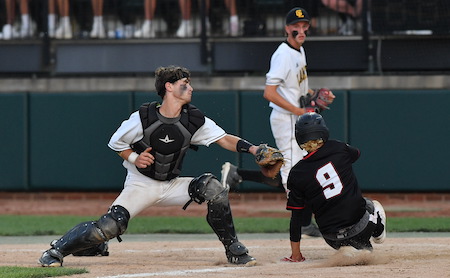
PHOTOS: (Top) A Hackett Catholic Prep hitter keeps his eyes on a drive during Friday’s Semifinal win. (Middle) Cardinal Mooney’s Julian Iodice eludes a tag to score at McLane Stadium.