


Add, Subtract, Divide, Multiply: MHSAA Not Alone
July 25, 2017
By Rob Kaminski
MHSAA benchmarks editor
This is the third part in a series on MHSAA tournament classification, past and present, that will be published over the next two weeks. This series originally ran in this spring's edition of MHSAA benchmarks.
As the MHSAA faces its most recent classification task with 8-Player Football, and opinions continue to swirl about as to the method, timeframe, location and other procedures, a look around the country provides plenty of company among state association brethren factoring variables into their own equations.
In the Pacific Northwest, the Oregon School Activities Association Football Playoffs are under public scrutiny as leadership ponders a five or six classification format beginning with the 2018-19 school year.
The OSAA has crowned six champions on the gridiron since 2006-07. Many of the state’s smaller schools would like to keep it that way, while larger schools lean toward a five-classification system, citing larger leagues, ease of travel and credibility to state championships as the advantages.
Still others would prefer more than six classes, pointing to safety issues and the opportunity to increase participation numbers as positives.
Moving southeast of Oregon, the Nevada Interscholastic Activities Association recently voted to hold serve on a classification proposal that was volleyed to the membership.
However, changes still could be forthcoming by as early as the 2018-19 season which would add a fifth classification in more populated southern Nevada while allowing northern schools to participate in four classifications. Such divisions could mean no state championship for the fifth class in southern Nevada.
Because of that, the NIAA wants equal numbers of schools in each classification on both ends of the state. Complicating the issue is the fact that the 24 largest schools in the state, by enrollment, are all in Clark County in Southern Nevada.
Across Nevada’s border into Arizona, charter schools are asking the Arizona Interscholastic Association to reconsider classification that was voted upon and approved in September 2015. That agreement called for the largest 33 percent of charter schools by enrollment to be placed in the state’s largest school classification, 3A, the middle 33 percent into 2A, and the smallest 33 percent into 1A.
Less than two years later the charter schools have had a change of heart and have asked to be considered the same as other Arizona public schools and be placed appropriately by enrollment beginning with the 2018-19 school year.
The situation in Arizona further illustrates how the public/private debate that all state associations have faced throughout existence now has the added dynamic of rapidly growing charter schools in today’s educational system, along with virtual school enrollment.
In the nation’s heartland, Nebraska has retooled its football classifications by using enrollment of boys students only in its schools rather than total enrollment. The Nebraska School Activities Association football-playing schools will kick off the 2018 season using this alignment.
Nebraska has three classes of 11-player football, with the smallest class divided in two, Class C-1 and C-2. The state also will have 8-player football for boys enrollments under 47, and the NSAA will sponsor a new 6-player tournament in 2018 for schools with 27 or fewer boys.
“This is a good proposal because some schools have a sizable imbalance between the number of boys and girls, and there’s a large gap (in enrollment) between the largest and smallest schools in Classes A and B,” NSAA executive director Jim Tenopir said. “I think this addresses both of those concerns.”
Swimmers in Georgia, meanwhile, will feel like they are moving with the current, rather than upstream in 2017-18, as the Georgia High School Association recently doubled the number of team championship events from two to four.
Swim enthusiasts can also count on longer days at the finals, as the top 30 finishers from the prelims will advance to the finals instead of 20, and all championship events will have three heats versus two.

Hackett Catholic Prep Returns from Break as D4's Best Again
By
Paul Costanzo
Special for MHSAA.com
June 12, 2021
FRANKENMUTH – Kalamazoo Hackett Catholic Prep officially won the MHSAA Lower Peninsula Division 4 Golf Final championship with its play Saturday afternoon, but the seeds for the victory were planted Thursday.
The Irish played a practice round at The Fortress Golf Club a day before competing in the two-day tournament, and what was learned during that round played a crucial role in a back-nine surge that clinched their second-straight title.
“We try and come out the day before the event, and we were able to do that this year, and I would say it was very crucial,” Hackett coach Jim Holton said. “We stress, ‘We’re not here to shoot a score (Thursday), we’re here to learn,’ and that’s what we did when we got here.”
Hackett finished with a two-day total of 640 strokes, finishing ahead of runner-up Lansing Christian by six. Charlevoix was third with 646, followed by Maple City Glen Lake at 677.
Clarkston Everest Collegiate’s Remy Stalcup was the tournament medalist, shooting a two-under 142 to win by seven strokes.
For Hackett, a course far from home felt familiar enough Saturday afternoon as it held off a Saturday morning surge from Lansing Christian.
About halfway through the round, the Pilgrims inched ahead, but it was the work done on the back nine that lifted the Irish to a victory.
Their scoring foursome of Tommy Keyte, Ben Bridenstine, Ryan Chafty and Niklas Johansson combined to shoot 158 on the back nine, while Lansing Christian’s top four came in at 166 down the stretch.
“I think we all went through a tough stretch there as a team,” said Keyte, who was the individual runner-up at 149. “Back nine, we just kind of locked in and we picked it up. Made some good birdies, made some good putts. Everything just kind of clicked together on the back. The practice round, we really focused on where we wanted to hit our golf shots. It wasn’t driver every hole, it’s 4-irons, hybrids – you have to place your tee shot because there’s trouble on every hole.”
 Holton said he and his team had identified the back nine as the key during Thursday’s practice round.
“We realized the back nine can cause problems for teams,” he said. “We discussed that in the practice round, made our gameplan based on the holes and what we needed to do to keep ourselves ahead of the other competition. We started off great, had a little lull, Lansing Christian went by us and I was a little concerned. But I knew those tough holes were ahead, and I knew we planned well for those holes.”
The second-straight title for Hackett was actually the team’s second in three years, as there was no 2020 season. The senior-laden group – Keyte, Bridenstine, Chafty and No. 5 player Grayson Walters are all seniors – was focused on retaining their title, despite the year off.
“It felt great,” Keyte said. “The whole team was really excited for this weekend, and we’ve been waiting for this for two years now, because we were trying to go back to back. We did it today, and we had a great time. It was a grind out there.”
Following up Keyte’s 149 for Hackett were Bridenstine (158), Chafty (163) and Johansson (171). Walters wasn’t far behind at 173.
Davis Garrett (150) took third individually to lead Lansing Christian, and was followed by William Combs (156), Caden Kinnas (167) and Baylor Brogan (173).
While Hackett was repeating as team champ, a new face was dominating the course in the individual race. As a sophomore, Stalcup was playing in his first MHSAA Finals, and he led nearly wire to wire. He essentially put the tournament away with an eagle on No. 1 (his 16th hole of the day) on Saturday.
“I hit my drive in the right heather, so I took a 5-iron out from about 230 (yards), and it almost went in, actually,” Stalcup said. “It was, like, not even a foot for a tap-in eagle and it got me back into it with a big lead.”
Stalcup had played the previous four holes at two-over par, and while the eagle ended up just padding his lead, at the time it seemed necessary.
“I thought it was close; I didn’t know if I was winning by a bunch or not,” he said. “So that helped a lot, for sure. I was happy then. I didn’t look at the leaderboard. I don’t want to know until the very end.”
Stalcup had played at The Fortress earlier in the season, and it was kind to him then as well.
“I love the course; I love it,” he said. “It’s one of my favorite courses, actually. I always play good here. I played good earlier in the season here, too. I putt really well on these greens, I love these greens. I made a lot of long putts. It helps a lot, too, I hit it pretty far. I hit a lot of wedges into greens.”
Jake Beaudoin of Charlevoix and Luke LeBourdais of Saginaw Nouvel tied for fourth at 153, followed by Brady Krohn of Elkton-Pigeon-Bay Port Laker (154), Michael Zanoni of Mount Pleasant Sacred Heart (155), Lansing Christian’s Combs, Blake O’Connor of Glen Lake (157) and Jeffrey Andrus of Royal Oak Shrine (157).
Full results will be linked when available.
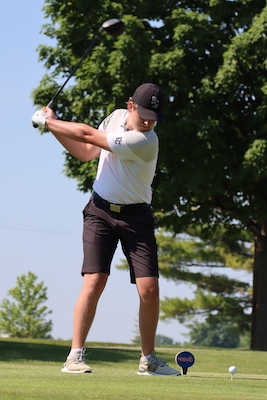
PHOTOS: (Top) Kalamazoo Hackett Catholic Prep, with a golfer putting here during Friday's first round, repeated as Division 4 champion. (Middle) Clarkston Everest Collegiate's Remy Stalcup drives during Friday's first round. (Click for more from High School Sports Scene.)