


Add, Subtract, Divide, Multiply: MHSAA Not Alone
July 25, 2017
By Rob Kaminski
MHSAA benchmarks editor
This is the third part in a series on MHSAA tournament classification, past and present, that will be published over the next two weeks. This series originally ran in this spring's edition of MHSAA benchmarks.
As the MHSAA faces its most recent classification task with 8-Player Football, and opinions continue to swirl about as to the method, timeframe, location and other procedures, a look around the country provides plenty of company among state association brethren factoring variables into their own equations.
In the Pacific Northwest, the Oregon School Activities Association Football Playoffs are under public scrutiny as leadership ponders a five or six classification format beginning with the 2018-19 school year.
The OSAA has crowned six champions on the gridiron since 2006-07. Many of the state’s smaller schools would like to keep it that way, while larger schools lean toward a five-classification system, citing larger leagues, ease of travel and credibility to state championships as the advantages.
Still others would prefer more than six classes, pointing to safety issues and the opportunity to increase participation numbers as positives.
Moving southeast of Oregon, the Nevada Interscholastic Activities Association recently voted to hold serve on a classification proposal that was volleyed to the membership.
However, changes still could be forthcoming by as early as the 2018-19 season which would add a fifth classification in more populated southern Nevada while allowing northern schools to participate in four classifications. Such divisions could mean no state championship for the fifth class in southern Nevada.
Because of that, the NIAA wants equal numbers of schools in each classification on both ends of the state. Complicating the issue is the fact that the 24 largest schools in the state, by enrollment, are all in Clark County in Southern Nevada.
Across Nevada’s border into Arizona, charter schools are asking the Arizona Interscholastic Association to reconsider classification that was voted upon and approved in September 2015. That agreement called for the largest 33 percent of charter schools by enrollment to be placed in the state’s largest school classification, 3A, the middle 33 percent into 2A, and the smallest 33 percent into 1A.
Less than two years later the charter schools have had a change of heart and have asked to be considered the same as other Arizona public schools and be placed appropriately by enrollment beginning with the 2018-19 school year.
The situation in Arizona further illustrates how the public/private debate that all state associations have faced throughout existence now has the added dynamic of rapidly growing charter schools in today’s educational system, along with virtual school enrollment.
In the nation’s heartland, Nebraska has retooled its football classifications by using enrollment of boys students only in its schools rather than total enrollment. The Nebraska School Activities Association football-playing schools will kick off the 2018 season using this alignment.
Nebraska has three classes of 11-player football, with the smallest class divided in two, Class C-1 and C-2. The state also will have 8-player football for boys enrollments under 47, and the NSAA will sponsor a new 6-player tournament in 2018 for schools with 27 or fewer boys.
“This is a good proposal because some schools have a sizable imbalance between the number of boys and girls, and there’s a large gap (in enrollment) between the largest and smallest schools in Classes A and B,” NSAA executive director Jim Tenopir said. “I think this addresses both of those concerns.”
Swimmers in Georgia, meanwhile, will feel like they are moving with the current, rather than upstream in 2017-18, as the Georgia High School Association recently doubled the number of team championship events from two to four.
Swim enthusiasts can also count on longer days at the finals, as the top 30 finishers from the prelims will advance to the finals instead of 20, and all championship events will have three heats versus two.

Dollar Bay Cashes In on School Records for 1st Finals Title
By
John Vrancic
Special for MHSAA.com
June 6, 2021
KINGSFORD — History was made in the Upper Peninsula Division 3 Track & Field Finals on Saturday as the Dollar Bay Blue Bolts were crowned champions for the first time with 67 points.
They were followed by Pickford with 55 and Rapid River with 47.
Dollar Bay set school records while winning the 1,600-meter relay in three minutes, 42.88 seconds and 3,200 relay in 8:31.01.
 Bessemer had won the 3,200 relay eight years in a row. The Speedboys, however, took third this time (8:58.64).
“We got it done,” said senior and Bay College basketball recruit Davin Hill. “Our coach pushed us hard all year. Our practices were harder than the meets.”
Senior John Norland anchored the winning 3,200 relay and took the 400 (51.38) and 800 (2:07.1).
“We knew we had a chance to win the U.P. Finals,” he said. “I ran my second-fastest split (2:01) in the 3,200 relay. The 400 and 800 are tough races. The 800 is very close to a sprint.”
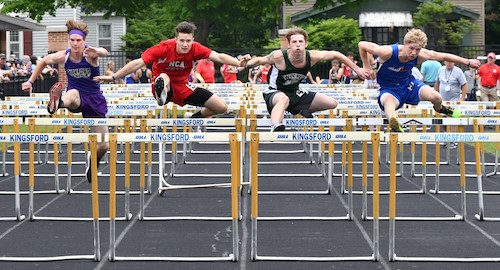
Conner LeClaire added a first in the 300 hurdles (42.33) and second in the 110s (17.63).
Pickford’s lone first came on Hayden Taylor’s toss of 42 feet, 8¼ inches in shot put with Cedarville senior Drew Bailey taking second (42-2).
Rapid River senior Parker Dausey won discus (126-1) and classmate Max Lenaker took high jump (6-1).
North Central took the 400 relay (46.32) and sophomore Luke Gorzinski captured the 200 (23.29), edging Republic-Michigamme’s Isaac Lawrence by two hundredths of a second.
Lawrence won long jump (20-2) and placed third in the 100 (11.69), one hundredth of a second behind Munising’s Micaiah Peramaki.
 Brimley senior Cameron Hoornstra won the 100 (11.62), and Rudyard’s Gannon Smith took pole vault (10-6).
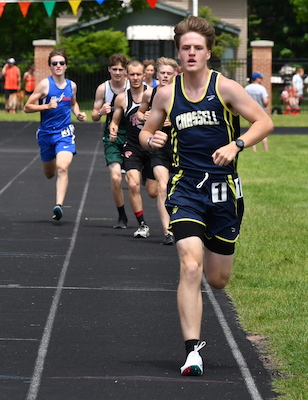
Chassell senior Kolson Kytta became a double winner, taking the 1,600 in a school-record 4:35.37 and 3,200 (10:45.14) on a hot and humid day in Dickinson County.
“I did a lot of visualization about how I thought the races would do,” said Kytta, who’s considering running at Michigan Tech. “I put in a lot of training to get better. I don’t think the heat affected me too much.”
Lake Linden-Hubbell recorded its lone first in the 800 relay (1:38.04), and Carney-Nadeau senior Tim Hodson crossed first in the 110 hurdles (17.58).
“Our handoffs looked pretty good,” said senior Caleb Klein, who anchored the winning 800 relay. “This was our best time all year ,and I think the competition helped us a lot. All the adrenalin from all the fans being here also got me going.”
PHOTOS: (Top) Dollar Bay's A.J. Datto passes the baton to Davin Hill during the 1,600 relay Saturday. (Middle) Chassell's Kolson Kytta leads the pack after completing six laps of the 3,200. (Below) Carney-Nadeau's Tim Hodson won the 110 hurdles with Connor LeClaire from Dollar Bay taking second, Pickford's Josh Sullivan taking third, and Powers North Central’s Trenton Naser taking fourth. (Photos by Cara Kamps. Click to see more at RunMichigan.com.)