


Add, Subtract, Divide, Multiply: MHSAA Not Alone
July 25, 2017
By Rob Kaminski
MHSAA benchmarks editor
This is the third part in a series on MHSAA tournament classification, past and present, that will be published over the next two weeks. This series originally ran in this spring's edition of MHSAA benchmarks.
As the MHSAA faces its most recent classification task with 8-Player Football, and opinions continue to swirl about as to the method, timeframe, location and other procedures, a look around the country provides plenty of company among state association brethren factoring variables into their own equations.
In the Pacific Northwest, the Oregon School Activities Association Football Playoffs are under public scrutiny as leadership ponders a five or six classification format beginning with the 2018-19 school year.
The OSAA has crowned six champions on the gridiron since 2006-07. Many of the state’s smaller schools would like to keep it that way, while larger schools lean toward a five-classification system, citing larger leagues, ease of travel and credibility to state championships as the advantages.
Still others would prefer more than six classes, pointing to safety issues and the opportunity to increase participation numbers as positives.
Moving southeast of Oregon, the Nevada Interscholastic Activities Association recently voted to hold serve on a classification proposal that was volleyed to the membership.
However, changes still could be forthcoming by as early as the 2018-19 season which would add a fifth classification in more populated southern Nevada while allowing northern schools to participate in four classifications. Such divisions could mean no state championship for the fifth class in southern Nevada.
Because of that, the NIAA wants equal numbers of schools in each classification on both ends of the state. Complicating the issue is the fact that the 24 largest schools in the state, by enrollment, are all in Clark County in Southern Nevada.
Across Nevada’s border into Arizona, charter schools are asking the Arizona Interscholastic Association to reconsider classification that was voted upon and approved in September 2015. That agreement called for the largest 33 percent of charter schools by enrollment to be placed in the state’s largest school classification, 3A, the middle 33 percent into 2A, and the smallest 33 percent into 1A.
Less than two years later the charter schools have had a change of heart and have asked to be considered the same as other Arizona public schools and be placed appropriately by enrollment beginning with the 2018-19 school year.
The situation in Arizona further illustrates how the public/private debate that all state associations have faced throughout existence now has the added dynamic of rapidly growing charter schools in today’s educational system, along with virtual school enrollment.
In the nation’s heartland, Nebraska has retooled its football classifications by using enrollment of boys students only in its schools rather than total enrollment. The Nebraska School Activities Association football-playing schools will kick off the 2018 season using this alignment.
Nebraska has three classes of 11-player football, with the smallest class divided in two, Class C-1 and C-2. The state also will have 8-player football for boys enrollments under 47, and the NSAA will sponsor a new 6-player tournament in 2018 for schools with 27 or fewer boys.
“This is a good proposal because some schools have a sizable imbalance between the number of boys and girls, and there’s a large gap (in enrollment) between the largest and smallest schools in Classes A and B,” NSAA executive director Jim Tenopir said. “I think this addresses both of those concerns.”
Swimmers in Georgia, meanwhile, will feel like they are moving with the current, rather than upstream in 2017-18, as the Georgia High School Association recently doubled the number of team championship events from two to four.
Swim enthusiasts can also count on longer days at the finals, as the top 30 finishers from the prelims will advance to the finals instead of 20, and all championship events will have three heats versus two.
Gazelles Cap Return Season with Familiar Celebration
By
Pam Shebest
Special for MHSAA.com
June 4, 2021
PORTAGE — Sisters Marisa and Kayla Nafso were ecstatic after pulling out a tough three-setter for the No. 4 doubles title Friday at Portage Central High School.
The last match off the courts, they had no clue that their team, Bloomfield Hills Academy of the Sacred Heart, won the team title at the MHSAA Lower Peninsula Division 4 tennis championship.
They were stunned to learn that their semifinal win actually had been team title clincher.
“Oh, we won?” Marisa, a junior, said, grabbing her sister in a big hug.
“Wait, wait, wait. Our semifinal win? Oh my gosh, we won. That’s great!
“Wow. I really wanted to win individually, but the team makes it 20 times better,” Kayla, a freshman, exclaimed with a huge grin.
Sacred Heart finished with 29 points, six ahead of Traverse City St. Francis.
Just two points separated the next four teams.
North Muskegon and Portland tied for third with 18 points each, Grand Rapids West Catholic was fifth with 17 and Jackson Lumen Christi sixth with 16.
Marisa Nafso won a state title at No. 2 doubles in 2019, and her sister was thrilled to be her partner this year.
“I was really lucky because she won states when she was a freshman,” Kayla Nafso said.
“Because of her experience, I was more comfortable. It was great that I got to win as a freshman.”
The sisters said the final was the match that scared them the most.
The top seeds at their flight, they defeated Grand Rapids NorthPointe Christian’s Delanie Minnema and Caroline Rudolph, the third seeds, 7-6(3), 2-6, 6-1.
“We were watching them play at the other site,” Nafso said. “Creds to the team we played for playing two three-set matches back to back.”
The team win was the Gazelles’ third Finals title in a row, but the first under coach Chris Shaya.
 Neither the coach nor the players knew for sure they clinched the title until all matches were finished.
“I figured we won but I was going to wait for the team so we all could find out together,” Shaya said.
“None of us looked. I knew Traverse City was very strong in singles, and I knew we were strong in doubles. In singles, they competed extremely well. It was tough for us to overcome, and they deserve those wins.”
As a coach, Shaya said, “First of all, you want their experience to be fun. You want to teach them some life lessons about hard work and how that pays off, and sometimes it doesn’t pay off.”
At No. 1 singles, top-seeded Moorea McNalley finished the season undefeated after entering the tournament with a 28-0 record.
She lost just seven games over her four tournament matches.
The Clarkston Everest Collegiate junior defeated the second seed, Lilly Bobrowski of St. Francis, 6-0, 6-0.
McNalley also won the No. 1 singles title two years ago. (The 2020 season was canceled due to COVID-19).
As the top seed, she said she felt a bit of pressure coming into the tournament, “especially the further matches. They are all very good players.”
Bobrowski, a senior who plans to play tennis at Ave Maria University in Florida, said the two played earlier in the regular season.
“We went into a third set tiebreak then,” she said. “(Friday, McNalley) was definitely on her game and I made a few unforced errors, but it was a lot of fun.”
Senior Alexi Lewis, one of two St. Francis singles winners, defeated Sacred Heart’s Isabelle Burg, the second seed, 6-2, 6-3, for the No. 2 flight championship.
“My goal was to win but I got kind of nervous looking at the draw because I had never played the No. 2 seed,” the top seed said.
“All the other seeds I had played and had good scores against them, so I was really confident going in. I was preparing myself for playing the No. 2 seed — a lot.”
Lewis, who plans to play tennis at Hope College, said the afternoon wind was a factor in the match.
“That threw me off a little bit,” she said. “So much of it was just mental toughness. (Burg) was a really, really good player and could get the ball back with a lot of pace.
“It was just working against that and trying to find that little spot where I could move her around. The wind complicated all that.”
Lewis was also undefeated entering the tournament.
The other St. Francis singles champ was Jillian Sodini, the top seed at No. 3, who defeated Portland’s Adriana Krieger, 6-2, 6-1.
“I knew I had to keep my eye on the prize and stay calm with it and play my game,” said Sodini, who ended her senior season undefeated.
 “(Second place as a team) is awesome. We have six underclassmen this year and six seniors. You’ve just got to bring it at states. We’ve been pretty rowdy all day.”
“Rowdy” is the perfect word for one of the loudest and most supportive teams at the tournament.
First-year coach Dane Fosgard thought for sure this would be the year St. Francis won the team title after finishing runner-up three of the last five seasons.
“Just when you have a team you think is good enough to win States, it’s not good enough,” he said.
“We have good players coming up. This year’s going to be tough to beat.”
He gave a nod to his three senior singles players, all co-captains, for being leaders on the team.
“Six seniors and three of them went out as finalists and two state champs,” he said. “Those three seniors, Lilly, Alexi and Jillian, have worked so hard all four years of their high school careers, both on the court and off the court.
“Having those three on the same team is something special. They’re all No. 1 singles-caliber players.”
Seeded third at No. 4 singles, Olivia Eaker of Jackson Lumen Christi was the lowest seed to win a title.
She upset top-seeded Erika Graham, of Ann Arbor Father Gabriel Richard, 6-0, 6-4, in the final after defeating St. Francis’ No. 2 seed, Mary Chittle, 5-6, 7-6(3), 6-4 in the semifinal.
Graham also won her semi in three sets, 6-7(2), 6-3, 6-4, over fourth seed Eve Jackson of Sacred Heart.
Both Eaker and Graham were exhausted after their match, the next to last off the courts.
Just a freshman, “I don’t even know,” Eaker said, catching her breath, about winning the final. “I’m honored and very grateful for this.
“I feel amazing, excited. It was definitely tough. We both worked really hard for it. We gave it all we had.”
Other doubles winners included second seeds Reagan Nauta and Shannon Russell, from Grand Rapids West Catholic, 7-5, 6-2, over top seeds Lulu George and Maggie Pulte of Sacred Heart.
Top seeds Noor Simon and Angelina Kakos, also of Sacred Heart, defeated third seeds Hannah Nelson and Brooke Tietz from West Catholic, 7-6(5), 6-4, at No. 3 doubles.
At No. 4, second seeds Marilyn Gaston and Greta Goszkowicz, from North Muskegon, defeated West Catholic top seeds Olivia Vallone and Karlie Kurlenda, 6-3, 6-5.
Goszkowicz, a senior, was one of the most exuberant winners, commenting, “My goal was to make it to the second day.”
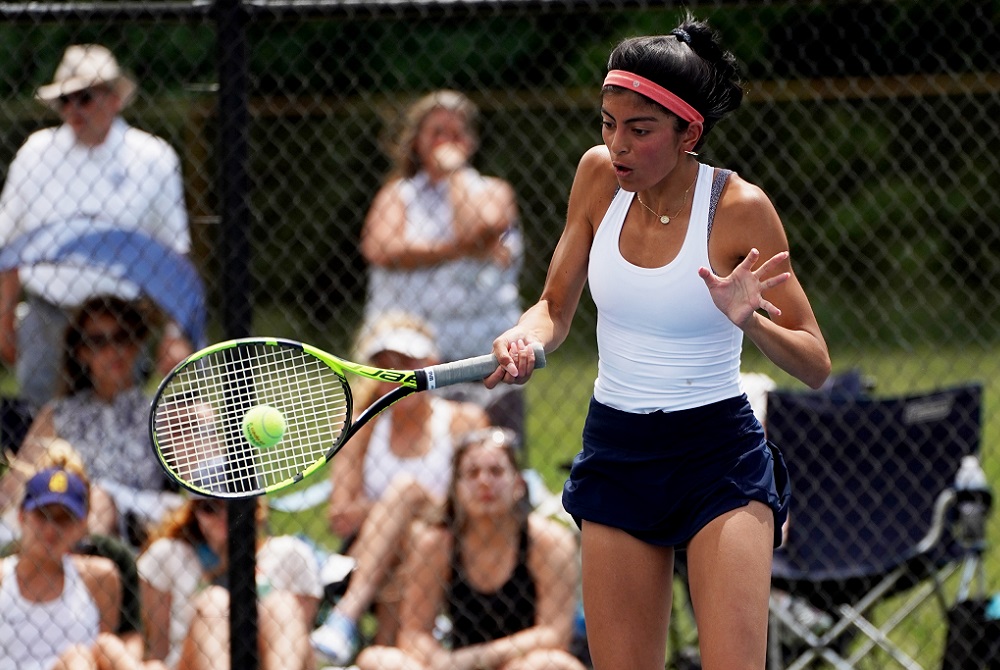
PHOTOS: (Top) Sacred Heart’s Marisa Nafso returns a volley during her and sister Kayla’s championship match win at No. 1 doubles Friday. (Middle) Clarkston Everest Collegiate's Moorea McNalley follows through on a return during her No. 1 singles championship match. (Below) Lilly Bobrowski scored big for Traverse City St. Francis also advancing to the No. 1 singles final. (Click for more from High School Sports Scene.)