


Add, Subtract, Divide, Multiply: MHSAA Not Alone
July 25, 2017
By Rob Kaminski
MHSAA benchmarks editor
This is the third part in a series on MHSAA tournament classification, past and present, that will be published over the next two weeks. This series originally ran in this spring's edition of MHSAA benchmarks.
As the MHSAA faces its most recent classification task with 8-Player Football, and opinions continue to swirl about as to the method, timeframe, location and other procedures, a look around the country provides plenty of company among state association brethren factoring variables into their own equations.
In the Pacific Northwest, the Oregon School Activities Association Football Playoffs are under public scrutiny as leadership ponders a five or six classification format beginning with the 2018-19 school year.
The OSAA has crowned six champions on the gridiron since 2006-07. Many of the state’s smaller schools would like to keep it that way, while larger schools lean toward a five-classification system, citing larger leagues, ease of travel and credibility to state championships as the advantages.
Still others would prefer more than six classes, pointing to safety issues and the opportunity to increase participation numbers as positives.
Moving southeast of Oregon, the Nevada Interscholastic Activities Association recently voted to hold serve on a classification proposal that was volleyed to the membership.
However, changes still could be forthcoming by as early as the 2018-19 season which would add a fifth classification in more populated southern Nevada while allowing northern schools to participate in four classifications. Such divisions could mean no state championship for the fifth class in southern Nevada.
Because of that, the NIAA wants equal numbers of schools in each classification on both ends of the state. Complicating the issue is the fact that the 24 largest schools in the state, by enrollment, are all in Clark County in Southern Nevada.
Across Nevada’s border into Arizona, charter schools are asking the Arizona Interscholastic Association to reconsider classification that was voted upon and approved in September 2015. That agreement called for the largest 33 percent of charter schools by enrollment to be placed in the state’s largest school classification, 3A, the middle 33 percent into 2A, and the smallest 33 percent into 1A.
Less than two years later the charter schools have had a change of heart and have asked to be considered the same as other Arizona public schools and be placed appropriately by enrollment beginning with the 2018-19 school year.
The situation in Arizona further illustrates how the public/private debate that all state associations have faced throughout existence now has the added dynamic of rapidly growing charter schools in today’s educational system, along with virtual school enrollment.
In the nation’s heartland, Nebraska has retooled its football classifications by using enrollment of boys students only in its schools rather than total enrollment. The Nebraska School Activities Association football-playing schools will kick off the 2018 season using this alignment.
Nebraska has three classes of 11-player football, with the smallest class divided in two, Class C-1 and C-2. The state also will have 8-player football for boys enrollments under 47, and the NSAA will sponsor a new 6-player tournament in 2018 for schools with 27 or fewer boys.
“This is a good proposal because some schools have a sizable imbalance between the number of boys and girls, and there’s a large gap (in enrollment) between the largest and smallest schools in Classes A and B,” NSAA executive director Jim Tenopir said. “I think this addresses both of those concerns.”
Swimmers in Georgia, meanwhile, will feel like they are moving with the current, rather than upstream in 2017-18, as the Georgia High School Association recently doubled the number of team championship events from two to four.
Swim enthusiasts can also count on longer days at the finals, as the top 30 finishers from the prelims will advance to the finals instead of 20, and all championship events will have three heats versus two.

GNC Champ Escanaba Hoping to Serve Up More History
By
John Vrancic
Special for MHSAA.com
June 2, 2021
ESCANABA — Fourteen years have passed since the Escanaba boys were last crowned Upper Peninsula tennis champions.
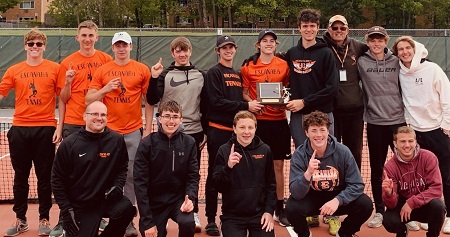
 The Eskymos, fresh from earning their first Great Northern Conference title since 2003, will try to change that at today’s U.P. Division 1 Finals at Negaunee.
“We have a very nice opportunity ahead of us,” said fifth-year coach Tom Penegor. “We just went through a tough GNC meet (May 27 at Marquette). We’re hoping that will give us an edge in the U.P. Finals. I think we have some momentum.”
Standing in the way is five-time reigning champ Negaunee.
“They’ll be tough, and Marquette has good singles players,” said Penegor. “The other schools also have some good players. There’s pressure out there, and everybody responds to that differently. The game is just as much mental as physical. The scoring system is different from the GNC. You need every single point.”
The Eskymos have an all-junior singles lineup with Gunner Dlugas holding a 14-5 record at No. 1. Filling out singles are Shawn Beauchamp (13-7) at No. 2, Nathan Howes (15-3) at No. 3 and Connor Smale (10-2) at No. 4.
“It felt great to win the GNC,” said Dlugas, who among latest improvements to his game has made the transition from a two-handed to a one-handed backhand shot. “We hadn’t won the GNC since I was born. Four of us have played for two years, and the rest of the guys are first-year players. We’re a fresh team, and that’s why this is so important for us. We have a lot of No. 1 seeds and we’re definitely improving, which gives us a pretty good feeling going into the Finals. I think we’re ready to go.”
Also part of today’s lineup are senior Ryan Moreau and junior Viktor Pospisil, an exchange student from Mladá Boleslov in the Czech Republic, who together are 10-2 at No. 1 doubles.
 “I wasn’t supposed to play tennis, but I started playing with the guys at first, then decided to join the team,” said Popisil. “I had been playing in my hometown in Europe and appreciate having the opportunity to play here. I didn’t think we’d be this good at the beginning of the season, but everything kind of progressed as the season went on. We’ve been coming together as a team.”
Moreau said he truly enjoys playing with his partner.
“Viktor’s a great player, and we’ve become great friends,” he added. “All the players from the other schools come up and talk to him.
“I’m real excited about the Finals. Negaunee has a great program. We’re coming in as kind of an underdog. We definitely have to play our game and take the title away from them. If we do that, we should take it.”
Junior Isaac Maki and sophomore Dawson Williams fill the No. 2 flight.
“This experience has been awesome,” said Williams. “I learned a lot about tennis and made a lot of new friends. This is actually my first high school sport. Our first match (this season) against Menominee was exciting. I didn’t know how it was going to go, but I thought we performed beyond expectations.
“Negaunee as a great team, and West Iron County is very good. I thank God for giving me the strength to play at a high level and Coach, my teammates and parents for all their encouragement and support. Winning the GNC gave us a boost going into the Finals.”
Joining them in the doubles lineup are seniors Tanner McDonald and Jordan Nance (13-1) at No. 3 and senior Brayden Roberts and junior Joe Hubert at No. 4.
Should the Eskymos prevail today, it would mark the first time they’d have won the GNC and U.P. Finals in the same year since 1999.
“We had four practices before the U.P. Finals,” said Penegor. “After the GNC meet, we asked the guys if they wanted to practice over the weekend and they decided they wanted to do that.
“Our team has worked hard, and our assistant coaches (Chris Ogren and Alan Adams) have been a tremendous asset to our team this year.”
Tennis is a self-supporting program at Escanaba, and Penegor said one of the reasons he took over after retiring from the city was out of love for the sport.
“We appreciate the support of our sponsors, and the parents have driven us to some of the meets,” said Penegor. “They’ve also been big supporters of our team.
“We started with four seniors. It’s nice to have a mixture of younger kids with our seniors. This is definitely the best mix we’ve had in my five years as coach. We stress to the kids the importance of having fun, making improvements and working on their game.”
 John Vrancic has covered high school sports in the Upper Peninsula since joining the Escanaba Daily Press staff in 1985. He is known most prominently across the peninsula for his extensive coverage of cross country and track & field that frequently appears in newspapers from the Wisconsin border to Lake Huron. He received the James Trethewey Award for Distinguished Service in 2015 from the Upper Peninsula Sportswriters and Sportscasters Association.
PHOTOS: (Top) Escanaba’s Ryan Moreau returns a volley this season against Ishpeming Westwood. (Middle) The Eskymos celebrate their Great Northern Conference championship. (Top photo courtesy of the Escanaba Daily Press; middle photo courtesy of the Escanaba athletic department.)