


Add, Subtract, Divide, Multiply: MHSAA Not Alone
July 25, 2017
By Rob Kaminski
MHSAA benchmarks editor
This is the third part in a series on MHSAA tournament classification, past and present, that will be published over the next two weeks. This series originally ran in this spring's edition of MHSAA benchmarks.
As the MHSAA faces its most recent classification task with 8-Player Football, and opinions continue to swirl about as to the method, timeframe, location and other procedures, a look around the country provides plenty of company among state association brethren factoring variables into their own equations.
In the Pacific Northwest, the Oregon School Activities Association Football Playoffs are under public scrutiny as leadership ponders a five or six classification format beginning with the 2018-19 school year.
The OSAA has crowned six champions on the gridiron since 2006-07. Many of the state’s smaller schools would like to keep it that way, while larger schools lean toward a five-classification system, citing larger leagues, ease of travel and credibility to state championships as the advantages.
Still others would prefer more than six classes, pointing to safety issues and the opportunity to increase participation numbers as positives.
Moving southeast of Oregon, the Nevada Interscholastic Activities Association recently voted to hold serve on a classification proposal that was volleyed to the membership.
However, changes still could be forthcoming by as early as the 2018-19 season which would add a fifth classification in more populated southern Nevada while allowing northern schools to participate in four classifications. Such divisions could mean no state championship for the fifth class in southern Nevada.
Because of that, the NIAA wants equal numbers of schools in each classification on both ends of the state. Complicating the issue is the fact that the 24 largest schools in the state, by enrollment, are all in Clark County in Southern Nevada.
Across Nevada’s border into Arizona, charter schools are asking the Arizona Interscholastic Association to reconsider classification that was voted upon and approved in September 2015. That agreement called for the largest 33 percent of charter schools by enrollment to be placed in the state’s largest school classification, 3A, the middle 33 percent into 2A, and the smallest 33 percent into 1A.
Less than two years later the charter schools have had a change of heart and have asked to be considered the same as other Arizona public schools and be placed appropriately by enrollment beginning with the 2018-19 school year.
The situation in Arizona further illustrates how the public/private debate that all state associations have faced throughout existence now has the added dynamic of rapidly growing charter schools in today’s educational system, along with virtual school enrollment.
In the nation’s heartland, Nebraska has retooled its football classifications by using enrollment of boys students only in its schools rather than total enrollment. The Nebraska School Activities Association football-playing schools will kick off the 2018 season using this alignment.
Nebraska has three classes of 11-player football, with the smallest class divided in two, Class C-1 and C-2. The state also will have 8-player football for boys enrollments under 47, and the NSAA will sponsor a new 6-player tournament in 2018 for schools with 27 or fewer boys.
“This is a good proposal because some schools have a sizable imbalance between the number of boys and girls, and there’s a large gap (in enrollment) between the largest and smallest schools in Classes A and B,” NSAA executive director Jim Tenopir said. “I think this addresses both of those concerns.”
Swimmers in Georgia, meanwhile, will feel like they are moving with the current, rather than upstream in 2017-18, as the Georgia High School Association recently doubled the number of team championship events from two to four.
Swim enthusiasts can also count on longer days at the finals, as the top 30 finishers from the prelims will advance to the finals instead of 20, and all championship events will have three heats versus two.

Ewen-Trout Creek Racers Fueled to Go Distance Again
By
John Vrancic
Special for MHSAA.com
May 25, 2021
BARAGA — Elise Besonen wasn’t always a huge fan of distance running.
 Then came 2020 and the COVID-19 pandemic, and the current Ewen-Trout Creek senior had a change of heart.
The University of Wisconsin-Superior basketball recruit now says she enjoys running.
Maybe there’s some truth to the saying “Absence makes the heart grow fonder.”
“I was pretty bummed when we didn’t get to run last year,” she said shortly after placing second in the 3,200-meter run at 13 minutes, 33.68 seconds in the Upper Peninsula Division 3 Regional meet last Wednesday at Baraga. “Then, I started running on some side roads with my dad, and it completely changed my mindset. It has been fun running for my dad. In my freshman year during driver’s ed, it was just us two. I guess it was sort of a blessing in disguise.”
Besonen was also runner-up in the 800 (2:40.21) and 1,600 (5:43.59) at the Regional, qualifying her for all three races at the Upper Peninsula Finals on June 5 at Kingsford.
“It was a pretty short meet,” said Besonen, who was also runner-up in the 800 at the previous Monday’s Copper Country Invitational in Houghton in a school-record 2:32.81. “The 800 and 3,200 were pretty close together, which made it pretty difficult because they were right on top of each other. At least my legs were warmed up.”
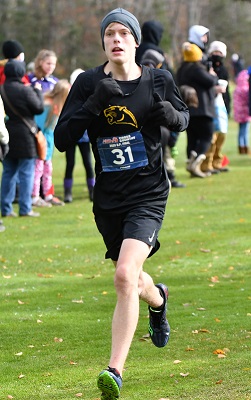 Junior Jonah Nordine hadn’t run in nearly a week following a mishap during homecoming activities at the school two weeks ago.
“I fell off a bike and scraped up my knee and arm,” he said. “We usually have homecoming for basketball, but that got postponed due to COVID and (we) held it during baseball and track this year.”
Nordine, the reigning U.P. Division 3 cross country champion, won the 800, 1,600 and 3,200 in the Marcy Bracket Invitational at Bessemer on May 13, then was runner-up in the 800 (2:16.48) and 1,600 (4:40.27) and third in the 3,200 (11:28.33) at Baraga.
“I had a side ache in the 3,200,” he said. “I probably didn’t eat enough (that day). I was pretty happy with my times. I just wanted to qualify. We had perfect conditions at Bessemer. I didn’t run in Houghton, but it was quite warm. It was in the 80s. I’m just glad to be running this year after losing my freshman season to COVID.”
“Jonah’s success generates a lot of excitement for this team," added Ewen-Trout Creek track and cross country coach Brad Besonen, who also is Elise’s father. “Jonah’s personality changed after his success in cross country last fall. He has become more outgoing.”
Elise is best-known as a high-scoring guard who made the Division 4 all-state basketball team again this winter and was named Upper Peninsula Division 4 Player of the Year in the sport.
She figures to continue playing point guard for Wisconsin-Superior, another chase she’ll take on when her track season is done.
“There will be a lot of adjustments to make,” she said. “Everybody wants to be there, and I’m looking forward to that.”
 John Vrancic has covered high school sports in the Upper Peninsula since joining the Escanaba Daily Press staff in 1985. He is known most prominently across the peninsula for his extensive coverage of cross country and track & field that frequently appears in newspapers from the Wisconsin border to Lake Huron. He received the James Trethewey Award for Distinguished Service in 2015 from the Upper Peninsula Sportswriters and Sportscasters Association.
PHOTOS: (Top) Ewen-Trout Creek’s Elise Besonen completes her anchor leg of the 3,200 relay during the UP Division 3 Finals in 2019. (Middle) Jonah Nordine crosses the finish line first at last fall’s UPD3 Boys Cross Country Final. (Photos by Cara Kamps.)