


Add, Subtract, Divide, Multiply: MHSAA Not Alone
July 25, 2017
By Rob Kaminski
MHSAA benchmarks editor
This is the third part in a series on MHSAA tournament classification, past and present, that will be published over the next two weeks. This series originally ran in this spring's edition of MHSAA benchmarks.
As the MHSAA faces its most recent classification task with 8-Player Football, and opinions continue to swirl about as to the method, timeframe, location and other procedures, a look around the country provides plenty of company among state association brethren factoring variables into their own equations.
In the Pacific Northwest, the Oregon School Activities Association Football Playoffs are under public scrutiny as leadership ponders a five or six classification format beginning with the 2018-19 school year.
The OSAA has crowned six champions on the gridiron since 2006-07. Many of the state’s smaller schools would like to keep it that way, while larger schools lean toward a five-classification system, citing larger leagues, ease of travel and credibility to state championships as the advantages.
Still others would prefer more than six classes, pointing to safety issues and the opportunity to increase participation numbers as positives.
Moving southeast of Oregon, the Nevada Interscholastic Activities Association recently voted to hold serve on a classification proposal that was volleyed to the membership.
However, changes still could be forthcoming by as early as the 2018-19 season which would add a fifth classification in more populated southern Nevada while allowing northern schools to participate in four classifications. Such divisions could mean no state championship for the fifth class in southern Nevada.
Because of that, the NIAA wants equal numbers of schools in each classification on both ends of the state. Complicating the issue is the fact that the 24 largest schools in the state, by enrollment, are all in Clark County in Southern Nevada.
Across Nevada’s border into Arizona, charter schools are asking the Arizona Interscholastic Association to reconsider classification that was voted upon and approved in September 2015. That agreement called for the largest 33 percent of charter schools by enrollment to be placed in the state’s largest school classification, 3A, the middle 33 percent into 2A, and the smallest 33 percent into 1A.
Less than two years later the charter schools have had a change of heart and have asked to be considered the same as other Arizona public schools and be placed appropriately by enrollment beginning with the 2018-19 school year.
The situation in Arizona further illustrates how the public/private debate that all state associations have faced throughout existence now has the added dynamic of rapidly growing charter schools in today’s educational system, along with virtual school enrollment.
In the nation’s heartland, Nebraska has retooled its football classifications by using enrollment of boys students only in its schools rather than total enrollment. The Nebraska School Activities Association football-playing schools will kick off the 2018 season using this alignment.
Nebraska has three classes of 11-player football, with the smallest class divided in two, Class C-1 and C-2. The state also will have 8-player football for boys enrollments under 47, and the NSAA will sponsor a new 6-player tournament in 2018 for schools with 27 or fewer boys.
“This is a good proposal because some schools have a sizable imbalance between the number of boys and girls, and there’s a large gap (in enrollment) between the largest and smallest schools in Classes A and B,” NSAA executive director Jim Tenopir said. “I think this addresses both of those concerns.”
Swimmers in Georgia, meanwhile, will feel like they are moving with the current, rather than upstream in 2017-18, as the Georgia High School Association recently doubled the number of team championship events from two to four.
Swim enthusiasts can also count on longer days at the finals, as the top 30 finishers from the prelims will advance to the finals instead of 20, and all championship events will have three heats versus two.
Kent City Finds Shooting Touch to Reach 1st Final
By
Perry A. Farrell
Special for MHSAA.com
April 7, 2021
EAST LANSING – Kent City has overcome every obstacle this season, and Friday the undefeated Eagles will play Grass Lake for the Division 3 girls basketball championship after defeating Calumet 59-53 in a Semifinal on Wednesday at the Breslin Center.
Grass Lake (19-1) advanced to Friday’s championship game when Hemlock opted out of the tournament Wednesday morning. Both Kent City and Grass Lake will be playing in a Final for the first time.
The Eagles (21-0) opened up an 11-point lead to start the fourth quarter Wednesday and held on despite the Copper Kings getting to within 54-50.
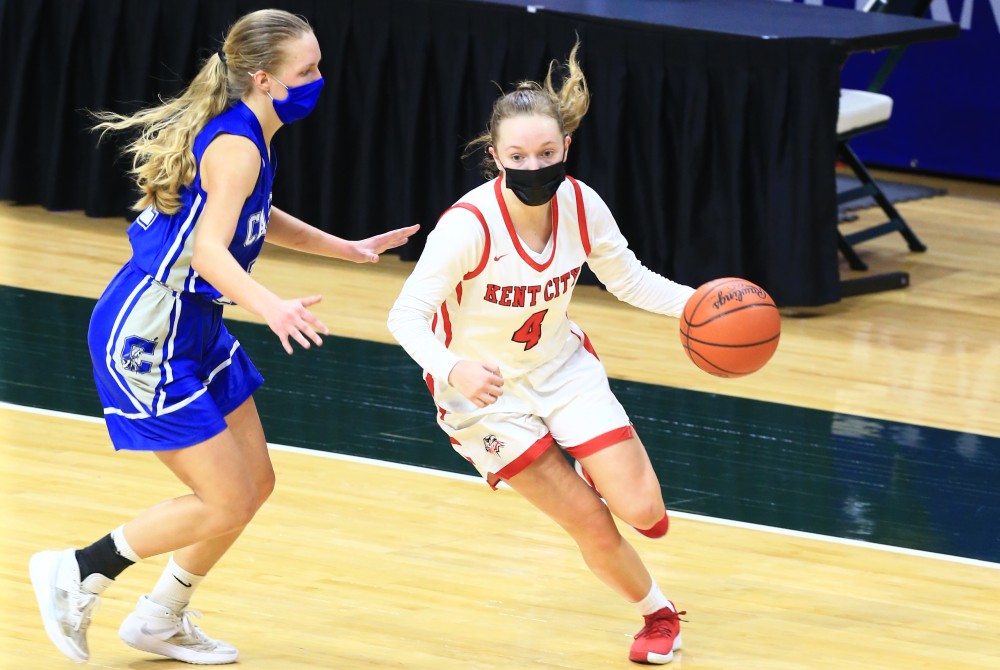
Kent City had a balanced offensive attack with Jenna Harrison scoring 15 points, Madelyn Geers 14, Kenzie Bowers 13, and sister Lexie Bowers 10.
“We just had to take a deep breath and relax,’’ said Harrison. “We knew eventually the shots would start falling.’’
Elli Djerf led the Copper Kings (20-1) with 22 points.
“She kept us in the game; she played her heart out,’’ said Calumet coach Matt Laho. “We needed to have a couple more players go with her, but unfortunately that didn’t happen.
“We had some defensive breakdowns in the third quarter, some bad rotations. It’s easy to make shots when you’re wide open.’’
Kent City pressured Calumet from the start as both teams struggled offensively in the first quarter. Both teams were under 25-percent shooting over those first eight minutes as the teams managed just 14 points for a 7-7 tie.
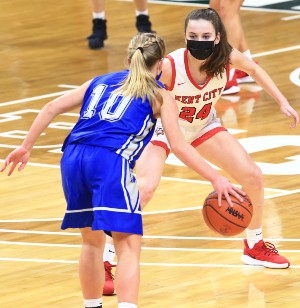 Geers, who scored four points in the first quarter, picked up her second foul with 9.8 seconds left in the period. Calumet then went on an 8-3 run to start the second quarter, using a triple from Djerf to take a 15-10 lead and force Kent City coach Scott Carlson to call a timeout.
Consecutive 3-pointers from Lexie Bowers got the Eagles back to within two of the lead, 17-15, as the offenses heated up.
A 10-0 run including consecutive threes from Bowers gave the Eagles a 24-19 advantage. But Djerf scored the last three points of the quarter to get the Copper Kings to within 24-22 at halftime.
“We knew eventually we’d make shots,’’ said Carlson.
Strom and Djerf scored the first six points of the third quarter to give Calumet a 28-24 lead, but Kent City’s offense, led by Geers, responded with a 20-9 run to take a 44-37 lead on a triple and floater by Kenzie Bowers.
Harrison finished the frantic quarter with a triple to give Kent City a 49-41 lead heading into the final eight minutes.
When Geers scored to start the fourth quarter, the Eagles had their largest lead of the game, 51-41.
Up 11, 52-41, Kent City went to its delay game, forcing the Copper Kings to foul.
“We have enough ball-handlers to run clock for five minutes.’’ said Carlson. “They were tired, and playing defense that long wears you out.’’
Lexie Bowers led Kent City with 10 points while Marybeth Halonen had seven for the Copper Kings.
“We’re living the dream right now on the big stage,” Carlson said. “I think it’s a huge advantage for us having played today (while Grass Lake didn’t).’’
PHOTOS: (Top) Kent City's Jenna Harrison (4) makes her way around a Calumet defender Wednesday at Breslin Center. (Middle) Madelyn Geers (24) defends as Calumet's Jana Loukus looks for an opening. (Click for more from Hockey Weekly Action Photos.)