


Add, Subtract, Divide, Multiply: MHSAA Not Alone
July 25, 2017
By Rob Kaminski
MHSAA benchmarks editor
This is the third part in a series on MHSAA tournament classification, past and present, that will be published over the next two weeks. This series originally ran in this spring's edition of MHSAA benchmarks.
As the MHSAA faces its most recent classification task with 8-Player Football, and opinions continue to swirl about as to the method, timeframe, location and other procedures, a look around the country provides plenty of company among state association brethren factoring variables into their own equations.
In the Pacific Northwest, the Oregon School Activities Association Football Playoffs are under public scrutiny as leadership ponders a five or six classification format beginning with the 2018-19 school year.
The OSAA has crowned six champions on the gridiron since 2006-07. Many of the state’s smaller schools would like to keep it that way, while larger schools lean toward a five-classification system, citing larger leagues, ease of travel and credibility to state championships as the advantages.
Still others would prefer more than six classes, pointing to safety issues and the opportunity to increase participation numbers as positives.
Moving southeast of Oregon, the Nevada Interscholastic Activities Association recently voted to hold serve on a classification proposal that was volleyed to the membership.
However, changes still could be forthcoming by as early as the 2018-19 season which would add a fifth classification in more populated southern Nevada while allowing northern schools to participate in four classifications. Such divisions could mean no state championship for the fifth class in southern Nevada.
Because of that, the NIAA wants equal numbers of schools in each classification on both ends of the state. Complicating the issue is the fact that the 24 largest schools in the state, by enrollment, are all in Clark County in Southern Nevada.
Across Nevada’s border into Arizona, charter schools are asking the Arizona Interscholastic Association to reconsider classification that was voted upon and approved in September 2015. That agreement called for the largest 33 percent of charter schools by enrollment to be placed in the state’s largest school classification, 3A, the middle 33 percent into 2A, and the smallest 33 percent into 1A.
Less than two years later the charter schools have had a change of heart and have asked to be considered the same as other Arizona public schools and be placed appropriately by enrollment beginning with the 2018-19 school year.
The situation in Arizona further illustrates how the public/private debate that all state associations have faced throughout existence now has the added dynamic of rapidly growing charter schools in today’s educational system, along with virtual school enrollment.
In the nation’s heartland, Nebraska has retooled its football classifications by using enrollment of boys students only in its schools rather than total enrollment. The Nebraska School Activities Association football-playing schools will kick off the 2018 season using this alignment.
Nebraska has three classes of 11-player football, with the smallest class divided in two, Class C-1 and C-2. The state also will have 8-player football for boys enrollments under 47, and the NSAA will sponsor a new 6-player tournament in 2018 for schools with 27 or fewer boys.
“This is a good proposal because some schools have a sizable imbalance between the number of boys and girls, and there’s a large gap (in enrollment) between the largest and smallest schools in Classes A and B,” NSAA executive director Jim Tenopir said. “I think this addresses both of those concerns.”
Swimmers in Georgia, meanwhile, will feel like they are moving with the current, rather than upstream in 2017-18, as the Georgia High School Association recently doubled the number of team championship events from two to four.
Swim enthusiasts can also count on longer days at the finals, as the top 30 finishers from the prelims will advance to the finals instead of 20, and all championship events will have three heats versus two.
Pioneer Climbs Podium for 16th Time, 1st Since 2009
By
Will Kennedy
Special for Second Half
March 27, 2021
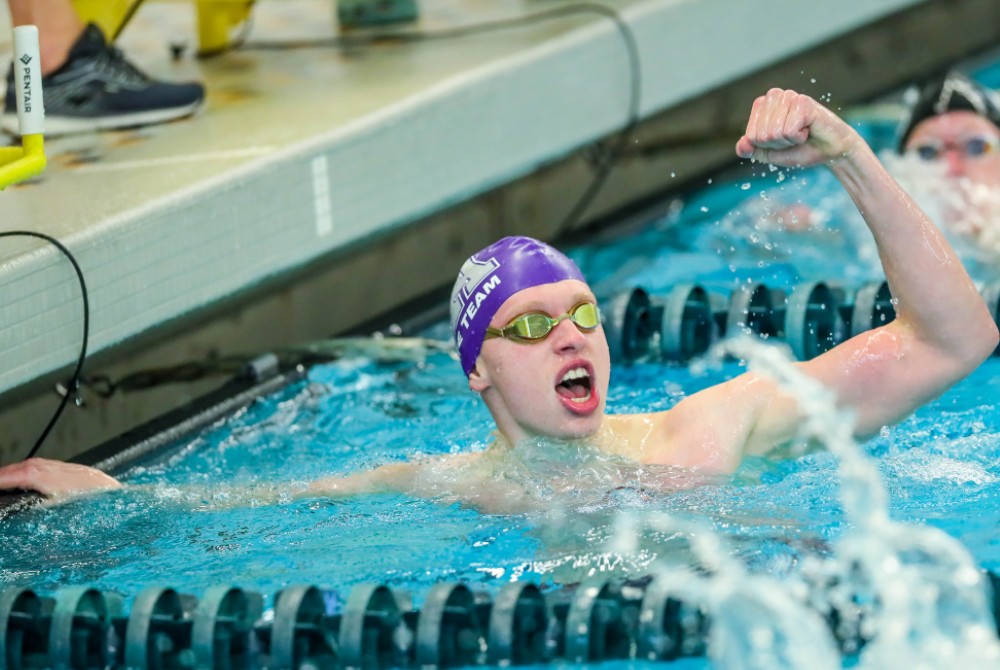
HUDSONVILLE — Ann Arbor Pioneer dominated Saturday’s Lower Peninsula Division 1 Finals and came away with its 16th championship, earning four individual titles in the process.
Coach Stefanie Kerska said she was thrilled with the way her team performed throughout the entire competition, earning 369 points. That total was nearly 100 points more than the Pioneers’ closest competitor.
“I am super pleased, I think we just wanted to be consistent from the start to the finish of the season,” Kerska said. “I thought they did such a great job doing that. Whether it was their preparation, execution, or just the way they’ve handled themselves, they’ve really been a dream.”
But the day got off to a fast start for Saline, which finished second in the team standings. The Hornets took home the top spot in the 200-yard relay with a time of 1:30.35, more than a second faster than any other team and breaking a Hudsonville pool record. But Pioneer wasn’t far behind, finishing in second place, with a time of 1:31.74.
Another pool record fell in the second event of the day, the 200 freestyle. Pioneer senior Matthew Segal earned it with his time of 1:38.24 and added 20 points for his team. Northville senior Conner Halberg touched the wall less than a second after Segal, clocking in at 1:38.87. Rounding out the podium was Saline junior Matt Adanin at 1:41.41; he would later finish runner-up in backstroke as well.
The Pioneers topped the podium again in the individual medley, with junior Ryan Hume touching the wall first in 1:50.37.
“I’ve been training for the whole year for this 200 IM,” Hume said. “I just had one mission, which was to win. I’m hoping to win again next year and hopefully break a varsity record.’
During the sprint of the afternoon, the 50 free, West Ottawa claimed two of the top three spots on the way to finishing team runner-up. Junior Kevin Maas finished first with a blistering swim of 20.60 seconds to break the pool record. Senior teammate Josh Rottier finished in third (21.33), as Lake Orion senior Dane Herrick finished in the middle with a time of 21.13.
Even though his team finished just off the top of the podium, West Ottawa coach Steve Bowyer said he was beyond pleased with the way the Panthers ended the season.
“We knew coming in this year that Ann Arbor Pioneer was going to be really tough to beat,” Bowyer said. “We came in hoping for a runner-up finish and our guys got the job done today … we had some really nice performances today.”
Just like most other events on the day, Pioneer dominated the one-meter dive, as senior Cole Tremewan won by nearly 40 points, scoring 449.05.
“I’m so happy for our diving program and for Cole winning; it was such a big moment for him,” Kerska said. “I know he felt a lot of pressure and handled it so beautifully.”
The 100 butterfly proved to be a race where Saline could claw back some points, finishing two swimmers among the top 16 to Pioneer’s one. Huron Valley junior Fletcher Smith topped the podium with a time of 50.40.
In the 100 free, Pioneer placed three swimmers among the top 16, while Saline had two. But the Hornets got more points earning the individual title thanks to senior Ethan Saunders’ blazing 44.64.
The Pioneers padded their lead in the 500, placing two swimmers among the top three, Hume finished in second (4:31.93) and junior Cameron Williston finished in third (4:40.80). Northville’s Halberg finished just ahead of Hume with a time of 4:31.31.
A new LP Division I Finals record was set in the 200-freestyle relay by West Ottawa’s team of Rottier, Tai Afrik, Alex Boersema and Maas, who finished in 1:23.25. Maas closed hard, finishing the final leg in just 19.94. Saline came in just milliseconds after the Panthers (1:23.68). The Pioneers weren’t far behind, clocking in third with a time of 1:25.32
“It was really close, Saline’s freestyle was superfast, so I knew I had to bring it home for the team,” Maas said.” That was our goal, to get that state record, for the entire season. We talked about it like every day.”
Pioneer put two more finishers among the top 16 in the 100 backstroke, which was won by Rochester junior Jack VanHowe in 49.35. Pioneer then dominated in the 100 breaststroke, with Segal posting an all-division/class Finals record of 53.26.
Segal said he was thrilled with the accolade, but the team title means so much more.
“This team is amazing,” Segal said. “I’m really happy about all my other events, achieving state titles in individual events is really fun, but winning it as a team is a surging sense of pride. To accomplish something we know we’ve been working for, we’ve had it in our minds the whole season.”
Pioneer continued to rack up the big points, finishing the 400 free relay in second place with a time of 3:03.84. Saline took the top spot again with a time of 3:03.84.
The title marks the Pioneers’ first since 2009. Though they don’t plan on waiting 12 years before winning it again, finally breaking the drought meant a lot to this team.
“It means a lot. ... I was on those Pioneer former state championship teams, so I know what it means to the school and the community,” Kerska said. “I’m just so glad that we’re bringing back the tradition of Pioneer swimming and diving.”
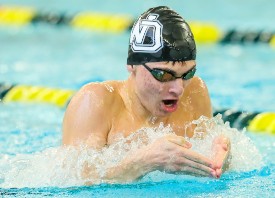
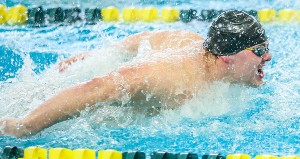
PHOTOS: (Top) An Ann Arbor Pioneer swimmer celebrates during Saturday’s Lower Peninsula Division 1 Finals at Hudsonville High School. (Middle) A Holland West Ottawa competitor swims the breaststroke. (Below) Another racer swims the butterfly. (Click for more from HighSchoolSportsScene.com.)