


Add, Subtract, Divide, Multiply: MHSAA Not Alone
July 25, 2017
By Rob Kaminski
MHSAA benchmarks editor
This is the third part in a series on MHSAA tournament classification, past and present, that will be published over the next two weeks. This series originally ran in this spring's edition of MHSAA benchmarks.
As the MHSAA faces its most recent classification task with 8-Player Football, and opinions continue to swirl about as to the method, timeframe, location and other procedures, a look around the country provides plenty of company among state association brethren factoring variables into their own equations.
In the Pacific Northwest, the Oregon School Activities Association Football Playoffs are under public scrutiny as leadership ponders a five or six classification format beginning with the 2018-19 school year.
The OSAA has crowned six champions on the gridiron since 2006-07. Many of the state’s smaller schools would like to keep it that way, while larger schools lean toward a five-classification system, citing larger leagues, ease of travel and credibility to state championships as the advantages.
Still others would prefer more than six classes, pointing to safety issues and the opportunity to increase participation numbers as positives.
Moving southeast of Oregon, the Nevada Interscholastic Activities Association recently voted to hold serve on a classification proposal that was volleyed to the membership.
However, changes still could be forthcoming by as early as the 2018-19 season which would add a fifth classification in more populated southern Nevada while allowing northern schools to participate in four classifications. Such divisions could mean no state championship for the fifth class in southern Nevada.
Because of that, the NIAA wants equal numbers of schools in each classification on both ends of the state. Complicating the issue is the fact that the 24 largest schools in the state, by enrollment, are all in Clark County in Southern Nevada.
Across Nevada’s border into Arizona, charter schools are asking the Arizona Interscholastic Association to reconsider classification that was voted upon and approved in September 2015. That agreement called for the largest 33 percent of charter schools by enrollment to be placed in the state’s largest school classification, 3A, the middle 33 percent into 2A, and the smallest 33 percent into 1A.
Less than two years later the charter schools have had a change of heart and have asked to be considered the same as other Arizona public schools and be placed appropriately by enrollment beginning with the 2018-19 school year.
The situation in Arizona further illustrates how the public/private debate that all state associations have faced throughout existence now has the added dynamic of rapidly growing charter schools in today’s educational system, along with virtual school enrollment.
In the nation’s heartland, Nebraska has retooled its football classifications by using enrollment of boys students only in its schools rather than total enrollment. The Nebraska School Activities Association football-playing schools will kick off the 2018 season using this alignment.
Nebraska has three classes of 11-player football, with the smallest class divided in two, Class C-1 and C-2. The state also will have 8-player football for boys enrollments under 47, and the NSAA will sponsor a new 6-player tournament in 2018 for schools with 27 or fewer boys.
“This is a good proposal because some schools have a sizable imbalance between the number of boys and girls, and there’s a large gap (in enrollment) between the largest and smallest schools in Classes A and B,” NSAA executive director Jim Tenopir said. “I think this addresses both of those concerns.”
Swimmers in Georgia, meanwhile, will feel like they are moving with the current, rather than upstream in 2017-18, as the Georgia High School Association recently doubled the number of team championship events from two to four.
Swim enthusiasts can also count on longer days at the finals, as the top 30 finishers from the prelims will advance to the finals instead of 20, and all championship events will have three heats versus two.
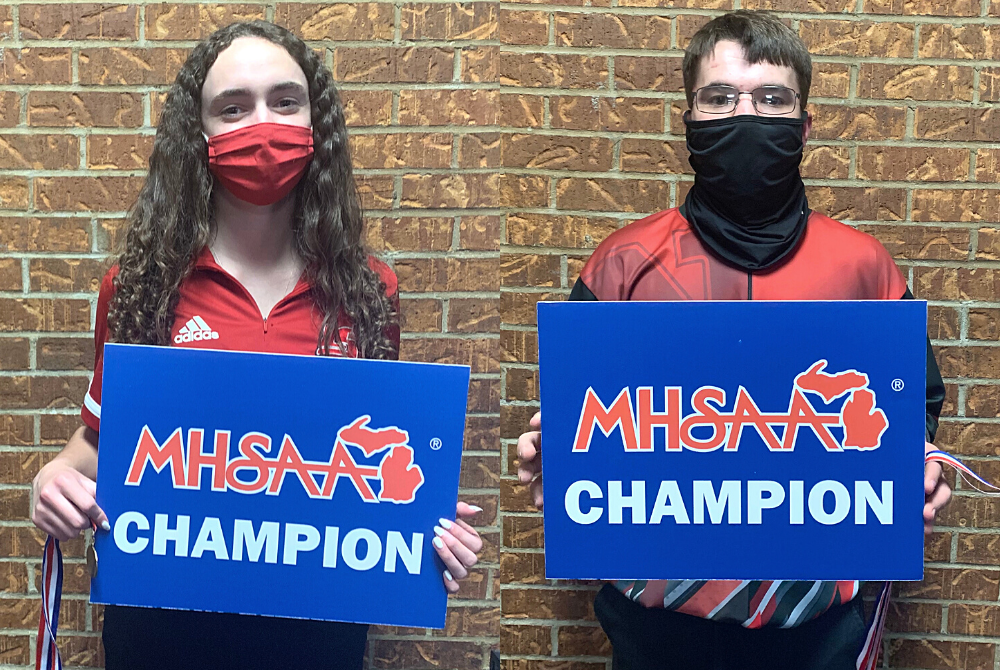
DeCruydt, Pranger Make Championship Strides
By
Jason Schmitt
Special for MHSAA.com
March 27, 2021
WATERFORD - Grand Rapids Northview’s Kyle Pranger was sent to Century Lanes in Waterford this weekend on a mission.
“This one was for Dan,” the sophomore said, shortly after capturing the championship at the Division 2 Bowling Singles Finals.
The Dan he spoke of was former teammate Dan Frey, who graduated last year after making it all the way to the championship match before falling to Warren Woods Tower’s Noah Tafanelli.
“He sent Kyle here and said, ‘You better not lose again,’” Northview head coach Harold Klukowski said, laughing.
Both Frey and Pranger reached the final four a year ago. Frey moved on, while Pranger lost in the semifinals. On Saturday, Pranger battled the elements, overcoming an up-and-down performance in qualifying block play before maneuvering his way through four rounds of match play, capping things off with a 416-388 victory over junior Damein Milliman of Jackson Northwest.
Pranger put together six straight strikes in the second game, clinching his victory on his second ball in the 10th frame. He needed to pick up one last spare.
“I knew that if I didn’t do something, he was going to take advantage,” Pranger said. “I needed to put some pressure on him. Having lost in the semifinals last year, I just wanted to come back and bowl better and win.”
Having played in countless tournaments outside of high school bowling, Pranger has come up clutch many times before. He just needed to execute.
“He’s been in these kinds of situations before,” Klukowski said. “Covering that 10 pin was clutch, but he’s experienced that before. The hard part was the mental grind during qualifying. The second 160 took him out of the cut after Game 4. He had to bounce back and grind because the pair (of lanes) that we ended up getting was touched by urethane, so he had to find a way to make it work, to stay alive and make the cut.”
Pranger was the ninth seed entering match play. He defeated eighth-seeded Zeke Dykstra, his teammate, in his first match, then went on to beat (No. 1) Owen Williams of Tecumseh and (No. 4) Brayden Metcalf of Jackson Northwest to reach the final.
Milliman was 11th in qualifying and beat teammate (No. 6) Shon Breslin, (No. 14) Chris Clark of Bay City John Glenn and (No. 7) Howard Hammond of Flint Kearsley on his way to the championship match.
Williams, just a freshman, bowled 1,470 in qualifying block play. He rolled three of the five highest games of the day, 289, 279 and 264. Dearborn Divine Child’s Noell Jackson was the No. 2 seed after qualifying with a 1,319.
St. Clair Shores Lake Shore’s Dani DeCruydt rallied from 54 pins down to capture her school’s first-ever bowling championship. The senior trailed Kearsley’s Allison Robbins entering Game 2, only to quickly erase the deficit by striking in each of her first four frames.
“I’ve been through it before,” DeCruydt said. “I just think, ‘One shot at a time.’ I could tell in the second game she was getting a little nervous, so I tried to step on it and get the lead back. At that point, I knew I had the lead back and that I just needed to get my spares and keep it going.”
DeCruydt bowled a 243 in Game 2, finishing with a 426-402 victory over Robbins, who entered match play as the No. 1 seed.
Robbins led 237-183 after the first game and looked poised to win another Finals championship; her team captured the team title Friday. But DeCruydt had other plans. She bowled a clean second game to complete the comeback.
“To be honest with you, I’m not nervous when Dani bowls,” Lake Shore head coach Greg Villasurda said. “The things that she does, they’ve become normal now. When she was down that big total, I just told her, ‘Dani, you’re going to find your shot, you’re going to get there and bang them out.’ And she did it. And (Robbins) had a couple bad breaks and that’s just bowling. It happens. It happened to Dani last year.
“Dani stayed with it. She never gets nervous. It’s crazy. I’ve never seen anything like it.”
DeCruydt finished runner-up as a sophomore in Division 1, then struggled as the 1-seed a year ago, falling in the first round — again in Division 1. She took from those experiences and put it all together Saturday afternoon.
“I learned to stay calm, play one shot at a time,” she said. “I was rushing last year. This year I slowed everything down. It feels pretty good.”
DeCruydt was the third seed after qualifying play. She defeated Kearsley seniors Allison Eible and Emilea Sturk in the first two rounds of match play before knocking out Mason senior Leigha Rue in the semifinal. Rue was the No. 2 seed.
Robbins earned the No. 1 seed after bowling a five-game qualifying block score of 1,287. Wayland sophomore Kadence Bottrall was the No. 2 seed.