


Add, Subtract, Divide, Multiply: MHSAA Not Alone
July 25, 2017
By Rob Kaminski
MHSAA benchmarks editor
This is the third part in a series on MHSAA tournament classification, past and present, that will be published over the next two weeks. This series originally ran in this spring's edition of MHSAA benchmarks.
As the MHSAA faces its most recent classification task with 8-Player Football, and opinions continue to swirl about as to the method, timeframe, location and other procedures, a look around the country provides plenty of company among state association brethren factoring variables into their own equations.
In the Pacific Northwest, the Oregon School Activities Association Football Playoffs are under public scrutiny as leadership ponders a five or six classification format beginning with the 2018-19 school year.
The OSAA has crowned six champions on the gridiron since 2006-07. Many of the state’s smaller schools would like to keep it that way, while larger schools lean toward a five-classification system, citing larger leagues, ease of travel and credibility to state championships as the advantages.
Still others would prefer more than six classes, pointing to safety issues and the opportunity to increase participation numbers as positives.
Moving southeast of Oregon, the Nevada Interscholastic Activities Association recently voted to hold serve on a classification proposal that was volleyed to the membership.
However, changes still could be forthcoming by as early as the 2018-19 season which would add a fifth classification in more populated southern Nevada while allowing northern schools to participate in four classifications. Such divisions could mean no state championship for the fifth class in southern Nevada.
Because of that, the NIAA wants equal numbers of schools in each classification on both ends of the state. Complicating the issue is the fact that the 24 largest schools in the state, by enrollment, are all in Clark County in Southern Nevada.
Across Nevada’s border into Arizona, charter schools are asking the Arizona Interscholastic Association to reconsider classification that was voted upon and approved in September 2015. That agreement called for the largest 33 percent of charter schools by enrollment to be placed in the state’s largest school classification, 3A, the middle 33 percent into 2A, and the smallest 33 percent into 1A.
Less than two years later the charter schools have had a change of heart and have asked to be considered the same as other Arizona public schools and be placed appropriately by enrollment beginning with the 2018-19 school year.
The situation in Arizona further illustrates how the public/private debate that all state associations have faced throughout existence now has the added dynamic of rapidly growing charter schools in today’s educational system, along with virtual school enrollment.
In the nation’s heartland, Nebraska has retooled its football classifications by using enrollment of boys students only in its schools rather than total enrollment. The Nebraska School Activities Association football-playing schools will kick off the 2018 season using this alignment.
Nebraska has three classes of 11-player football, with the smallest class divided in two, Class C-1 and C-2. The state also will have 8-player football for boys enrollments under 47, and the NSAA will sponsor a new 6-player tournament in 2018 for schools with 27 or fewer boys.
“This is a good proposal because some schools have a sizable imbalance between the number of boys and girls, and there’s a large gap (in enrollment) between the largest and smallest schools in Classes A and B,” NSAA executive director Jim Tenopir said. “I think this addresses both of those concerns.”
Swimmers in Georgia, meanwhile, will feel like they are moving with the current, rather than upstream in 2017-18, as the Georgia High School Association recently doubled the number of team championship events from two to four.
Swim enthusiasts can also count on longer days at the finals, as the top 30 finishers from the prelims will advance to the finals instead of 20, and all championship events will have three heats versus two.
Richmond Holds Off New Challenger to Complete 3-Peat
By
Tom Kendra
Special for MHSAA.com
March 26, 2021
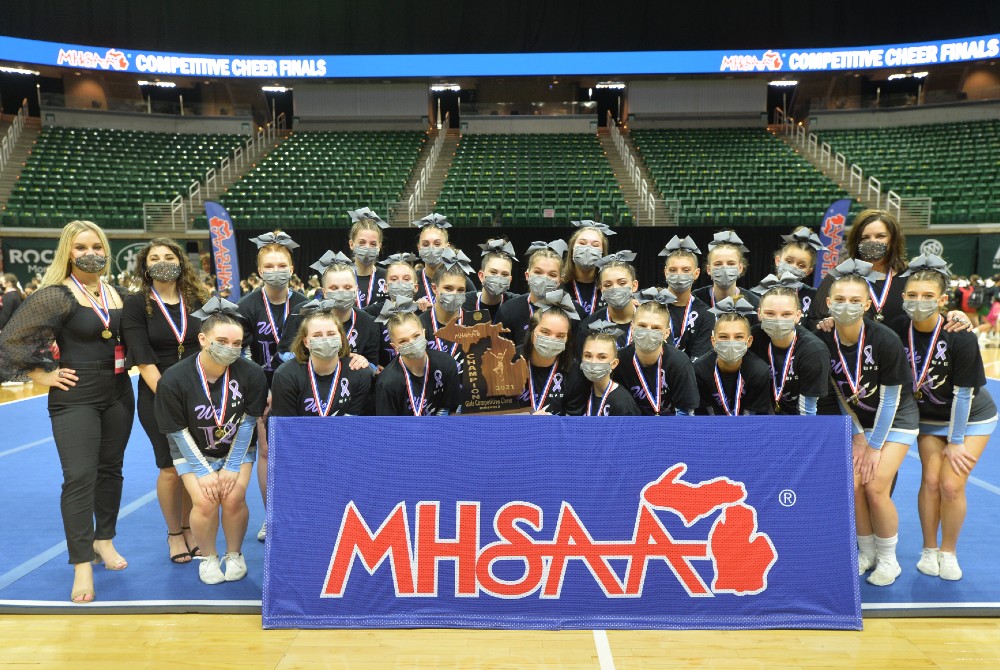
EAST LANSING – Richmond getting pushed at the Competitive Cheer Finals is nothing new.
The difference Friday was there was a new team applying the pressure at the Division 3 Final at Michigan State University’s Breslin Center.
Richmond led upset-minded Paw Paw by a miniscule three tenths of a point heading into the pivotal Round 3, but called on its experience and tradition to deliver a clutch performance and capture its third straight championship.
“There was not one ounce of doubt from anyone that we were going to do it,” said Richmond junior Gracie Ellis, one of two returning all-staters for the Blue Devils, along with fellow junior Makenna Parker.
Richmond took first at 771.62, followed by Paw Paw (770.72) and Pontiac Notre Dame Prep (767.42), which had finished either first or second for seven consecutive years.
While none of the Blue Devils had any doubt, it’s safe to say many outsiders may have wondered whether they were capable of a “three-peat.”
For one thing, Richmond lost 10 seniors off last year’s championship team and 13th-year coach Kelli Matthes fielded one of her youngest teams – and one of the youngest teams at the Finals in any division. Jenna Jaissle is the only senior on Richmond’s 23-athlete roster.
Then the Blue Devils placed a surprising fourth at Tuesday’s Regional competition.
“That kind of re-lit our fire and made us determined to go out with a bang,” said Jaissle.
Matthes said her team had another source of motivation which might have provided the extra .9 of a point it needed.
“On March 3, we lost our football coach after a five-year battle with cancer,” said Matthes, referring to 10-year Richmond head coach John Kocher. “We dealt with the COVID issue all season like everyone else, but maybe we had a little something extra.”
Richmond, which finished second to Notre Dame Prep for four consecutive years before breaking through with titles the past two seasons, looked dominant in Friday’s opening round – posting a 233.30 score, which was a full 2.4 points better than second-place Notre Dame and 2.9 points better than third-place Paw Paw.

But Paw Paw, which had never finished higher than third at a Finals, moved up to within a whisker of Richmond with a near-perfect Round 2 routine.
The Red Wolves then delivered an outstanding final round to put the pressure on Richmond, meaning one mistake or bobble by the two-time reigning champ could give Paw Paw its first-ever Finals title.
Going last in the eight-team field, the young Blue Devils showed the focus and grit of seasoned veterans to pull out the win. Richmond’s final-round score of 314.80 allowed it to hold off the challenge from Paw Paw (314.20 in the final round).
In addition to returning all-staters Ellis and Parker, Richmond’s strong, eight-person junior class also includes returning second-team all-stater Ava Moskwa. The Blue Devils also have eight sophomores and six freshmen.
After the competition, it looked like there were co-champions as Paw Paw coach Stefanie Miller, in her 12th year, proudly clutched the runner-up trophy.
“These ladies have worked tirelessly to get to this point,” said an emotional Miller, who coached both of her daughters this year – Mackenzie, a senior, and Paige, a junior.
“It’s incredible to share an experience like this with my daughters. To do something that the three of us all love so much and to make school history at the same time, that’s pretty special.”
Click for full team standings.
PHOTOS: (Top) Richmond celebrates Friday's Division 3 championship won at the Breslin Center. (Middle) Paw Paw finished runner-up, its highest finish in program history. (Click for more from Hockey Weekly Action Photos.)