


Add, Subtract, Divide, Multiply: MHSAA Not Alone
July 25, 2017
By Rob Kaminski
MHSAA benchmarks editor
This is the third part in a series on MHSAA tournament classification, past and present, that will be published over the next two weeks. This series originally ran in this spring's edition of MHSAA benchmarks.
As the MHSAA faces its most recent classification task with 8-Player Football, and opinions continue to swirl about as to the method, timeframe, location and other procedures, a look around the country provides plenty of company among state association brethren factoring variables into their own equations.
In the Pacific Northwest, the Oregon School Activities Association Football Playoffs are under public scrutiny as leadership ponders a five or six classification format beginning with the 2018-19 school year.
The OSAA has crowned six champions on the gridiron since 2006-07. Many of the state’s smaller schools would like to keep it that way, while larger schools lean toward a five-classification system, citing larger leagues, ease of travel and credibility to state championships as the advantages.
Still others would prefer more than six classes, pointing to safety issues and the opportunity to increase participation numbers as positives.
Moving southeast of Oregon, the Nevada Interscholastic Activities Association recently voted to hold serve on a classification proposal that was volleyed to the membership.
However, changes still could be forthcoming by as early as the 2018-19 season which would add a fifth classification in more populated southern Nevada while allowing northern schools to participate in four classifications. Such divisions could mean no state championship for the fifth class in southern Nevada.
Because of that, the NIAA wants equal numbers of schools in each classification on both ends of the state. Complicating the issue is the fact that the 24 largest schools in the state, by enrollment, are all in Clark County in Southern Nevada.
Across Nevada’s border into Arizona, charter schools are asking the Arizona Interscholastic Association to reconsider classification that was voted upon and approved in September 2015. That agreement called for the largest 33 percent of charter schools by enrollment to be placed in the state’s largest school classification, 3A, the middle 33 percent into 2A, and the smallest 33 percent into 1A.
Less than two years later the charter schools have had a change of heart and have asked to be considered the same as other Arizona public schools and be placed appropriately by enrollment beginning with the 2018-19 school year.
The situation in Arizona further illustrates how the public/private debate that all state associations have faced throughout existence now has the added dynamic of rapidly growing charter schools in today’s educational system, along with virtual school enrollment.
In the nation’s heartland, Nebraska has retooled its football classifications by using enrollment of boys students only in its schools rather than total enrollment. The Nebraska School Activities Association football-playing schools will kick off the 2018 season using this alignment.
Nebraska has three classes of 11-player football, with the smallest class divided in two, Class C-1 and C-2. The state also will have 8-player football for boys enrollments under 47, and the NSAA will sponsor a new 6-player tournament in 2018 for schools with 27 or fewer boys.
“This is a good proposal because some schools have a sizable imbalance between the number of boys and girls, and there’s a large gap (in enrollment) between the largest and smallest schools in Classes A and B,” NSAA executive director Jim Tenopir said. “I think this addresses both of those concerns.”
Swimmers in Georgia, meanwhile, will feel like they are moving with the current, rather than upstream in 2017-18, as the Georgia High School Association recently doubled the number of team championship events from two to four.
Swim enthusiasts can also count on longer days at the finals, as the top 30 finishers from the prelims will advance to the finals instead of 20, and all championship events will have three heats versus two.
Legacy Families Bolstering North's Officiating Ranks
By
Tom Spencer
Special for MHSAA.com
March 12, 2021
When Marc Crossman was attending middle and high school at Benzie Central, he didn’t attempt a shot. He never blocked a shot either.
 For that matter, the 2019 grad was never charged with a foul or a violation, nor credited with an assist.
Today, he uses the fitness he’s kept up from his track and cross country days at Benzie to call fouls and violations. And, nearly every day, he assists high school boys and girls on basketball courts all over Northern Michigan.
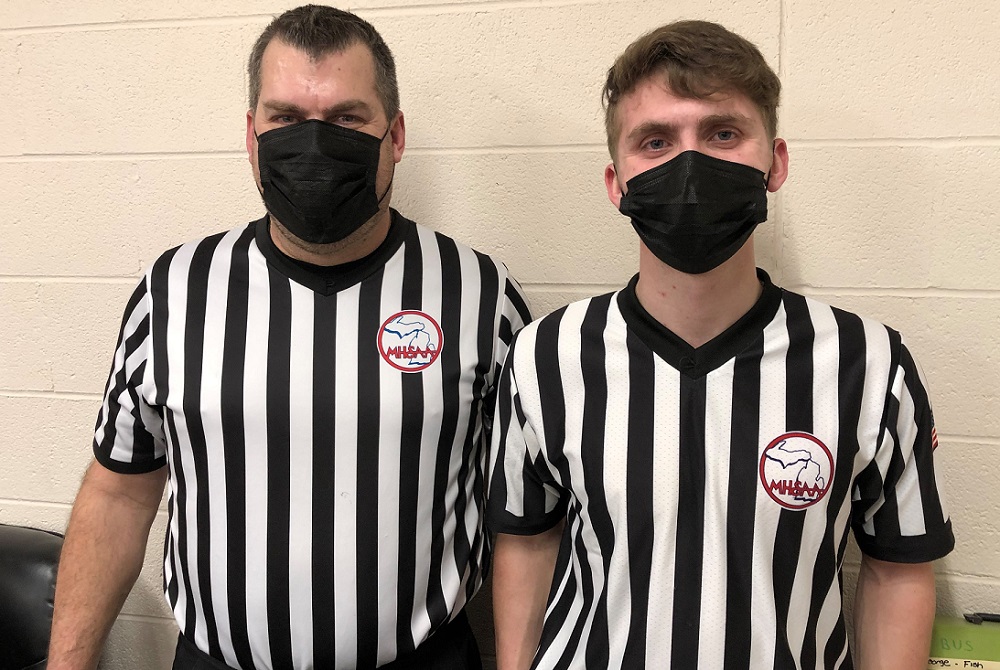
Crossman is one of very few young MHSAA basketball officials in the north. He is also among a handful of father-son basketball and other sports officials calling Northern Michigan home.
“I tell you what man, I was probably the most dedicated fan in high school,” he said. “I went to all the home games. All the away games, boys, girls.
“When I was in high school, I was obsessed with the game of basketball.”
Crossman did play elementary basketball. He tried out for the Huskies middle school team but wasn’t chosen.
“That was the end of my basketball career,” proclaimed Crossman, who also officiates football. “And then it started up again when I was a junior when my dad (Don) roped me into the whole legacy thing with officiating.
The MHSAA’s Legacy Student Officials Program is open to any high school student at least 14 years of age. Freshman and sophomore student officials may officiate at the junior high/middle school level only, and junior and senior student officials may officiate at any subvarsity level.
 The Legacy Program pairs a student with a mentor official, which can be set up through direct contact with an official the student knows, or with help from the student’s athletic director in making contact with a local approved officials association. Lucky for Crossman, he did know someone, his father Don, an assignor for the Northern Michigan Sports Officials Association.
Don is a nine-year veteran official registered in baseball, softball, volleyball and football. He’s aware of the severe shortage of officials in general, but keenly aware most officials are closer to retiring than starting on the hard court. He’s enjoyed working with his son and assigning him with others.
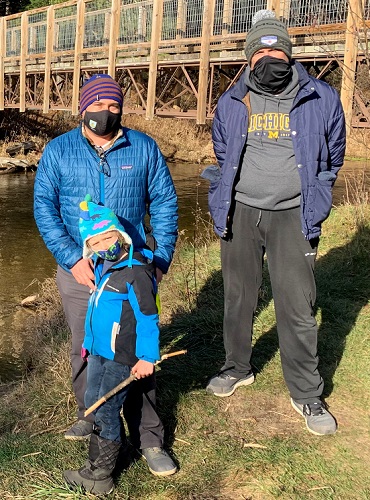
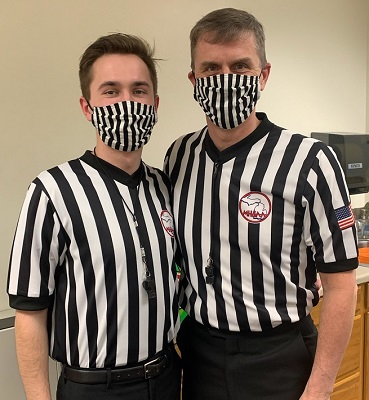
He also has the good fortune of having other father-son combinations to assign. Among them are Tom and Ben Post and John and Jayden O’Hagan. Ben Post and Jayden O’Hagan also started in the Legacy Program, with Ben among the first to take part.
Tom Post has been a registered official for 48 years and honored with MHSAA Finals assignments. John O’Hagan has 36 years of basketball experience and registered for baseball and softball spanning two decades.
All of those fathers and sons indicate they enjoy working together and with other partners, but note officiating comes with some challenges.
Most come from fans and coaches rarely seeing a young referee in the crew.
“There have been a few games where the coaches just seem to get in his (Jayden’s) ear more than the experienced official,” said his father. “My fear is that Jayden — and all other referees — might one day say ‘I had enough of getting screamed at all the time and want to quit.’
“We talk to coaches, we explain their youth and that we are teaching and trying to recruit more young officials,” John O’Hagan continued. “Recruiting is difficult enough encouraging people to get registered; however, when the coaches and fans simply forget it is just a game, that we are human and we will make mistakes, their behavior can deter folks from becoming a referee.”
With ongoing support and teaching from his father and regular partner Dave Nemecek, Jayden is excited to hit the court after his days as a college student.
“My dad has taught me everything I know when it comes to the game and rules side of it,” noted the 19-year-old O’Hagan. “He’s always watching me and having me do certain things to make sure that I’m doing the best I can.
“So when there’s nights I’m just not having it or am not doing good, he makes sure to let me know,” he continued. “He always keeps me on top of my game.”
The assignor Crossman enjoys helping his son navigate the referee waters.
“It is awesome, very cool,” he said. “It is fun to see him grow. It is a challenge for me to help him grow.”
 Ben Post is among a significant number of Northern Michigan referees not officiating during the current pandemic. He had been on the hard court every year since graduating from college and starting to teach at age 24 in 2004.
“I absorbed his (my father’s) officiating philosophy pretty much through osmosis, and as a result we call a pretty similar game, although I have no hope of matching his competence or consistency,” Ben Post pointed out. “My dad is most in his element while working a game, and I’ve cherished every opportunity to watch and study him in that element, first as a fan and then while working alongside him.”
The pandemic has younger northern referees like Gabriel Wise, Gabe Janowiak, Brandon Nichols, Marc Crossman and Jayden O’Hagan perhaps finding themselves in tougher assignments than they anticipated this early in their careers.
“Now you’re in it,” Don Crossman said of the opportunities taken on by the younger refs. “You’ve proved yourself on a fast track.
“You’re just one of the guys now,” he continued. “It is real exciting.”
Younger referees are becoming a welcome site nowadays for coaches and athletic directors.
“When a crew comes to the gym and there are officials of varying ages, the diversity provides credibility to the crew as a whole,” said Steve Graetz, Benzie’s athletic director.
Graetz is filled with pride when he sees the youthful Crossman on the court, especially knowing he started doing many middle school games at Benzie in the Legacy Program.
“It was a safe environment in which Marc could learn the craft,” Graetz said. “To see him now regularly officiating high school games at varying levels on a regular basis speaks as much to the hard work he has put into learning and improving as it does to the accommodating format and structure of the Legacy Program.”
 Tom Spencer is a longtime MHSAA-registered basketball and soccer official, and former softball and baseball official, and he also has coached in the northern Lower Peninsula area. He previously has written for the Saginaw News, Bay County Sports Page and Midland Daily News. He can be reached at [email protected] with story ideas for Manistee, Wexford, Missaukee, Roscommon, Ogemaw, Iosco, Alcona, Oscoda, Crawford, Kalkaska, Grand Traverse, Benzie, Leelanau, Antrim, Otsego, Montmorency, Alpena, Presque Isle, Cheboygan, Charlevoix and Emmet counties.
PHOTOS: (Top) MHSAA officials Don Crossman, left, and his son Marc. (Middle) Ben Post, top left, with father Tom Post and son James. (Below) Jayden O’Hagan, left, and his father Jon O’Hagan. (Courtesy photos.)